
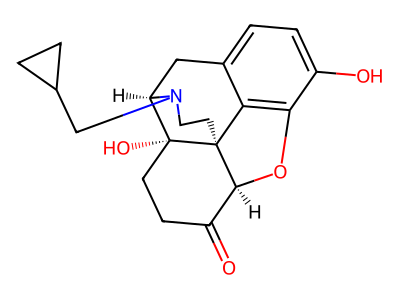
naltrexone
Also known as: 17-(cyclopropylmethyl)-4,5-epoxy-3,14-dihydroxymorphinan-6-one, (5α)-17-(Cyclopropylmethyl)-4,5-epoxy-3,14-dihydroxymorphinan-6-one, (4R,4aS,7aR,12bS)-3-(cyclopropylmethyl)-4a,9-dihydroxy-2,3,4,4a,5,6-hexahydro-1H-4,12-methanobenzofuro[3,2-e]isoquinolin-7(7aH)-one, ReVia, Vivitrol, Depade, Nalorex, Trexonil, NeMexin, Depotrex, Celupan, Naltrel, Antaxone, Tre xan, Um-792, En 1639A
naltrexone (CAS 16590-41-3) is a compound in the Ketones category listed in the Jingsj chemical database. It has the molecular formula C20H23NO4 and a molecular weight of 341.40 g/mol. Key properties include a melting point of 168-170ºC, a boiling point of 558.1±50.0 °C at 760 mmHg, a density of 1.5±0.1 g/cm3 and a flash point of 291.4±30.1 °C. It is classified under GHS with signal word Danger and hazard statements H225 — Highly flammable liquid and vapour, H301 — Toxic if swallowed and H311 — Toxic in contact with skin. No supplier offers are currently listed; request a quote. Record last updated Aug 21, 2026.
- CAS No.
- 16590-41-3
- Jingsj CID
- J-1958179-4
- Molecular Formula
- C20H23NO4
- Molecular Weight
- 341.40 g/mol
- Category
- Ketones
- Last updated
- 8/21/2026
No offers for this compound yet.
Request a quotePhysicochemical Properties
| Melting Point | 168-170ºC |
|---|---|
| Boiling Point | 558.1±50.0 °C at 760 mmHg |
| Density | 1.5±0.1 g/cm3 |
| Flash Point | 291.4±30.1 °C |
| Exact Mass | 341.162720 |
| PSA | 70.00000 |
| LogP | 1.80 |
| Vapor Pressure | 0.0±1.6 mmHg at 25°C |
| Refractive Index | 1.709 |
GHS Safety & Compliance
- H225 — Highly flammable liquid and vapour
- H301 — Toxic if swallowed
- H311 — Toxic in contact with skin
- H331 — Toxic if inhaled
- H370 — Causes damage to organs
Activity & Biological Data
| Additional Information | [1]. Couto RD, et al. Low Doses Naltrexone: The Potential Benefit Effects for its Use in Patients with Cancer. Curr Drug Res Rev. 2021;13(2):86-89. [2]. Lobmaier PP, et al. Naltrexone depot formulations for opioid and alcohol dependence: a systematic review. CNS Neurosci Ther. 2011 Dec;17(6):629-36. [3]. Mannelli P, Peindl KS, Wu LT. Pharmacological enhancement of naltrexone treatment for opioid dependence: a review. Subst Abuse Rehabil. 2011 Jun;2011(2):113-123. [4]. Swift R, Oslin DW, Alexander M, Forman R. Adherence monitoring in naltrexone pharmacotherapy trials: a systematic review. J Stud Alcohol Drugs. 2011 Nov;72(6):1012-8. [5]. Makowski CT, Gwinn KM, Hurren KM. Naltrexone/bupropion: an investigational combination for weight loss and maintenance. Obes Facts. 2011;4(6):489-94. [6]. Hulse GK. Improving Clinical Outcomes for Naltrexone as a Management of Problem Alcohol Use. Br J Clin Pharmacol. 2012 Sep 5. doi: 10.1111/j.1365-2125.2012.04452.x. [7]. Naltrexone |
|---|
Frequently Asked Questions
What is the CAS number of naltrexone?
The CAS number of naltrexone is 16590-41-3.
What are the molecular formula and molecular weight of naltrexone?
naltrexone has molecular formula C20H23NO4 and molecular weight 341.40 g/mol.
Is naltrexone hazardous?
naltrexone has GHS signal word Danger and hazard statements H225 — Highly flammable liquid and vapour; H301 — Toxic if swallowed; H311 — Toxic in contact with skin.
What are the upstream and downstream products of naltrexone?
For naltrexone, Upstream Products: (Bromomethyl)cyclopropane, Naltrexone hydrochloride, Noroxymorphone; Downstream Products: Nalmefene, Methylnaltrexone bromide, Nor-binaltorphimine dihydrochloride.
Data compiled from public chemical databases such as PubChem and supplier catalogs; supplier offers are provided by suppliers.
Last updated:
How to cite: Jingsj. "naltrexone (CAS 16590-41-3)". Jingsj Chemical Database. https://www.jingsj.com/compound/J-1958179-4 (accessed 2026-11-09).
Data for reference only; verify product details with suppliers before purchase.