
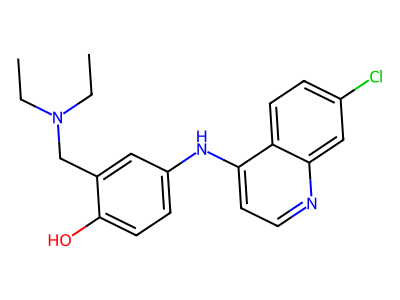
Amodiaquine
阿莫地喹
Also known as: 4-[(7-Chloro-4-quinolinyl)amino]-2-[(diethylamino)methyl]phenol, 4-[(7-Chloro-4-quinolinyl)amino]-α-(diethylamino)-o-cresol, 4-[(7-Chloroquinolin-4-yl)amino]-2-[(diethylamino)methyl]phenol, 7-Chloro-4-(3-diethylaminomethyl-4-hydroxyphenylamino)quinoline, Camoquin, Camoquine, Flavoquine, Miaquin, SN 10,751
Amodiaquine (CAS 86-42-0) is a compound in the Organic Compounds category listed in the Jingsj chemical database. It has the molecular formula C20H22ClN3O and a molecular weight of 355.861 g/mol. It is also known as 4-[(7-Chloro-4-quinolinyl)amino]-2-[(diethylamino)methyl]phenol, 4-[(7-Chloro-4-quinolinyl)amino]-α-(diethylamino)-o-cresol and 4-[(7-Chloroquinolin-4-yl)amino]-2-[(diethylamino)methyl]phenol. Key properties include a melting point of 208°C, a boiling point of 478.0±45.0 °C at 760 mmHg, a density of 1.3±0.1 g/cm3 and a flash point of 242.9±28.7 °C. No supplier offers are currently listed; request a quote. Record last updated Aug 21, 2026.
- CAS No.
- 86-42-0
- Jingsj CID
- J-10239-5
- Molecular Formula
- C20H22ClN3O
- Chinese Name
- 阿莫地喹
- Molecular Weight
- 355.861 g/mol
- Category
- Organic Compounds
- Last updated
- 8/21/2026
No offers for this compound yet.
Request a quotePhysicochemical Properties
| Melting Point | 208°C |
|---|---|
| Boiling Point | 478.0±45.0 °C at 760 mmHg |
| Density | 1.3±0.1 g/cm3 |
| Flash Point | 242.9±28.7 °C |
| Exact Mass | 355.145142 |
| PSA | 48.39000 |
| LogP | 4.77 |
| Vapor Pressure | 0.0±1.2 mmHg at 25°C |
| Refractive Index | 1.669 |
| Storage Conditions | -20°C Freezer |
Activity & Biological Data
| Target | EC50: ~20 μM (Nurr1-LBD (ligand binding domain))[1] Histamine N-methyltransferase[3] |
|---|---|
| Additional Information | [1]. Chun-Hyung Kim, et al. Nuclear receptor Nurr1 agonists enhance its dual functions and improve behavioral deficits in an animal model of Parkinson's disease. Proc Natl Acad Sci U S A. 2015 Jul 14;112(28):8756-61. [2]. Keita Kinoshita, et al. A Nurr1 agonist amodiaquine attenuates inflammatory events and neurological deficits in a mouse model of intracerebral hemorrhage. J Neuroimmunol. 2019 May 15;330:48-54. [3]. Akira Yokoyama, et al. Effect of amodiaquine, a histamine N-methyltransferase inhibitor, on, Propionibacterium acnes and lipopolysaccharide-induced hepatitis in mice. Eur J Pharmacol. 2007 Mar 8;558(1-3):179-84. [4]. M T HOEKENGA. The treatment of acute malaria with single oral doses of amodiaquin, chloroquine, hydroxychloroquine and pyrimethamine. Am J Trop Med Hyg. 1954 Sep;3(5):833-8. |
Customs & Trade Information
| HS Code | 2933499090 |
|---|---|
| Summary | 2933499090. other compounds containing in the structure a quinoline or isoquinoline ring-system (whether or not hydrogenated), not further fused. VAT:17.0%. Tax rebate rate:13.0%. . MFN tariff:6.5%. General tariff:20.0% |
Frequently Asked Questions
What is the CAS number of Amodiaquine?
The CAS number of Amodiaquine is 86-42-0.
What are the molecular formula and molecular weight of Amodiaquine?
Amodiaquine has molecular formula C20H22ClN3O and molecular weight 355.861 g/mol.
What are the upstream and downstream products of Amodiaquine?
For Amodiaquine, Upstream Products: 4,7-Dichloroquinoline, 4-Aminophenol, Diethylamine; Downstream Products: N-Desethylamodiaquine.
Data compiled from public chemical databases and supplier catalogs; supplier offers are provided by suppliers.
Last updated:
How to cite: Jingsj. "Amodiaquine (CAS 86-42-0)". Jingsj Chemical Database. https://www.jingsj.com/compound/J-10239-5 (accessed 2026-10-28).
Data for reference only; verify specifications, grades and regulatory status with suppliers before purchase.