
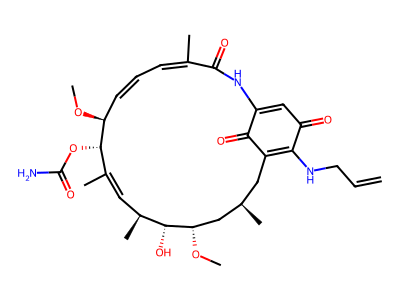
Tanespimycin
坦螺旋霉素
Also known as: 17-AAG, 17-allylamino-17-demethoxygeldanamycin, 17-(Allylamino)-17-demethoxygeldanamycin, NSC-330507, KOS 953, CP 127374, Gld-36, 17-AG, 17-AGG, (4E,6Z,8S,9S,10E,12S,13R,14S,16R)-19-(Allylamino)-13-hydroxy-8,14-dimethoxy-4,10,12,16-tetramethyl-3,20,22-trioxo-2-azabicyclo[16.3.1]docosa-1(21),4,6,10,18-pentaen-9-yl carbamate, 2-Azabicyclo[16.3.1]docosa-4,6,10,18,21-pentaene-3,20,22-trione, 9-[(aminocarbonyl)oxy]-13-hydroxy-8,14-dimethoxy-4,10,12,16-tetramethyl-19-(2-propen-1-ylamino)-, (4E,6Z,8S,9S,10E,12S,13R,14S,16R)-
Tanespimycin (CAS 75747-14-7) is a compound in the Organic Compounds category listed in the Jingsj chemical database. It has the molecular formula C31H43N3O8 and a molecular weight of 585.688 g/mol. It is also known as 17-AAG, 17-allylamino-17-demethoxygeldanamycin and 17-(Allylamino)-17-demethoxygeldanamycin. Key properties include a melting point of 201-203ºC, a boiling point of 797.8±60.0 °C at 760 mmHg, a density of 1.2±0.1 g/cm3 and a flash point of 436.3±32.9 °C. No supplier offers are currently listed; request a quote. Record last updated Aug 21, 2026.
- CAS No.
- 75747-14-7
- Jingsj CID
- J-48439-8
- Molecular Formula
- C31H43N3O8
- Chinese Name
- 坦螺旋霉素
- Molecular Weight
- 585.688 g/mol
- Category
- Organic Compounds
- Last updated
- 8/21/2026
No offers for this compound yet.
Request a quotePhysicochemical Properties
| Melting Point | 201-203ºC |
|---|---|
| Boiling Point | 797.8±60.0 °C at 760 mmHg |
| Density | 1.2±0.1 g/cm3 |
| Flash Point | 436.3±32.9 °C |
| Exact Mass | 585.304993 |
| PSA | 166.28000 |
| LogP | 2.68 |
| Vapor Pressure | 0.0±6.4 mmHg at 25°C |
| Refractive Index | 1.566 |
Activity & Biological Data
| Target | HSP90:5 nM (IC50) Mitophagy Autophagy |
|---|---|
| Additional Information | [1]. Solit DB, et al. 17-Allylamino-17-demethoxygeldanamycin induces the degradation of androgen receptor and HER-2/neu and inhibits the growth of prostate cancer xenografts.Clin Cancer Res, 2002, 8(5), 986-993. [2]. Raja, Srikumar M., et al. A combination of Trastuzumab and 17-AAG induces enhanced ubiquitinylation and lysosomal pathway-dependent ErbB2 degradation and cytotoxicity in ErbB2-overexpressing breast cancer cells. Cancer Biology & Therapy (2008), 7(10), 163 [3]. Zhang J, et al. The heat shock protein 90 inhibitor 17-AAG suppresses growth and induces apoptosis in human cholangiocarcinoma cells.Clin Exp Med. 2012 Sep 7. [4]. Newman B, et al. HSP90 Inhibitor 17-AAG Selectively Eradicates Lymphoma Stem Cells.Cancer Res. 2012 Sep 1;72(17):4551-61. Epub 2012 Jun 29. [5]. Kamal A, et al. A high-affinity conformation of Hsp90 confers tumour selectivity on Hsp90 inhibitors. Nature. 2003 Sep 25;425(6956):407-10. |
Frequently Asked Questions
What is the CAS number of Tanespimycin?
The CAS number of Tanespimycin is 75747-14-7.
What are the molecular formula and molecular weight of Tanespimycin?
Tanespimycin has molecular formula C31H43N3O8 and molecular weight 585.688 g/mol.
What are the upstream and downstream products of Tanespimycin?
For Tanespimycin, Upstream Products: Geldanamycin; Downstream Products: Retaspimycin.
Data compiled from public chemical databases and supplier catalogs; supplier offers are provided by suppliers.
Last updated:
How to cite: Jingsj. "Tanespimycin (CAS 75747-14-7)". Jingsj Chemical Database. https://www.jingsj.com/compound/J-48439-8 (accessed 2026-10-28).
Data for reference only; verify specifications, grades and regulatory status with suppliers before purchase.