
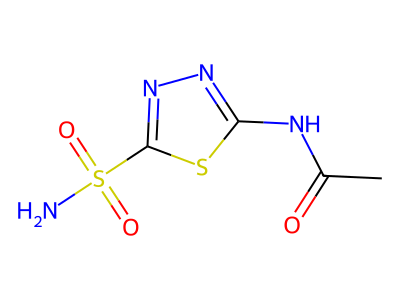
Acetazolamide
乙酰唑胺
Also known as: 2-Acetylamino-1,3,4-thiadiazole-5-sulfonamide, N-(5-Sulfamoyl-1,3,4-thiadiazol-2-yl)acetamide, 5-Acetamido-1,3,4-thiadiazole-2-sulfonamide, 2-Acetamido-5-sulfamoyl-1,3,4-thiadiazole, Acetamide, N-[5-(aminosulfonyl)-1,3,4-thiadiazol-2-yl]-, Diamox, Didoc, Donmox, Edemox, Glupax, Cidamex, Diacarb, Diakarb, Diluran, Atenezol, 5-acetamido-1,3,4-thiadiazole-2-sulphonamide
Acetazolamide (CAS 59-66-5) is a compound in the Organic Bases category listed in the Jingsj chemical database. It has the molecular formula C4H6N4O3S2 and a molecular weight of 222.245 g/mol. It is also known as 2-Acetylamino-1,3,4-thiadiazole-5-sulfonamide, N-(5-Sulfamoyl-1,3,4-thiadiazol-2-yl)acetamide and 5-Acetamido-1,3,4-thiadiazole-2-sulfonamide. Key properties include a melting point of 256-261°C and a density of 1.7±0.1 g/cm3. It is classified under GHS with signal word Warning and hazard statements H315 — Causes skin irritation and H319 — Causes serious eye irritation. No supplier offers are currently listed; request a quote. Record last updated Aug 21, 2026.
- CAS No.
- 59-66-5
- Jingsj CID
- J-1967672-8
- Molecular Formula
- C4H6N4O3S2
- Chinese Name
- 乙酰唑胺
- Molecular Weight
- 222.245 g/mol
- Category
- Organic Bases
- Last updated
- 8/21/2026
No offers for this compound yet.
Request a quotePhysicochemical Properties
| Melting Point | 256-261°C |
|---|---|
| Density | 1.7±0.1 g/cm3 |
| Exact Mass | 221.988129 |
| PSA | 151.66000 |
| LogP | -0.26 |
| Refractive Index | 1.641 |
| Additional Property | <0.1 g/100 mL at 22 ºC |
GHS Safety & Compliance
- H315 — Causes skin irritation
- H319 — Causes serious eye irritation
Activity & Biological Data
| Additional Information | [1]. Hou Z, et al. Dual-tail approach to discovery of novel carbonic anhydrase IX inhibitors by simultaneously matching the hydrophobic and hydrophilic halves of the active site. Eur J Med Chem. 2017 May 26;132:1-10. [2]. Gao H, et al. Combined treatment with acetazolamide and cisplatin enhances chemosensitivity in laryngeal carcinoma Hep-2 cells. Oncol Lett. 2018 Jun;15(6):9299-9306. [3]. Bayat Mokhtari R, et al. Acetazolamide potentiates the anti-tumor potential of HDACi, MS-275, in neuroblastoma. BMC Cancer. 2017 Feb 24;17(1):156. [4]. Kassamali R, et al. Acetazolamide: a forgotten diuretic agent. Cardiol Rev. 2011 Nov-Dec;19(6):276-8. |
|---|
Customs & Trade Information
| HS Code | 2935009090 |
|---|---|
| Summary | 2935009090 other sulphonamides VAT:17.0% Tax rebate rate:9.0% Supervision conditions:none MFN tariff:6.5% General tariff:35.0% |
Frequently Asked Questions
What is the CAS number of Acetazolamide?
The CAS number of Acetazolamide is 59-66-5.
What are the molecular formula and molecular weight of Acetazolamide?
Acetazolamide has molecular formula C4H6N4O3S2 and molecular weight 222.245 g/mol.
Is Acetazolamide hazardous?
Acetazolamide has GHS signal word Warning and hazard statements H315 — Causes skin irritation; H319 — Causes serious eye irritation.
What are the upstream and downstream products of Acetazolamide?
For Acetazolamide, Upstream Products: 2-(Acetamido)-5-(chlorosulfonyl)-1,3,4-thiadiazole, 2-Acetamido-5-benzylthio-1,3,4-thiadiazole; Downstream Products: 5-Amino-1,3,4-thiadiazole-2-sulfonamide, acetic acid.
Data compiled from public chemical databases and supplier catalogs; supplier offers are provided by suppliers.
Last updated:
How to cite: Jingsj. "Acetazolamide (CAS 59-66-5)". Jingsj Chemical Database. https://www.jingsj.com/compound/J-1967672-8 (accessed 2026-10-28).
Data for reference only; verify specifications, grades and regulatory status with suppliers before purchase.