
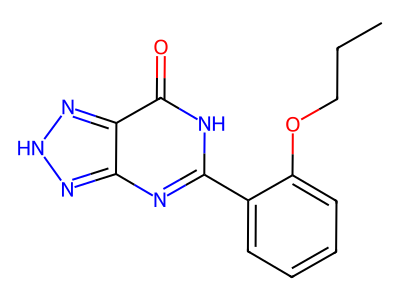
Zaprinast
扎普司特
Also known as: M&B 22948, 2-(2-Propoxyphenyl)-8-azahypoxanthine, 1,4-Dihydro-5-(2-propoxyphenyl)-7H-1,2,3-triazolo[4,5-d]pyrimidin-7-one, 5-(2-Propoxyphenyl)-1,4-dihydro-7H-[1,2,3]triazolo[4,5-d]pyrimidin-7-one, 2-(2-Propoxyphenyl)-8-azapurin-6-one, 8-Aza-2-(2-propoxyphenyl)-6-purinone, Phenylaza purinon, B 22,948, EINECS 253-655-1, MFCD00214073
Zaprinast (CAS 37762-06-4) is a compound in the Organic Compounds category listed in the Jingsj chemical database. It has the molecular formula C13H13N5O2 and a molecular weight of 271.275 g/mol. It is also known as M&B 22948, 2-(2-Propoxyphenyl)-8-azahypoxanthine and 1,4-Dihydro-5-(2-propoxyphenyl)-7H-1,2,3-triazolo[4,5-d]pyrimidin-7-one. Key properties include a melting point of 237-238ºC dec., a boiling point of 406.3±47.0 °C at 760 mmHg, a density of 1.484g/cm3 and a flash point of 199.5±29.3 °C. It is classified under GHS with signal word Warning and hazard statements H315 — Causes skin irritation, H319 — Causes serious eye irritation and H335 — May cause respiratory irritation. No supplier offers are currently listed; request a quote. Record last updated Aug 21, 2026.
- CAS No.
- 37762-06-4
- Jingsj CID
- J-1987249-0
- Molecular Formula
- C13H13N5O2
- Chinese Name
- 扎普司特
- Molecular Weight
- 271.275 g/mol
- Category
- Organic Compounds
- Last updated
- 8/21/2026
No offers for this compound yet.
Request a quotePhysicochemical Properties
| Melting Point | 237-238ºC dec. |
|---|---|
| Boiling Point | 406.3±47.0 °C at 760 mmHg |
| Density | 1.484g/cm3 |
| Flash Point | 199.5±29.3 °C |
| Exact Mass | 271.106934 |
| PSA | 96.55000 |
| LogP | 0.17 |
| Vapor Pressure | 0.0±0.9 mmHg at 25°C |
| Refractive Index | 1.719 |
| Additional Property | Soluble to 100 mM in DMSO |
GHS Safety & Compliance
- H315 — Causes skin irritation
- H319 — Causes serious eye irritation
- H335 — May cause respiratory irritation
Activity & Biological Data
| Target | PDE[1], GPR35[2] |
|---|---|
| Additional Information | [1]. Choi SH , et al. Zaprinast, an inhibitor of cGMP-selective phosphodiesterases, enhances the secretion of TNF-alpha and IL-1beta and the expression of iNOS and MHC class II molecules in rat microglial cells. J Neurosci Res. 2002 Feb 1;67(3):411-21. [2]. Taniguchi Y, et al. Zaprinast, a well-known cyclic guanosine monophosphate-specific phosphodiesterase inhibitor, is an agonist for GPR35. FEBS Lett. 2006 Sep 18;580(21):5003-8. Epub 2006 Aug 17. [3]. Keswani AN , et al The cyclic GMP modulators YC-1 and zaprinast reduce vessel remodeling through antiproliferative and proapoptotic effects. J Cardiovasc Pharmacol Ther. 2009 Jun;14(2):116-24. |
Frequently Asked Questions
What is the CAS number of Zaprinast?
The CAS number of Zaprinast is 37762-06-4.
What are the molecular formula and molecular weight of Zaprinast?
Zaprinast has molecular formula C13H13N5O2 and molecular weight 271.275 g/mol.
Is Zaprinast hazardous?
Zaprinast has GHS signal word Warning and hazard statements H315 — Causes skin irritation; H319 — Causes serious eye irritation; H335 — May cause respiratory irritation.
Data compiled from public chemical databases and supplier catalogs; supplier offers are provided by suppliers.
Last updated:
How to cite: Jingsj. "Zaprinast (CAS 37762-06-4)". Jingsj Chemical Database. https://www.jingsj.com/compound/J-1987249-0 (accessed 2026-10-28).
Data for reference only; verify specifications, grades and regulatory status with suppliers before purchase.