
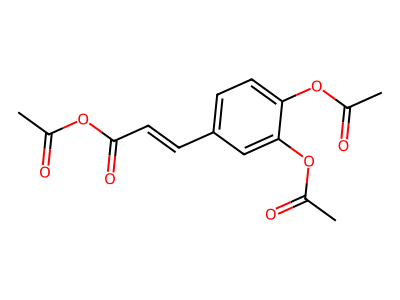
Caffeic acid
Also known as: 3,4-Dihydroxycinnamic acid, (E)-3-(3,4-dihydroxyphenyl)prop-2-enoic acid, 3-(3,4-Dihydroxyphenyl)acrylic acid, 4-(2-Carboxyethenyl)-1,2-dihydroxybenzene, trans-Caffeic acid
Caffeic acid (CAS 331-39-5) is a compound in the Organic Acids category listed in the Jingsj chemical database. It has the molecular formula C9H8O4 and a molecular weight of 180.15900 g/mol. Key properties include a melting point of 211-213 °C (dec.)(lit.), a boiling point of 416.8±35.0 °C at 760 mmHg, a density of 1.5±0.1 g/cm3 and a flash point of 220.0±22.4 °C. It is classified under GHS with signal word Warning and hazard statements H315 — Causes skin irritation, H319 — Causes serious eye irritation and H335 — May cause respiratory irritation. It is listed by 1 supplier; request a quote for pricing. Record last updated Nov 4, 2026.
- CAS No.
- 331-39-5
- Jingsj CID
- J-44855-5
- Molecular Formula
- C9H8O4
- Molecular Weight
- 180.15900 g/mol
- Category
- Organic Acids
- Last updated
- 11/4/2026
| Supplier | Purity / Pack | Base Price | Unit Price | Origin | |
|---|---|---|---|---|---|
Made to Order | - | - | CN China |
Physicochemical Properties
| Melting Point | 211-213 °C (dec.)(lit.) |
|---|---|
| Boiling Point | 416.8±35.0 °C at 760 mmHg |
| Density | 1.5±0.1 g/cm3 |
| Flash Point | 220.0±22.4 °C |
| Exact Mass | 180.042252 |
| PSA | 77.76000 |
| LogP | 1.42 |
| Vapor Pressure | 0.0±1.0 mmHg at 25°C |
| Refractive Index | 1.707 |
| Additional Property | soluble in hot water |
GHS Safety & Compliance
- H315 — Causes skin irritation
- H319 — Causes serious eye irritation
- H335 — May cause respiratory irritation
- H351 — Suspected of causing cancer
- H361 — Suspected of damaging fertility or the unborn child
Activity & Biological Data
| Target | Human Endogenous Metabolite |
|---|---|
| Additional Information | [1]. Pradhananga S, et al. Caffeic acid exhibits anti-pruritic effects by inhibition of multiple itch transmission pathways in mice. Eur J Pharmacol. 2015 Sep 5;762:313-21. [2]. Liang G, et al. The protective effect of caffeic acid on global cerebral ischemia-reperfusion injury in rats. Behav Brain Funct. 2015 Apr 18;11:18. |
Customs & Trade Information
| HS Code | 2918290000 |
|---|---|
| Summary | HS: 2918290000 other carboxylic acids with phenol function but without other oxygen function, their anhydrides, halides, peroxides, peroxyacids and their derivatives Tax rebate rate:9.0% Supervision conditions:AB(certificate of inspection for goods inward,certificate of inspection for goods outward) VAT:17.0% MFN tariff:6.5% General tariff:30.0% |
Frequently Asked Questions
What is the CAS number of Caffeic acid?
The CAS number of Caffeic acid is 331-39-5.
What are the molecular formula and molecular weight of Caffeic acid?
Caffeic acid has molecular formula C9H8O4 and molecular weight 180.15900 g/mol.
Which suppliers offer Caffeic acid?
1 supplier(s) listed; request a quote for pricing.
Is Caffeic acid hazardous?
Caffeic acid has GHS signal word Warning and hazard statements H315 — Causes skin irritation; H319 — Causes serious eye irritation; H335 — May cause respiratory irritation.
What are the upstream and downstream products of Caffeic acid?
For Caffeic acid, Upstream Products: Caftaric acid, Malonic acid, 3,4-Dihydroxybenzaldehyde; Downstream Products: Methyl caffeate, Butyl 3-(3,4-dihydroxyphenyl)acrylate, Catechol.
Data compiled from public chemical databases such as PubChem and supplier catalogs; supplier offers are provided by suppliers.
Last updated:
How to cite: Jingsj. "Caffeic acid (CAS 331-39-5)". Jingsj Chemical Database. https://www.jingsj.com/compound/J-44855-5 (accessed 2026-11-09).
Data for reference only; verify product details with suppliers before purchase.