
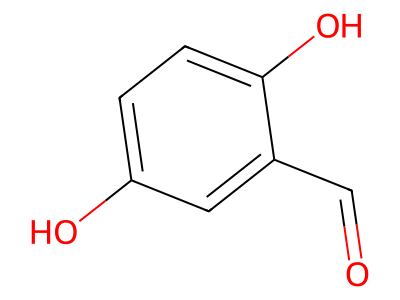
2,5-Dihydroxybenzaldehyde
Also known as: Gentisaldehyde, Gentisinaldehyde, Gentisate aldehyde, 5-Hydroxysalicylaldehyde, 2-Formylhydroquinone, 2,5-Dihydroxybenzaldchyde, Gentisic aldehyde, MFCD00003333
2,5-Dihydroxybenzaldehyde (CAS 1194-98-5) is a compound in the Aromatic Hydrocarbons category listed in the Jingsj chemical database. It has the molecular formula C7H6O3 and a molecular weight of 138.121 g/mol. Key properties include a melting point of 97-99 °C(lit.), a boiling point of 276.1±20.0 °C at 760 mmHg, a density of 1.4±0.1 g/cm3 and a flash point of 135.1±18.3 °C. It is classified under GHS with signal word Warning and hazard statements H315 — Causes skin irritation, H317 — May cause an allergic skin reaction and H319 — Causes serious eye irritation. It is listed by 1 supplier; request a quote for pricing. Record last updated Aug 21, 2026.
- CAS No.
- 1194-98-5
- Jingsj CID
- J-3755-0
- Molecular Formula
- C7H6O3
- Molecular Weight
- 138.121 g/mol
- Category
- Aromatic Hydrocarbons
- Last updated
- 8/21/2026
| Supplier | Purity / Pack | Base Price | Unit Price | Origin | |
|---|---|---|---|---|---|
Made to Order | - | - | CN China |
Physicochemical Properties
| Melting Point | 97-99 °C(lit.) |
|---|---|
| Boiling Point | 276.1±20.0 °C at 760 mmHg |
| Density | 1.4±0.1 g/cm3 |
| Flash Point | 135.1±18.3 °C |
| Exact Mass | 138.031693 |
| PSA | 57.53000 |
| LogP | 1.12 |
| Vapor Pressure | 0.0±0.6 mmHg at 25°C |
| Refractive Index | 1.674 |
| Additional Property | soluble |
GHS Safety & Compliance
- H315 — Causes skin irritation
- H317 — May cause an allergic skin reaction
- H319 — Causes serious eye irritation
- H335 — May cause respiratory irritation
Activity & Biological Data
| Target | MIC50: 500 mg/L (S. aureus)[2]Mycobacterium avium subsp. paratuberculosis[1] |
|---|---|
| Additional Information | [1]. Stella W Nowotarska, et al. Mechanisms of Antimicrobial Action of Cinnamon and Oregano Oils, Cinnamaldehyde, Carvacrol, 2,5-Dihydroxybenzaldehyde, and 2-Hydroxy-5-Methoxybenzaldehyde Against Mycobacterium Avium Subsp. Paratuberculosis (Map). Foods. 2017 Aug 24;6(9):72. [2]. Andrea Schabauer, et al. Gentisaldehyde and Its Derivative 2,3-Dihydroxybenzaldehyde Show Antimicrobial Activities Against Bovine Mastitis Staphylococcus aureus. Front Vet Sci. 2018 Jul 11;5:148. |
Customs & Trade Information
| HS Code | 2912499000 |
|---|---|
| Summary | 2912499000. other aldehyde-ethers, aldehyde-phenols and aldehydes with other oxygen function. VAT:17.0%. Tax rebate rate:9.0%. . MFN tariff:5.5%. General tariff:30.0% |
Frequently Asked Questions
What is the CAS number of 2,5-Dihydroxybenzaldehyde?
The CAS number of 2,5-Dihydroxybenzaldehyde is 1194-98-5.
What are the molecular formula and molecular weight of 2,5-Dihydroxybenzaldehyde?
2,5-Dihydroxybenzaldehyde has molecular formula C7H6O3 and molecular weight 138.121 g/mol.
Which suppliers offer 2,5-Dihydroxybenzaldehyde?
1 supplier(s) listed; request a quote for pricing.
Is 2,5-Dihydroxybenzaldehyde hazardous?
2,5-Dihydroxybenzaldehyde has GHS signal word Warning and hazard statements H315 — Causes skin irritation; H317 — May cause an allergic skin reaction; H319 — Causes serious eye irritation.
What are the upstream and downstream products of 2,5-Dihydroxybenzaldehyde?
For 2,5-Dihydroxybenzaldehyde, Upstream Products: 5-Bromosalicylaldehyde, 2,5-Dimethoxybenzaldehyde, 1',3',3'-Trimethylspiro[chromene-2,2'-indolin]-6-ol; Downstream Products: 2,5-Dihydroxybenzoic acid, 5-Hydroxy-2-methoxybenzaldehyde, Methylhydroquinone.
Data compiled from public chemical databases such as PubChem and supplier catalogs; supplier offers are provided by suppliers.
Last updated:
How to cite: Jingsj. "2,5-Dihydroxybenzaldehyde (CAS 1194-98-5)". Jingsj Chemical Database. https://www.jingsj.com/compound/J-3755-0 (accessed 2026-11-07).
Data for reference only; verify product details with suppliers before purchase.