
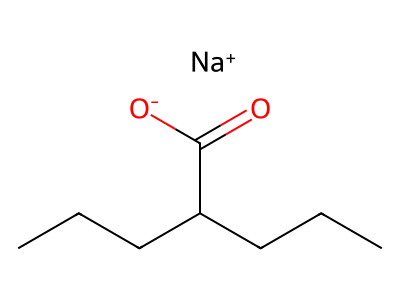
Sodium 2-propylpentanoate
Also known as: Sodium valproate, Valproate sodium, Valproic acid sodium salt, 2-Propylpentanoic acid sodium salt, 2-Propylvaleric acid sodium salt, Sodium dipropylacetate, Sodium 2-propylvalerate, Depacon, Epilim, Ergenyl, Depakine, MFCD00078604, UNII:5VOM6GYJ0D
Sodium 2-propylpentanoate (CAS 1069-66-5) is a compound in the Organic Acids category listed in the Jingsj chemical database. It has the molecular formula C8H15NaO2 and a molecular weight of 166.193 g/mol. Key properties include a melting point of 300 °C, a boiling point of 220ºC at 760 mmHg, a density of 1.0803 g/cm3 and a flash point of STABILITY. It is classified under GHS with signal word Warning and hazard statements H302 — Harmful if swallowed. No supplier offers are currently listed; request a quote. Record last updated Aug 21, 2026.
- CAS No.
- 1069-66-5
- Jingsj CID
- J-19977-9
- Molecular Formula
- C8H15NaO2
- Molecular Weight
- 166.193 g/mol
- Category
- Organic Acids
- Last updated
- 8/21/2026
No offers for this compound yet.
Request a quotePhysicochemical Properties
| Melting Point | 300 °C |
|---|---|
| Boiling Point | 220ºC at 760 mmHg |
| Density | 1.0803 g/cm3 |
| Flash Point | STABILITY |
| Exact Mass | 166.096970 |
| PSA | 40.13000 |
| LogP | 0.95270 |
| Vapor Pressure | 0.0435mmHg at 25°C |
| Additional Property | soluble |
GHS Safety & Compliance
- H302 — Harmful if swallowed
Activity & Biological Data
| Target | HDAC1:400 μM (IC50) HDAC:0.5-2 mM (IC50) HDAC2 Autophagy Mitophagy |
|---|---|
| Additional Information | [1]. Han BR, et al. Valproic acid inhibits the growth of HeLa cervical cancer cells via caspase-dependent apoptosis. Oncol Rep. 2013 Dec;30(6):2999-3005. [2]. Zhang ZH, et al. Valproic acid inhibits tumor angiogenesis in mice transplanted with Kasumi 1 leukemia cells. Mol Med Rep. 2013 Nov 28. [3]. Cohen OS, et al. Acute prenatal exposure to a moderate dose of valproic acid increases social behavior and alters gene expression in rats. Int J Dev Neurosci. 2013 Dec;31(8):740-50. [4]. Avery LB, et al. Valproic Acid Is a Novel Activator of AMP-Activated Protein Kinase and Decreases Liver Mass, Hepatic Fat Accumulation, and Serum Glucose in Obese Mice. Mol Pharmacol. 2014 Jan;85(1):1-10. [5]. Valproic acid, et al. Histone deacetylase is a direct target of valproic acid, a potent anticonvulsant, mood stabilizer, and teratogen. J Biol Chem. 2001 Sep 28;276(39):36734-41. |
Customs & Trade Information
| HS Code | 2915900090 |
|---|---|
| Summary | 2915900090 other saturated acyclic monocarboxylic acids and their anhydrides, halides, peroxides and peroxyacids; their halogenated, sulphonated, nitrated or nitrosated derivatives VAT:17.0% Tax rebate rate:9.0% Supervision conditions:AB(certificate of inspection for goods inward,certificate of inspection for goods outward) MFN tariff:5.5% General tariff:30.0% |
Frequently Asked Questions
What is the CAS number of Sodium 2-propylpentanoate?
The CAS number of Sodium 2-propylpentanoate is 1069-66-5.
What are the molecular formula and molecular weight of Sodium 2-propylpentanoate?
Sodium 2-propylpentanoate has molecular formula C8H15NaO2 and molecular weight 166.193 g/mol.
Is Sodium 2-propylpentanoate hazardous?
Sodium 2-propylpentanoate has GHS signal word Warning and hazard statements H302 — Harmful if swallowed.
What are the upstream and downstream products of Sodium 2-propylpentanoate?
For Sodium 2-propylpentanoate, Upstream Products: Valproic acid; Downstream Products: Valproic acid.
Data compiled from public chemical databases such as PubChem and supplier catalogs; supplier offers are provided by suppliers.
Last updated:
How to cite: Jingsj. "Sodium 2-propylpentanoate (CAS 1069-66-5)". Jingsj Chemical Database. https://www.jingsj.com/compound/J-19977-9 (accessed 2026-11-09).
Data for reference only; verify product details with suppliers before purchase.