
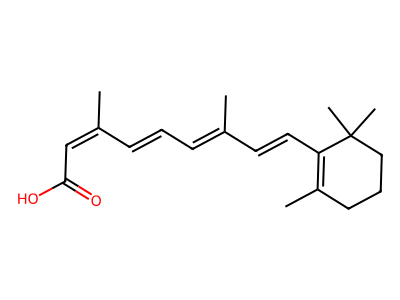
Isotretinoin
Also known as: 13-cis-Retinoic acid, 13-cis-vitamin A acid, Accutane, Amnesteem, Claravis, Roaccutan, Sotret, isotrex, cis-retinoic acid, Ro 4-3780, (2Z,4E,6E,8E)-3,7-dimethyl-9-(2,6,6-trimethylcyclohex-1-en-1-yl)nona-2,4,6,8-tetraenoic acid, 13-cis-Tretinoin, 13Z-Retinoic acid
Isotretinoin (CAS 4759-48-2) is a compound in the Organic Acids category listed in the Jingsj chemical database. It has the molecular formula C20H28O2 and a molecular weight of 300.435 g/mol. Key properties include a melting point of 172-175 °C(lit.), a boiling point of 462.8±14.0 °C at 760 mmHg, a density of 1.0±0.1 g/cm3 and a flash point of 350.6±11.0 °C. It is classified under GHS with signal word Danger and hazard statements H315 — Causes skin irritation, H319 — Causes serious eye irritation and H335 — May cause respiratory irritation. No supplier offers are currently listed; request a quote. Record last updated Aug 21, 2026.
- CAS No.
- 4759-48-2
- Jingsj CID
- J-801585-8
- Molecular Formula
- C20H28O2
- Molecular Weight
- 300.435 g/mol
- Category
- Organic Acids
- Last updated
- 8/21/2026
No offers for this compound yet.
Request a quotePhysicochemical Properties
| Melting Point | 172-175 °C(lit.) |
|---|---|
| Boiling Point | 462.8±14.0 °C at 760 mmHg |
| Density | 1.0±0.1 g/cm3 |
| Flash Point | 350.6±11.0 °C |
| Exact Mass | 300.208923 |
| PSA | 37.30000 |
| LogP | 6.83 |
| Vapor Pressure | 0.0±2.5 mmHg at 25°C |
| Refractive Index | 1.556 |
| Additional Property | insoluble |
GHS Safety & Compliance
- H315 — Causes skin irritation
- H319 — Causes serious eye irritation
- H335 — May cause respiratory irritation
- H360 — May damage fertility or the unborn child
Activity & Biological Data
| Target | Human Endogenous Metabolite |
|---|---|
| Additional Information | [1]. Thielitz, A. and H. Gollnick, [Isotretinoin. How should it be used?]. Hautarzt, 2013. 64(4): p. 263-8. [2]. Norris, D.A., et al., Isotretinoin produces significant inhibition of monocyte and neutrophil chemotaxis in vivo in patients with cystic acne. J Invest Dermatol, 1987. 89(1): p. 38-43. [3]. Rademaker, M., J.M. Wishart, and N.M. Birchall, Isotretinoin 5 mg daily for low-grade adult acne vulgaris - a placebo-controlled, randomized double-blind study. J Eur Acad Dermatol Venereol, 2013. [4]. Dicken, C.H., Isotretinoin treatment of pityriasis rubra pilaris. J Am Acad Dermatol, 1987. 16(2 Pt 1): p. 297-301. |
Customs & Trade Information
| HS Code | 2942000000 |
|---|
Frequently Asked Questions
What is the CAS number of Isotretinoin?
The CAS number of Isotretinoin is 4759-48-2.
What are the molecular formula and molecular weight of Isotretinoin?
Isotretinoin has molecular formula C20H28O2 and molecular weight 300.435 g/mol.
Is Isotretinoin hazardous?
Isotretinoin has GHS signal word Danger and hazard statements H315 — Causes skin irritation; H319 — Causes serious eye irritation; H335 — May cause respiratory irritation.
What are the upstream and downstream products of Isotretinoin?
For Isotretinoin, Upstream Products: [(2E,4E)-3-Methyl-5-(2,6,6-trimethylcyclohex-2-en-1-yl)-2,4-pentadien-1-yl]triphenylphosphonium bromide, Tretinoin.
Data compiled from public chemical databases such as PubChem and supplier catalogs; supplier offers are provided by suppliers.
Last updated:
How to cite: Jingsj. "Isotretinoin (CAS 4759-48-2)". Jingsj Chemical Database. https://www.jingsj.com/compound/J-801585-8 (accessed 2026-11-09).
Data for reference only; verify product details with suppliers before purchase.