
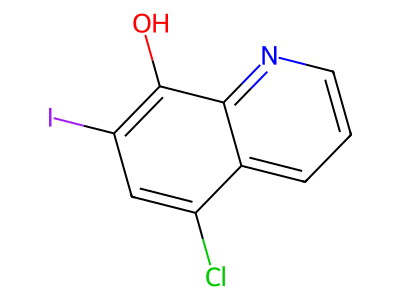
Clioquinol
Also known as: 5-chloro-7-iodoquinolin-8-ol, 5-chloro-8-hydroxy-7-iodoquinoline, 5-chloro-7-iodo-8-hydroxyquinoline, 5-chloro-7-iodo-8-quinolinol, 7-iodo-5-chloroxine, 8-quinolinol, 5-chloro-7-iodo-, iodochlorhydroxyquin, iodochlorohydroxyquinoline, vioform, entero-vioform, ala-quin, alchloquin, aleoquin, alioform, amebil, amoenol, bactol, cliochinolo, clioqinol, cliquinol
Clioquinol (CAS 130-26-7) is a compound in the Organohalogen Compounds category listed in the Jingsj chemical database. It has the molecular formula C9H5ClINO and a molecular weight of 305.500 g/mol. Key properties include a melting point of 175-183 °C, a boiling point of 350.4±37.0 °C at 760 mmHg, a density of 2.0±0.1 g/cm3 and a flash point of 165.7±26.5 °C. It is classified under GHS with signal word Danger and hazard statements H301 — Toxic if swallowed. No supplier offers are currently listed; request a quote. Record last updated Aug 21, 2026.
- CAS No.
- 130-26-7
- Jingsj CID
- J-49240-9
- Molecular Formula
- C9H5ClINO
- Molecular Weight
- 305.500 g/mol
- Category
- Organohalogen Compounds
- Last updated
- 8/21/2026
No offers for this compound yet.
Request a quotePhysicochemical Properties
| Melting Point | 175-183 °C |
|---|---|
| Boiling Point | 350.4±37.0 °C at 760 mmHg |
| Density | 2.0±0.1 g/cm3 |
| Flash Point | 165.7±26.5 °C |
| Exact Mass | 304.910431 |
| PSA | 33.12000 |
| LogP | 3.86 |
| Vapor Pressure | 0.0±0.8 mmHg at 25°C |
| Refractive Index | 1.768 |
| Additional Property | <0.1 g/100 mL at 20 ºC |
GHS Safety & Compliance
- H301 — Toxic if swallowed
Activity & Biological Data
| Additional Information | [1]. Nguyen T, et al. Clioquinol down-regulates mutant huntingtin expression in vitro and mitigates pathology in a Huntington's disease mouse model. Proc Natl Acad Sci U S A. 2005 Aug 16;102(33):11840-5. [2]. Cao B, et al. Clioquinol induces pro-death autophagy in leukemia and myeloma cells by disrupting the mTOR signaling pathway. Sci Rep. 2014 Jul 18;4:5749. [3]. Katsuyama M, et al. Clioquinol increases the expression of VGF, a neuropeptide precursor, through induction of c-Fos expression. J Pharmacol Sci. 2014;124(4):427-32. [4]. Matlack KE, et al. Clioquinol promotes the degradation of metal-dependent amyloid-β (Aβ) oligomers to restore endocytosis and ameliorate Aβ toxicity. Proc Natl Acad Sci U S A. 2014 Mar 18;111(11):4013-8. |
|---|
Customs & Trade Information
| HS Code | 2933499090 |
|---|---|
| Summary | 2933499090. other compounds containing in the structure a quinoline or isoquinoline ring-system (whether or not hydrogenated), not further fused. VAT:17.0%. Tax rebate rate:13.0%. . MFN tariff:6.5%. General tariff:20.0% |
Frequently Asked Questions
What is the CAS number of Clioquinol?
The CAS number of Clioquinol is 130-26-7.
What are the molecular formula and molecular weight of Clioquinol?
Clioquinol has molecular formula C9H5ClINO and molecular weight 305.500 g/mol.
Is Clioquinol hazardous?
Clioquinol has GHS signal word Danger and hazard statements H301 — Toxic if swallowed.
What are the upstream and downstream products of Clioquinol?
For Clioquinol, Upstream Products: 5-Chloro-8-hydroxyquinoline, 8-Hydroxyquinoline, Water; Downstream Products: Chloroxine, Iodoquinol, 5-Chloro-8-hydroxyquinoline.
Data compiled from public chemical databases such as PubChem and supplier catalogs; supplier offers are provided by suppliers.
Last updated:
How to cite: Jingsj. "Clioquinol (CAS 130-26-7)". Jingsj Chemical Database. https://www.jingsj.com/compound/J-49240-9 (accessed 2026-11-07).
Data for reference only; verify product details with suppliers before purchase.