
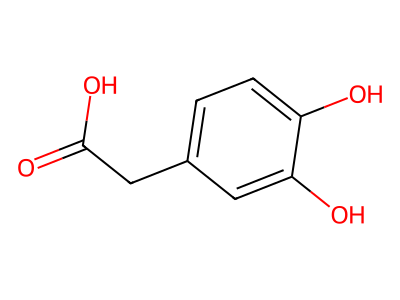
3,4-Dihydroxyphenylacetic acid
Also known as: 3,4-Dihydroxybenzeneacetic acid, Homoprotocatechuic acid, DOPAC, Dopacetic acid, 4-Carboxymethylcatechol, 4-Carboxymethylpyrocatechol, Catechol-4-acetic acid, Pyrocatechol-4-acetic acid, 2-(3,4-Dihydroxyphenyl)acetic acid, Ba 2773
3,4-Dihydroxyphenylacetic acid (CAS 102-32-9) is a compound in the Organic Acids category listed in the Jingsj chemical database. It has the molecular formula C8H8O4 and a molecular weight of 168.147 g/mol. Key properties include a melting point of 127-130 °C(lit.), a boiling point of 418.4±30.0 °C at 760 mmHg, a density of 1.5±0.1 g/cm3 and a flash point of 221.0±21.1 °C. It is classified under GHS with signal word Warning and hazard statements H315 — Causes skin irritation, H319 — Causes serious eye irritation and H335 — May cause respiratory irritation. No supplier offers are currently listed; request a quote. Record last updated Aug 21, 2026.
- CAS No.
- 102-32-9
- Jingsj CID
- J-47982-3
- Molecular Formula
- C8H8O4
- Molecular Weight
- 168.147 g/mol
- Category
- Organic Acids
- Last updated
- 8/21/2026
No offers for this compound yet.
Request a quotePhysicochemical Properties
| Melting Point | 127-130 °C(lit.) |
|---|---|
| Boiling Point | 418.4±30.0 °C at 760 mmHg |
| Density | 1.5±0.1 g/cm3 |
| Flash Point | 221.0±21.1 °C |
| Exact Mass | 168.042252 |
| PSA | 77.76000 |
| LogP | 0.17 |
| Vapor Pressure | 0.0±1.0 mmHg at 25°C |
| Refractive Index | 1.643 |
GHS Safety & Compliance
- H315 — Causes skin irritation
- H319 — Causes serious eye irritation
- H335 — May cause respiratory irritation
Activity & Biological Data
| Target | Human Endogenous Metabolite |
|---|---|
| Additional Information | [1]. Goldstein DS, et al. Elevated cerebrospinal fluid ratios of cysteinyl-dopamine/3,4-dihydroxyphenylacetic acid in parkinsonian synucleinopathies. Parkinsonism Relat Disord. 2016 Oct;31:79-86. |
Customs & Trade Information
| HS Code | 2918290000 |
|---|---|
| Summary | HS: 2918290000 other carboxylic acids with phenol function but without other oxygen function, their anhydrides, halides, peroxides, peroxyacids and their derivatives Tax rebate rate:9.0% Supervision conditions:AB(certificate of inspection for goods inward,certificate of inspection for goods outward) VAT:17.0% MFN tariff:6.5% General tariff:30.0% |
Frequently Asked Questions
What is the CAS number of 3,4-Dihydroxyphenylacetic acid?
The CAS number of 3,4-Dihydroxyphenylacetic acid is 102-32-9.
What are the molecular formula and molecular weight of 3,4-Dihydroxyphenylacetic acid?
3,4-Dihydroxyphenylacetic acid has molecular formula C8H8O4 and molecular weight 168.147 g/mol.
Is 3,4-Dihydroxyphenylacetic acid hazardous?
3,4-Dihydroxyphenylacetic acid has GHS signal word Warning and hazard statements H315 — Causes skin irritation; H319 — Causes serious eye irritation; H335 — May cause respiratory irritation.
What are the upstream and downstream products of 3,4-Dihydroxyphenylacetic acid?
For 3,4-Dihydroxyphenylacetic acid, Upstream Products: 4-Hydroxyphenylacetic acid, Vanilpyruvic acid, Homovanillic acid; Downstream Products: 1,3-Benzodioxole-5-acetic acid methyl ester, 3,4-Diethoxyphenylacetic acid, protocatechuic acid.
Data compiled from public chemical databases such as PubChem and supplier catalogs; supplier offers are provided by suppliers.
Last updated:
How to cite: Jingsj. "3,4-Dihydroxyphenylacetic acid (CAS 102-32-9)". Jingsj Chemical Database. https://www.jingsj.com/compound/J-47982-3 (accessed 2026-11-09).
Data for reference only; verify product details with suppliers before purchase.