
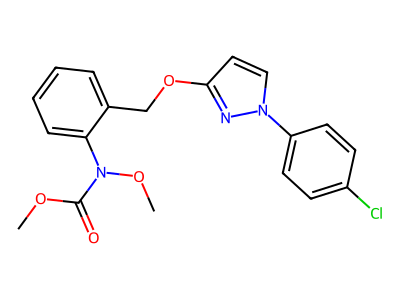
Pyraclostrobin
Also known as: BAS 500 F, CABRIO, HEADLINE, INSIGNIA, OPERA, METHYL [2-[1-(4-CHLOROPHENYL)-1H-PYRAZOL-3-YLOXYMETHYL]PHENYL]METHOXYCARBAMATE, Methyl (2-(((1-(4-chlorophenyl)-1H-pyrazol-3-yl)oxy)methyl)phenyl)(methoxy)carbamate, Methyl [2-({[1-(4-chlorophenyl)-1H-pyrazol-3-yl]oxy}methyl)phenyl]methoxycarbamate, carbamic acid, [2-[[[1-(4-chlorophenyl)-1H-pyrazol-3-yl]oxy]methyl]phenyl]methoxy-, methyl ester, methyl 2-[1-(4-chlorophenyl)pyrazol-3-yloxymethyl]-N-methoxycarbanilate, methyl N-[2-[[1-(4-chlorophenyl)pyrazol-3-yl]oxymethyl]phenyl]-N-methoxycarbamate, methyl N-[2-[[[1-(4-chlorophenyl)-1H-pyrazol-3-yl]oxy]methyl]phenyl]-N-methoxycarbamate, Pyraclostrobine, Pyraclostrobin
Pyraclostrobin (CAS 175013-18-0) is a compound in the Pharma Intermediates category listed in the Jingsj chemical database. It has the molecular formula C19H18ClN3O4 and a molecular weight of 387.817 g/mol. Key properties include a melting point of 63.7-65.2°, a boiling point of 501.1±60.0 °C at 760 mmHg, a density of 1.3±0.1 g/cm3 and a flash point of 256.8±32.9 °C. It is classified under GHS with signal word Danger and hazard statements H315 — Causes skin irritation, H331 — Toxic if inhaled and H410 — Very toxic to aquatic life with long lasting effects. No supplier offers are currently listed; request a quote. Record last updated Aug 21, 2026.
- CAS No.
- 175013-18-0
- Jingsj CID
- J-45358-5
- Molecular Formula
- C19H18ClN3O4
- Molecular Weight
- 387.817 g/mol
- Category
- Pharma Intermediates
- Last updated
- 8/21/2026
No offers for this compound yet.
Request a quotePhysicochemical Properties
| Melting Point | 63.7-65.2° |
|---|---|
| Boiling Point | 501.1±60.0 °C at 760 mmHg |
| Density | 1.3±0.1 g/cm3 |
| Flash Point | 256.8±32.9 °C |
| Exact Mass | 387.098572 |
| PSA | 65.82000 |
| LogP | 4.25 |
| Vapor Pressure | 0.0±1.3 mmHg at 25°C |
| Refractive Index | 1.592 |
GHS Safety & Compliance
- H315 — Causes skin irritation
- H331 — Toxic if inhaled
- H410 — Very toxic to aquatic life with long lasting effects
Activity & Biological Data
| Additional Information | [1]. Anthony L Luz,et al. The High-Production Volume Fungicide Pyraclostrobin Induces Triglyceride Accumulation Associated With Mitochondrial Dysfunction, and Promotes Adipocyte Differentiation Independent of PPARγ Activation, in 3T3-L1 Cells. 2018 Jan 15;393:150-159. [2]. Alexander H Tuttle, et al.Choice of Vehicle Affects Pyraclostrobin Toxicity in Mice.Chemosphere. 2019 Mar;218:501-506. |
|---|
Frequently Asked Questions
What is the CAS number of Pyraclostrobin?
The CAS number of Pyraclostrobin is 175013-18-0.
What are the molecular formula and molecular weight of Pyraclostrobin?
Pyraclostrobin has molecular formula C19H18ClN3O4 and molecular weight 387.817 g/mol.
Is Pyraclostrobin hazardous?
Pyraclostrobin has GHS signal word Danger and hazard statements H315 — Causes skin irritation; H331 — Toxic if inhaled; H410 — Very toxic to aquatic life with long lasting effects.
What are the upstream and downstream products of Pyraclostrobin?
For Pyraclostrobin, Upstream Products: 1-(4-Chlorophenyl)-1,2-dihydro-3H-pyrazol-3-one, 4-Bromochlorobenzene, 2-Nitrobenzyl bromide.
Data compiled from public chemical databases such as PubChem and supplier catalogs; supplier offers are provided by suppliers.
Last updated:
How to cite: Jingsj. "Pyraclostrobin (CAS 175013-18-0)". Jingsj Chemical Database. https://www.jingsj.com/compound/J-45358-5 (accessed 2026-11-06).
Data for reference only; verify product details with suppliers before purchase.