
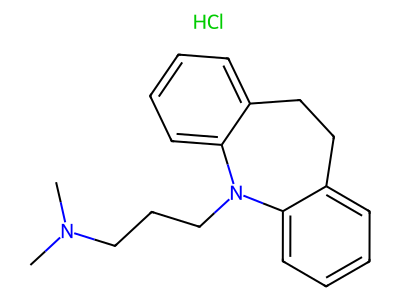
Imipramine hydrochloride
Also known as: Tofranil, Janimine, Melipramine, 5-[3-(Dimethylamino)propyl]-10,11-dihydro-5H-dibenz[b,f]azepine hydrochloride, 10,11-Dihydro-N,N-dimethyl-5H-dibenz[b,f]azepine-5-propanamine hydrochloride, N-(γ-Dimethylaminopropyl)iminodibenzyl hydrochloride, Imipramine HCl, G 22355
Imipramine hydrochloride (CAS 113-52-0) is a compound in the Organic Acids category listed in the Jingsj chemical database. It has the molecular formula C19H25ClN2 and a molecular weight of 316.868 g/mol. Key properties include a melting point of 168-1700C, a boiling point of 403.1ºC at 760mmHg, a density of 1.041g/cm3 and a flash point of 179.7ºC. It is classified under GHS with signal word Warning and hazard statements H302 — Harmful if swallowed. No supplier offers are currently listed; request a quote. Record last updated Aug 21, 2026.
- CAS No.
- 113-52-0
- Jingsj CID
- J-44513-6
- Molecular Formula
- C19H25ClN2
- Molecular Weight
- 316.868 g/mol
- Category
- Organic Acids
- Last updated
- 8/21/2026
No offers for this compound yet.
Request a quotePhysicochemical Properties
| Melting Point | 168-1700C |
|---|---|
| Boiling Point | 403.1ºC at 760mmHg |
| Density | 1.041g/cm3 |
| Flash Point | 179.7ºC |
| Exact Mass | 316.170624 |
| PSA | 6.48000 |
| LogP | 4.74200 |
| Appearance | crystalline | white |
| Vapor Pressure | 6.6E-06mmHg at 25°C |
| Storage Conditions | 2-8°C |
| Additional Property | H2O: 50 mg/mL |
GHS Safety & Compliance
- H302 — Harmful if swallowed
Activity & Biological Data
| Target | IC50: 32 nM (serotonin)[1] |
|---|---|
| Additional Information | [1]. Balkovetz DF, et al. Evidence for an imipramine-sensitive serotonin transporter in human placental brush-border membranes. J Biol Chem. 1989 Feb 5;264(4):2195-8. [2]. Yasuda S, et al. Imipramine ameliorates pain-related negative emotion via induction of brain-derived neurotrophic factor. Cell Mol Neurobiol. 2014 Nov;34(8):1199-208. [3]. Ramirez K, et al. Imipramine attenuates neuroinflammatory signaling and reverses stress-induced social avoidance. Brain Behav Immun. 2015 May;46:212-20. [4]. Erburu M, et al. Chronic mild stress and imipramine treatment elicit opposite changes in behavior and in gene expression in the mouse prefrontal cortex. Pharmacol BiochemBehav. 2015 Aug;135:227-36. [5]. Nagasawa M, et al. Chronic imipramine treatment differentially alters the brain and plasma amino acid metabolism in Wistar and Wistar Kyoto rats. Eur J Pharmacol. 2015 Sep 5;762:127-35. [6]. Tokarski K, et al. Imipramine counteracts corticosterone-induced alterations in the effects of the activation of 5-HT(7) receptors in rat hippocampus. J Physiol Pharmacol. 2009 Jun;60(2):83-8. |
Frequently Asked Questions
What is the CAS number of Imipramine hydrochloride?
The CAS number of Imipramine hydrochloride is 113-52-0.
What are the molecular formula and molecular weight of Imipramine hydrochloride?
Imipramine hydrochloride has molecular formula C19H25ClN2 and molecular weight 316.868 g/mol.
Is Imipramine hydrochloride hazardous?
Imipramine hydrochloride has GHS signal word Warning and hazard statements H302 — Harmful if swallowed.
What are the upstream and downstream products of Imipramine hydrochloride?
For Imipramine hydrochloride, Downstream Products: Iminodibenzyl, Imipramine N-oxide, Desipramine hydrochloride.
Data compiled from public chemical databases such as PubChem and supplier catalogs; supplier offers are provided by suppliers.
Last updated:
How to cite: Jingsj. "Imipramine hydrochloride (CAS 113-52-0)". Jingsj Chemical Database. https://www.jingsj.com/compound/J-44513-6 (accessed 2026-11-09).
Data for reference only; verify product details with suppliers before purchase.