
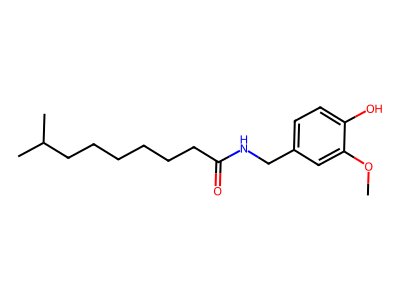
Dihydrocapsaicin
Also known as: 8-Methyl-N-vanillylnonanamide, N-(4-Hydroxy-3-methoxybenzyl)-8-methylnonanamide, 6,7-Dihydrocapsaicin, Nonanamide, 8-methyl-N-vanillyl-, N-[(4-Hydroxy-3-methoxy-phenyl)methyl]-8-methyl-nonanamide, 8-methyl-N-vanillyl-nonamide, 8-methyl-nonanoic acid vanillylamide, FEMA 3404, MFCD00057794
Dihydrocapsaicin (CAS 19408-84-5) is a compound in the Organic Compounds category listed in the Jingsj chemical database. It has the molecular formula C18H29NO3 and a molecular weight of 307.428 g/mol. Key properties include a melting point of 62-65 °C(lit.), a boiling point of 457.3±55.0 °C at 760 mmHg, a density of 1.0±0.1 g/cm3 and a flash point of 230.4±31.5 °C. It is classified under GHS with signal word Danger and hazard statements H301 — Toxic if swallowed, H315 — Causes skin irritation and H319 — Causes serious eye irritation. No supplier offers are currently listed; request a quote. Record last updated Aug 21, 2026.
- CAS No.
- 19408-84-5
- Jingsj CID
- J-35969-3
- Molecular Formula
- C18H29NO3
- Molecular Weight
- 307.428 g/mol
- Category
- Organic Compounds
- Last updated
- 8/21/2026
No offers for this compound yet.
Request a quotePhysicochemical Properties
| Melting Point | 62-65 °C(lit.) |
|---|---|
| Boiling Point | 457.3±55.0 °C at 760 mmHg |
| Density | 1.0±0.1 g/cm3 |
| Flash Point | 230.4±31.5 °C |
| Exact Mass | 307.214752 |
| PSA | 58.56000 |
| LogP | 4.72 |
| Vapor Pressure | 0.0±1.2 mmHg at 25°C |
| Refractive Index | 1.508 |
| Storage Conditions | 2-8°C |
| Additional Property | H2O: insoluble |
GHS Safety & Compliance
- H301 — Toxic if swallowed
- H315 — Causes skin irritation
- H319 — Causes serious eye irritation
- H335 — May cause respiratory irritation
Activity & Biological Data
| Additional Information | [1]. Gao F, et al. Impairment in function and expression of transient receptor potential vanilloid type 4 in Dahl salt-sensitive rats: significance and mechanism. Hypertension. 2010 Apr;55(4):1018-25. [2]. Dihydrocapsaicin, et al. Dihydrocapsaicin (DHC) enhances the hypothermia-induced neuroprotection following ischemic stroke via PI3K/Akt regulation in rat. Brain Res. 2017 Sep 15;1671:18-25. |
|---|
Customs & Trade Information
| HS Code | 2924299090 |
|---|---|
| Summary | 2924299090. other cyclic amides (including cyclic carbamates) and their derivatives; salts thereof. VAT:17.0%. Tax rebate rate:13.0%. . MFN tariff:6.5%. General tariff:30.0% |
Frequently Asked Questions
What is the CAS number of Dihydrocapsaicin?
The CAS number of Dihydrocapsaicin is 19408-84-5.
What are the molecular formula and molecular weight of Dihydrocapsaicin?
Dihydrocapsaicin has molecular formula C18H29NO3 and molecular weight 307.428 g/mol.
Is Dihydrocapsaicin hazardous?
Dihydrocapsaicin has GHS signal word Danger and hazard statements H301 — Toxic if swallowed; H315 — Causes skin irritation; H319 — Causes serious eye irritation.
What are the upstream and downstream products of Dihydrocapsaicin?
For Dihydrocapsaicin, Upstream Products: 4-Hydroxy-3-methoxybenzylamine hydrochloride, Capsaicin, (Z)-Capsaicin.
Data compiled from public chemical databases such as PubChem and supplier catalogs; supplier offers are provided by suppliers.
Last updated:
How to cite: Jingsj. "Dihydrocapsaicin (CAS 19408-84-5)". Jingsj Chemical Database. https://www.jingsj.com/compound/J-35969-3 (accessed 2026-11-09).
Data for reference only; verify product details with suppliers before purchase.