
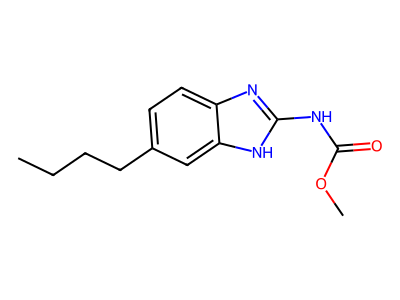
Parbendazole
Also known as: Methyl (5-butyl-1H-benzimidazol-2-yl)carbamate, Methyl (5-butyl-1H-benzo[d]imidazol-2-yl)carbamate, Methyl (5-butyl-1H-benzoimidazol-2-yl)carbamate, Carbamic acid, N-(5-butyl-1H-benzimidazol-2-yl)-, methyl ester, SK&F 29044, Helmatac, Verminum, PBDZ, Methyl5-butyl-2-benzimidazolecarbamate, TCMDC-131798
Parbendazole (CAS 14255-87-9) is a compound in the Aromatic Hydrocarbons category listed in the Jingsj chemical database. It has the molecular formula C13H17N3O2 and a molecular weight of 247.293 g/mol. Key properties include a melting point of 255-257°C and a density of 1.2±0.1 g/cm3. It is classified under GHS with signal word Warning and hazard statements H302 — Harmful if swallowed and H361 — Suspected of damaging fertility or the unborn child. No supplier offers are currently listed; request a quote. Record last updated Aug 21, 2026.
- CAS No.
- 14255-87-9
- Jingsj CID
- J-32740-6
- Molecular Formula
- C13H17N3O2
- Molecular Weight
- 247.293 g/mol
- Category
- Aromatic Hydrocarbons
- Last updated
- 8/21/2026
No offers for this compound yet.
Request a quotePhysicochemical Properties
| Melting Point | 255-257°C |
|---|---|
| Density | 1.2±0.1 g/cm3 |
| Exact Mass | 247.132080 |
| PSA | 67.01000 |
| LogP | 3.57 |
| Refractive Index | 1.632 |
| Stability | Stable. Incompatible with strong oxidizing agents. |
| Additional Property | <0.1 g/100 mL at 18 ºC |
GHS Safety & Compliance
- H302 — Harmful if swallowed
- H361 — Suspected of damaging fertility or the unborn child
Activity & Biological Data
| Target | EC50: 8.79 nM (tubulin)[1] |
|---|---|
| Additional Information | [1]. Lo YC, et al. Computational Cell Cycle Profiling of Cancer Cells for Prioritizing FDA-Approved Drugs with Repurposing Potential. Sci Rep. 2017 Sep 12;7(1):11261. [2]. Lo YC, et al. Computational Cell Cycle Profiling of Cancer Cells for Prioritizing FDA-Approved Drugs with Repurposing Potential. Sci Rep. 2017 Sep 12;7(1):11261. [3]. Havercroft JC, et al. Binding of parbendazole to tubulin and its influence on microtubules in tissue-culture cells as revealed by immunofluorescence microscopy. J Cell Sci. 1981 Jun;49:195-204. [4]. Havercroft JC, et al. Binding of parbendazole to tubulin and its influence on microtubules in tissue-culture cells as revealed by immunofluorescence microscopy. J Cell Sci. 1981 Jun;49:195-204. [5]. Foster KE, et al. A mutant beta-tubulin confers resistance to the action of benzimidazole-carbamate microtubule inhibitors both in vivo and in vitro. Eur J Biochem. 1987 Mar 16;163(3):449-55. [6]. Foster KE, et al. A mutant beta-tubulin confers resistance to the action of benzimidazole-carbamate microtubule inhibitors both in vivo and in vitro. Eur J Biochem. 1987 Mar 16;163(3):449-55. |
Customs & Trade Information
| HS Code | 2933990090 |
|---|---|
| Summary | 2933990090. heterocyclic compounds with nitrogen hetero-atom(s) only. VAT:17.0%. Tax rebate rate:13.0%. . MFN tariff:6.5%. General tariff:20.0% |
Frequently Asked Questions
What is the CAS number of Parbendazole?
The CAS number of Parbendazole is 14255-87-9.
What are the molecular formula and molecular weight of Parbendazole?
Parbendazole has molecular formula C13H17N3O2 and molecular weight 247.293 g/mol.
Is Parbendazole hazardous?
Parbendazole has GHS signal word Warning and hazard statements H302 — Harmful if swallowed; H361 — Suspected of damaging fertility or the unborn child.
Data compiled from public chemical databases such as PubChem and supplier catalogs; supplier offers are provided by suppliers.
Last updated:
How to cite: Jingsj. "Parbendazole (CAS 14255-87-9)". Jingsj Chemical Database. https://www.jingsj.com/compound/J-32740-6 (accessed 2026-11-07).
Data for reference only; verify product details with suppliers before purchase.