
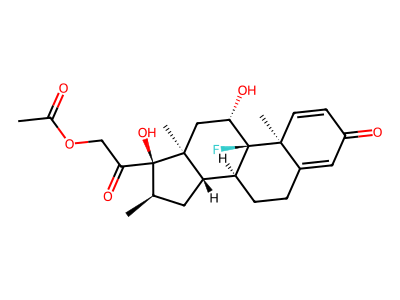
Dexamethasone acetate
Also known as: Dexamethasone 21-acetate, Dexamethasone-17-acetate, Dexamethasone (acetate), 9α-Fluoro-16α-methylprednisolone acetate, (11β,16α)-9-Fluoro-11,17-dihydroxy-16-methyl-3,20-dioxopregna-1,4-dien-21-yl acetate, 9-Fluoro-11,17-dihydroxy-16-methyl-3,20-dioxopregna-1,4-dien-21-yl acetate, Dalalone D.P., Decadronal, Dectancyl, Fortecortin, NSC 39471, Prednitin
Dexamethasone acetate (CAS 1177-87-3) is a compound in the Organic Acids category listed in the Jingsj chemical database. It has the molecular formula C24H31FO6 and a molecular weight of 434.498 g/mol. Key properties include a melting point of 238-240 °C(lit.), a boiling point of 579.4±50.0 °C at 760 mmHg, a density of 1.3±0.1 g/cm3 and a flash point of 304.2±30.1 °C. It is classified under GHS with signal word Warning and hazard statements H317 — May cause an allergic skin reaction. No supplier offers are currently listed; request a quote. Record last updated Aug 21, 2026.
- CAS No.
- 1177-87-3
- Jingsj CID
- J-28200-8
- Molecular Formula
- C24H31FO6
- Molecular Weight
- 434.498 g/mol
- Category
- Organic Acids
- Last updated
- 8/21/2026
No offers for this compound yet.
Request a quotePhysicochemical Properties
| Melting Point | 238-240 °C(lit.) |
|---|---|
| Boiling Point | 579.4±50.0 °C at 760 mmHg |
| Density | 1.3±0.1 g/cm3 |
| Flash Point | 304.2±30.1 °C |
| Exact Mass | 434.210480 |
| PSA | 100.90000 |
| LogP | 2.96 |
| Vapor Pressure | 0.0±3.6 mmHg at 25°C |
| Refractive Index | 1.571 |
GHS Safety & Compliance
- H317 — May cause an allergic skin reaction
Activity & Biological Data
| Target | Glucocorticoid receptor[1] |
|---|---|
| Additional Information | [1]. LaLone CA, et al. Effects of a glucocorticoid receptor agonist, Dexamethasone, on fathead minnow reproduction, growth, and development. Environ Toxicol Chem. 2012 Mar;31(3):611-22. [2]. Adcock IM, et al. Ligand-induced differentiation of glucocorticoid receptor (GR) trans-repression and transactivation: preferential targetting of NF-kappaB and lack of I-kappaB involvement. Br J Pharmacol. 1999 Jun;127(4):1003-11 [3]. Rocksén D, et al. Differential anti-inflammatory and anti-oxidative effects of Dexamethasone and N-acetylcysteine in endotoxin-induced lung inflammation. Clin Exp Immunol. 2000 Nov;122(2):249-56 [4]. Roussel D, et al. Dexamethasone treatment specifically increases the basal proton conductance of rat liver mitochondria. FEBS Lett. 2003 Apr 24;541(1-3):75-9. |
Customs & Trade Information
| HS Code | 2937229000 |
|---|
Frequently Asked Questions
What is the CAS number of Dexamethasone acetate?
The CAS number of Dexamethasone acetate is 1177-87-3.
What are the molecular formula and molecular weight of Dexamethasone acetate?
Dexamethasone acetate has molecular formula C24H31FO6 and molecular weight 434.498 g/mol.
Is Dexamethasone acetate hazardous?
Dexamethasone acetate has GHS signal word Warning and hazard statements H317 — May cause an allergic skin reaction.
What are the upstream and downstream products of Dexamethasone acetate?
For Dexamethasone acetate, Upstream Products: 9β,11β-Epoxy-17,21-dihydroxy-16β-methylpregna-1,4-diene-3,20-dione 21-Acetate, 17α,21-Dihydroxy-16α-methylpregna-1,4,9(11)-triene-3,20-dione 21-acetate; Downstream Products: Dexamethasone.
Data compiled from public chemical databases such as PubChem and supplier catalogs; supplier offers are provided by suppliers.
Last updated:
How to cite: Jingsj. "Dexamethasone acetate (CAS 1177-87-3)". Jingsj Chemical Database. https://www.jingsj.com/compound/J-28200-8 (accessed 2026-11-09).
Data for reference only; verify product details with suppliers before purchase.