
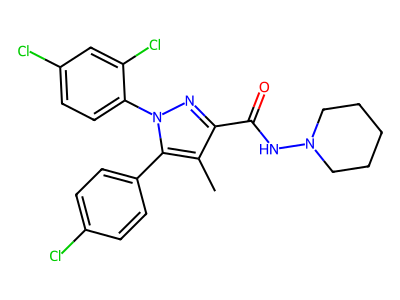
Rimonabant
Also known as: SR141716, SR 141716A, SR-141716A, Acomplia, Zimulti, A 281, MFCD04034714, Unii-rml78en3xe, 5-(4-Chlorophenyl)-1-(2,4-dichlorophenyl)-4-methyl-N-(1-piperidinyl)-1H-pyrazole-3-carboxamide, 5-(4-Chlorophenyl)-1-(2,4-dichlorophenyl)-4-methyl-N-(piperidin-1-yl)-1H-pyrazole-3-carboxamide, 5-(4-Chlorophenyl)-1-(2,4-dichlorophenyl)-4-methyl-N-piperidinopyrazole-3-carboxamide, 1H-Pyrazole-3-carboxamide, 5-(4-chlorophenyl)-1-(2,4-dichlorophenyl)-4-methyl-N-1-piperidinyl-, 5-(4-Chlorophenyl)-1-(2,4-dichlorophenyl)-4-methyl-N-1-piperidinyl-1H-pyrazole-3-carboxamide
Rimonabant (CAS 168273-06-1) is a compound in the Organic Compounds category listed in the Jingsj chemical database. It has the molecular formula C22H21Cl3N4O and a molecular weight of 463.787 g/mol. Key properties include a melting point of 230-240ºC, a boiling point of 627.6ºC at 760 mmHg, a density of 1.4±0.1 g/cm3 and a flash point of 333.3ºC. No supplier offers are currently listed; request a quote. Record last updated Aug 21, 2026.
- CAS No.
- 168273-06-1
- Jingsj CID
- J-2342-7
- Molecular Formula
- C22H21Cl3N4O
- Molecular Weight
- 463.787 g/mol
- Category
- Organic Compounds
- Last updated
- 8/21/2026
No offers for this compound yet.
Request a quotePhysicochemical Properties
| Melting Point | 230-240ºC |
|---|---|
| Boiling Point | 627.6ºC at 760 mmHg |
| Density | 1.4±0.1 g/cm3 |
| Flash Point | 333.3ºC |
| Exact Mass | 462.078094 |
| PSA | 50.16000 |
| LogP | 6.01 |
| Refractive Index | 1.668 |
| Storage Conditions | 2~8°C |
Activity & Biological Data
| Additional Information | [1]. Heppenstall C, Bunce S, Smith JC. Relationships between glucose, energy intake and dietary composition in obese adults with type 2 diabetes receiving the cannabinoid 1 (CB1) receptor antagonist, rimonabant. Nutr J. 2012 Jul 23;11(1):50. [2]. Seely KA, Brents LK, Franks LN, Rajasekaran M, Zimmerman SM, Fantegrossi WE, Prather PL. AM-251 and rimonabant act as direct antagonists at mu-opioid receptors: Implications for opioid/cannabinoid interaction studies. Neuropharmacology. 2012 Oct;63(5):9 [3]. Mandhane S, Nayak P, Soni D, Jain S, Ashton JC, Rajamannar T. Induction of glucose intolerance by acute administration of rimonabant. Pharmacology. 2012;89(5-6):339-47. [4]. Leite, C.E., Mocelin, C.A., Petersen, G.O., et al. Rimonabant: An antagonist drug of the endocannabinoid system for the treatment of obesity. Pharmacol Rep 61 217-224 (2009). [5]. Erdozain, A. M. et al. The inverse agonist effect of rimonabant on G protein activation is not mediated by the cannabinoid CB1 receptor: Evidence from postmortem human brain Biochemical Pharmacology (2012), 83(2), 260-268. |
|---|
Customs & Trade Information
| HS Code | 2933990090 |
|---|---|
| Summary | 2933990090. heterocyclic compounds with nitrogen hetero-atom(s) only. VAT:17.0%. Tax rebate rate:13.0%. . MFN tariff:6.5%. General tariff:20.0% |
Frequently Asked Questions
What is the CAS number of Rimonabant?
The CAS number of Rimonabant is 168273-06-1.
What are the molecular formula and molecular weight of Rimonabant?
Rimonabant has molecular formula C22H21Cl3N4O and molecular weight 463.787 g/mol.
What are the upstream and downstream products of Rimonabant?
For Rimonabant, Upstream Products: 1-Aminopiperidine, Rimonabant hydrochloride, ethyl 5-(4-chlorophenyl)-1-(2,4-dichlorophenyl)-4-methyl-1H-pyrazole-3-carboxylate; Downstream Products: Rimonabant hydrochloride.
Data compiled from public chemical databases such as PubChem and supplier catalogs; supplier offers are provided by suppliers.
Last updated:
How to cite: Jingsj. "Rimonabant (CAS 168273-06-1)". Jingsj Chemical Database. https://www.jingsj.com/compound/J-2342-7 (accessed 2026-11-09).
Data for reference only; verify product details with suppliers before purchase.