
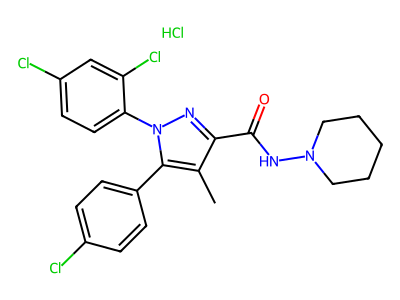
Rimonabant hydrochloride
Also known as: SR 141716A, Acomplia, 5-(4-Chlorophenyl)-1-(2,4-dichlorophenyl)-4-methyl-N-(1-piperidinyl)-1H-pyrazole-3-carboxamide hydrochloride, 5-(4-Chlorophenyl)-1-(2,4-dichlorophenyl)-4-methyl-N-(piperidin-1-yl)-1H-pyrazole-3-carboxamide hydrochloride, 1H-Pyrazole-3-carboxamide, 5-(4-chlorophenyl)-1-(2,4-dichlorophenyl)-4-methyl-N-1-piperidinyl-, hydrochloride (1:1), 5-(4-chlorophenyl)-1-(2,4-dichlorophenyl)-4-methyl-N-piperidin-1-ylpyrazole-3-carboxamide hydrochloride, 5-(4-chlorophenyl)-1-(2,4-dichlorophenyl)-4-methyl-n-1-piperidinyl-1h-pyrazole-3-carboxamide monohydrochloride, Rimonabant HCl, Rimonabant (Hydrochloride), MFCD04034714
Rimonabant hydrochloride (CAS 158681-13-1) is a compound in the Organic Acids category listed in the Jingsj chemical database. It has the molecular formula C22H22Cl4N4O and a molecular weight of 500.248 g/mol. Key properties include a melting point of 230-240ºC, a boiling point of 627.6ºC at 760 mmHg and a flash point of 333.3ºC. It is classified under GHS with signal word Danger and hazard statements H301 — Toxic if swallowed and H319 — Causes serious eye irritation. No supplier offers are currently listed; request a quote. Record last updated Aug 21, 2026.
- CAS No.
- 158681-13-1
- Jingsj CID
- J-1961668-3
- Molecular Formula
- C22H22Cl4N4O
- Molecular Weight
- 500.248 g/mol
- Category
- Organic Acids
- Last updated
- 8/21/2026
No offers for this compound yet.
Request a quotePhysicochemical Properties
| Melting Point | 230-240ºC |
|---|---|
| Boiling Point | 627.6ºC at 760 mmHg |
| Flash Point | 333.3ºC |
| Exact Mass | 498.054779 |
| PSA | 50.16000 |
| LogP | 7.06940 |
| Storage Conditions | -20°C Freezer |
GHS Safety & Compliance
- H301 — Toxic if swallowed
- H319 — Causes serious eye irritation
Activity & Biological Data
| Target | Ki: 2 nM (CB1 receptor)[1] |
|---|---|
| Additional Information | [1]. Vivian JA, et al. Analgesic, respiratory and heart rate effects of cannabinoid and opioid agonists in rhesus monkeys: antagonist effects of SR 141716A. J Pharmacol Exp Ther. 1998 Aug;286(2):697-703. [2]. Netherland C, et al. Rimonabant is a dual inhibitor of acyl CoA:cholesterol acyltransferases 1 and 2. Biochem Biophys Res Commun. 2010 Aug 6;398(4):671-6. [3]. Rodríguez-Arias M, et al. Effects of Cannabinoid Exposure during Adolescence on the Conditioned Rewarding Effects of WIN 55212-2 and Cocaine in Mice: Influence of the Novelty-Seeking Trait. Neural Plast. 2016;2016:6481862. |
Frequently Asked Questions
What is the CAS number of Rimonabant hydrochloride?
The CAS number of Rimonabant hydrochloride is 158681-13-1.
What are the molecular formula and molecular weight of Rimonabant hydrochloride?
Rimonabant hydrochloride has molecular formula C22H22Cl4N4O and molecular weight 500.248 g/mol.
Is Rimonabant hydrochloride hazardous?
Rimonabant hydrochloride has GHS signal word Danger and hazard statements H301 — Toxic if swallowed; H319 — Causes serious eye irritation.
What are the upstream and downstream products of Rimonabant hydrochloride?
For Rimonabant hydrochloride, Upstream Products: 1-Aminopiperidine, Rimonabant, 4'-Chloropropiophenone; Downstream Products: Rimonabant.
Data compiled from public chemical databases such as PubChem and supplier catalogs; supplier offers are provided by suppliers.
Last updated:
How to cite: Jingsj. "Rimonabant hydrochloride (CAS 158681-13-1)". Jingsj Chemical Database. https://www.jingsj.com/compound/J-1961668-3 (accessed 2026-11-09).
Data for reference only; verify product details with suppliers before purchase.