
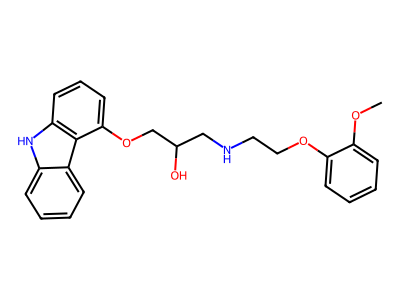
Carvedilol
Also known as: 1-(9H-carbazol-4-yloxy)-3-[2-(2-methoxyphenoxy)ethylamino]propan-2-ol, 1-(9H-Carbazol-4-yloxy)-3-[[2-(2-methoxyphenoxy)ethyl]amino]-2-propanol, 1-(9H-carbazol-4-yloxy)-3-{[2-(2-methoxyphenoxy)ethyl]amino}-2-propanol, 1-(9H-carbazol-4-yloxy)-3-[(2-{[2-(methyloxy)phenyl]oxy}ethyl)amino]propan-2-ol, 1-(9H-carbazol-4-yloxy)-3-[2-(2-methoxy-phenoxy)-ethylamino]-propan-2-ol, 1-(9h-carbazol-4-yloxy)-3-((2-(2-methoxyphenoxy)ethyl)amino)-2-propano, 1-[carbazolyl-(4)-oxy]-3-[(2-methoxyphenoxyethyl)amino]-propanol-(2), 2-Propanol, 1-(9H-carbazol-4-yloxy)-3-[[2-(2-methoxyphenoxy)ethyl]amino]-, BM-14190, COREG, Carvedilolum, Coreg, Coropress, DILATREND, DIMITONE, DQ-2466, Dilatrend, Dimitone, Eucardic, Kredex
Carvedilol (CAS 72956-09-3) is a compound in the Organic Compounds category listed in the Jingsj chemical database. It has the molecular formula C24H26N2O4 and a molecular weight of 406.474 g/mol. Key properties include a melting point of 113-117ºC, a boiling point of 655.2±55.0 °C at 760 mmHg, a density of 1.3±0.1 g/cm3 and a flash point of 350.1±31.5 °C. GHS hazard statements: H411 — Toxic to aquatic life with long lasting effects. No supplier offers are currently listed; request a quote. Record last updated Aug 21, 2026.
- CAS No.
- 72956-09-3
- Jingsj CID
- J-22858-0
- Molecular Formula
- C24H26N2O4
- Molecular Weight
- 406.474 g/mol
- Category
- Organic Compounds
- Last updated
- 8/21/2026
No offers for this compound yet.
Request a quotePhysicochemical Properties
| Melting Point | 113-117ºC |
|---|---|
| Boiling Point | 655.2±55.0 °C at 760 mmHg |
| Density | 1.3±0.1 g/cm3 |
| Flash Point | 350.1±31.5 °C |
| Exact Mass | 406.189270 |
| PSA | 75.74000 |
| LogP | 4.11 |
| Vapor Pressure | 0.0±2.1 mmHg at 25°C |
| Refractive Index | 1.657 |
GHS Safety & Compliance
- H411 — Toxic to aquatic life with long lasting effects
Activity & Biological Data
| Additional Information | [1]. Chen J, Huang C, Zhang B, et al. The effects of carvedilol on cardiac structural remodeling: The role of endogenous nitric oxide in the activity of carvedilol. Mol Med Rep. 2013 Apr;7(4):1155-8. [2]. Stafylas PC, Sarafidis PA. Carvedilol in hypertension treatment. Vasc Health Risk Manag. 2008;4(1):23-30. [3]. Othman AA, Tenero DM, Boyle DA et al. Population pharmacokinetics of S(-)-carvedilol in healthy volunteers after administration of the immediate-release (IR) and the new controlled-release (CR) dosage forms of the racemate. AAPS J. 2007 Jun 15;9(2):E208-1 [4]. Koshimizu TA, Tsujimoto G, Hirasawa A et al. Carvedilol selectively inhibits oscillatory intracellular calcium changes evoked by human alpha1D- and alpha1B-adrenergic receptors. Cardiovasc Res. 2004 Sep 1;63(4):662-72. |
|---|
Customs & Trade Information
| HS Code | 2933990090 |
|---|---|
| Summary | 2933990090. heterocyclic compounds with nitrogen hetero-atom(s) only. VAT:17.0%. Tax rebate rate:13.0%. . MFN tariff:6.5%. General tariff:20.0% |
Frequently Asked Questions
What is the CAS number of Carvedilol?
The CAS number of Carvedilol is 72956-09-3.
What are the molecular formula and molecular weight of Carvedilol?
Carvedilol has molecular formula C24H26N2O4 and molecular weight 406.474 g/mol.
Is Carvedilol hazardous?
Carvedilol has GHS hazard statements H411 — Toxic to aquatic life with long lasting effects.
What are the upstream and downstream products of Carvedilol?
For Carvedilol, Upstream Products: N-Benzyl Carvedilol, 4-(2,3-Epoxypropoxy)carbazole, Carvedilol; Downstream Products: (R)-Carvedilol, (S)-Carvedilol, Carvedilol.
Data compiled from public chemical databases such as PubChem and supplier catalogs; supplier offers are provided by suppliers.
Last updated:
How to cite: Jingsj. "Carvedilol (CAS 72956-09-3)". Jingsj Chemical Database. https://www.jingsj.com/compound/J-22858-0 (accessed 2026-11-09).
Data for reference only; verify product details with suppliers before purchase.