
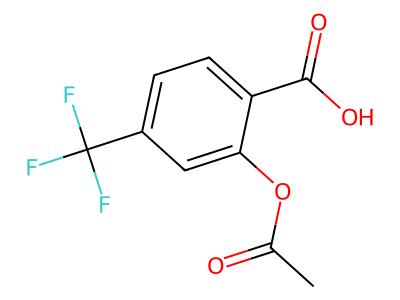
Triflusal
Also known as: 2-Acetoxy-4-(trifluoromethyl)benzoic acid, 2-Acetoxy-4-trifluoromethylbenzoic acid, 2-(Acetyloxy)-4-(trifluoromethyl)benzoic acid, 2-Carboxy-5-(trifluoromethyl)phenyl acetate, Disgren, UR 1501, α,α,α-Trifluoro-2,4-cresotic acid acetate, Triflusalum, Triflux
Triflusal (CAS 322-79-2) is a compound in the Organic Acids category listed in the Jingsj chemical database. It has the molecular formula C10H7F3O4 and a molecular weight of 248.155 g/mol. Key properties include a melting point of 115 °C, a boiling point of 316.0±42.0 °C at 760 mmHg, a density of 1.4±0.1 g/cm3 and a flash point of 144.9±27.9 °C. It is classified under GHS with signal word Warning and hazard statements H302 — Harmful if swallowed, H315 — Causes skin irritation and H317 — May cause an allergic skin reaction. No supplier offers are currently listed; request a quote. Record last updated Aug 21, 2026.
- CAS No.
- 322-79-2
- Jingsj CID
- J-1980137-7
- Molecular Formula
- C10H7F3O4
- Molecular Weight
- 248.155 g/mol
- Category
- Organic Acids
- Last updated
- 8/21/2026
No offers for this compound yet.
Request a quotePhysicochemical Properties
| Melting Point | 115 °C |
|---|---|
| Boiling Point | 316.0±42.0 °C at 760 mmHg |
| Density | 1.4±0.1 g/cm3 |
| Flash Point | 144.9±27.9 °C |
| Exact Mass | 248.029648 |
| PSA | 63.60000 |
| LogP | 2.90 |
| Vapor Pressure | 0.0±0.7 mmHg at 25°C |
| Refractive Index | 1.484 |
| Storage Conditions | 2-8°C |
GHS Safety & Compliance
- H302 — Harmful if swallowed
- H315 — Causes skin irritation
- H317 — May cause an allergic skin reaction
- H319 — Causes serious eye irritation
- H335 — May cause respiratory irritation
Activity & Biological Data
| Target | COX-2:280 μM (IC50) COX-2:160 μM (IC50, in human blood) |
|---|---|
| Additional Information | [1]. Fernández de Arriba A, et al. Inhibition of cyclooxygenase-2 expression by 4-trifluoromethyl derivatives of salicylate, triflusal, and its deacetylated metabolite, 2-hydroxy-4-trifluoromethylbenzoic acid. Mol Pharmacol. 1999 Apr;55(4):753-60. [2]. Duran, X., et al., Protective effects of triflusal on secondary thrombus growth and vascular cyclooxygenase-2. J Thromb Haemost, 2008. 6(8): p. 1385-92. [3]. De Miguel, L.S., et al., A 4-trifluoromethyl derivative of salicylate, triflusal, stimulates nitric oxide production by human neutrophils: role in platelet function. Eur J Clin Invest, 2000. 30(9): p. 811-7. |
Customs & Trade Information
| HS Code | 2918990090 |
|---|---|
| Summary | 2918990090. other carboxylic acids with additional oxygen function and their anhydrides, halides, peroxides and peroxyacids; their halogenated, sulphonated, nitrated or nitrosated derivatives. VAT:17.0%. Tax rebate rate:13.0%. . MFN tariff:6.5%. General tariff:30.0% |
Frequently Asked Questions
What is the CAS number of Triflusal?
The CAS number of Triflusal is 322-79-2.
What are the molecular formula and molecular weight of Triflusal?
Triflusal has molecular formula C10H7F3O4 and molecular weight 248.155 g/mol.
Is Triflusal hazardous?
Triflusal has GHS signal word Warning and hazard statements H302 — Harmful if swallowed; H315 — Causes skin irritation; H317 — May cause an allergic skin reaction.
What are the upstream and downstream products of Triflusal?
For Triflusal, Upstream Products: 3-(Trifluoromethyl)phenol, 4-Trifluoromethylsalicylic acid; Downstream Products: 4-Trifluoromethylsalicylic acid.
Data compiled from public chemical databases such as PubChem and supplier catalogs; supplier offers are provided by suppliers.
Last updated:
How to cite: Jingsj. "Triflusal (CAS 322-79-2)". Jingsj Chemical Database. https://www.jingsj.com/compound/J-1980137-7 (accessed 2026-11-09).
Data for reference only; verify product details with suppliers before purchase.