
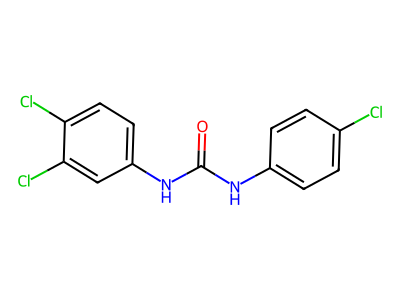
Triclocarban
Also known as: TCC, Trichlorocarbanilide, 3,4,4'-Trichlorocarbanilide, N-(4-Chlorophenyl)-N'-(3,4-dichlorophenyl)urea, 1-(4-Chlorophenyl)-3-(3,4-dichlorophenyl)urea, N-(4-Chlorophenyl)-N-(3,4-dichlorophenyl)urea, Procutene, Solubacter, Nobacer
Triclocarban (CAS 101-20-2) is a compound in the Organohalogen Compounds category listed in the Jingsj chemical database. It has the molecular formula C13H9Cl3N2O and a molecular weight of 315.582 g/mol. Key properties include a melting point of 254-256 °C(lit.), a boiling point of 475.3±55.0 °C at 760 mmHg, a density of 1.4±0.1 g/cm3 and a flash point of 241.2±31.5 °C. It is classified under GHS with signal word Warning and hazard statements H410 — Very toxic to aquatic life with long lasting effects. No supplier offers are currently listed; request a quote. Record last updated Aug 21, 2026.
- CAS No.
- 101-20-2
- Jingsj CID
- J-19199-9
- Molecular Formula
- C13H9Cl3N2O
- Molecular Weight
- 315.582 g/mol
- Category
- Organohalogen Compounds
- Last updated
- 8/21/2026
No offers for this compound yet.
Request a quotePhysicochemical Properties
| Melting Point | 254-256 °C(lit.) |
|---|---|
| Boiling Point | 475.3±55.0 °C at 760 mmHg |
| Density | 1.4±0.1 g/cm3 |
| Flash Point | 241.2±31.5 °C |
| Exact Mass | 313.978058 |
| PSA | 41.13000 |
| LogP | 5.66 |
| Vapor Pressure | 0.0±1.2 mmHg at 25°C |
| Refractive Index | 1.630 |
| Storage Conditions | Refrigerator |
| Stability | Stable. Combustible. Incompatible with strong oxidizing agents strong bases. |
| Additional Property | <0.1 g/100 mL at 26 ºC |
GHS Safety & Compliance
- H410 — Very toxic to aquatic life with long lasting effects
Activity & Biological Data
| Target | Bacterial[1] |
|---|---|
| Additional Information | [1]. Kanbara Y, et al. Nanomolar concentration of triclocarban increases the vulnerability of rat thymocytes to oxidative stress. J Toxicol Sci. 2013 Feb;38(1):49-55. [2]. Huang H, et al. The in vitro estrogenic activities of triclosan and triclocarban. J Appl Toxicol. 2014 Sep;34(9):1060-7. [3]. Kennedy RC, et al. Early life triclocarban exposure during lactation affects neonate rat survival. Reprod Sci. 2015 Jan;22(1):75-89. |
Customs & Trade Information
| HS Code | 2924299090 |
|---|---|
| Summary | 2924299090. other cyclic amides (including cyclic carbamates) and their derivatives; salts thereof. VAT:17.0%. Tax rebate rate:13.0%. . MFN tariff:6.5%. General tariff:30.0% |
Frequently Asked Questions
What is the CAS number of Triclocarban?
The CAS number of Triclocarban is 101-20-2.
What are the molecular formula and molecular weight of Triclocarban?
Triclocarban has molecular formula C13H9Cl3N2O and molecular weight 315.582 g/mol.
Is Triclocarban hazardous?
Triclocarban has GHS signal word Warning and hazard statements H410 — Very toxic to aquatic life with long lasting effects.
What are the upstream and downstream products of Triclocarban?
For Triclocarban, Upstream Products: 4-Chloroaniline, 3,4-Dichlorophenyl isocyanate, 4-Chlorophenyl isocyanate; Downstream Products: 4-Chloroaniline, 3,4-Dichloroaniline.
Data compiled from public chemical databases such as PubChem and supplier catalogs; supplier offers are provided by suppliers.
Last updated:
How to cite: Jingsj. "Triclocarban (CAS 101-20-2)". Jingsj Chemical Database. https://www.jingsj.com/compound/J-19199-9 (accessed 2026-11-07).
Data for reference only; verify product details with suppliers before purchase.