
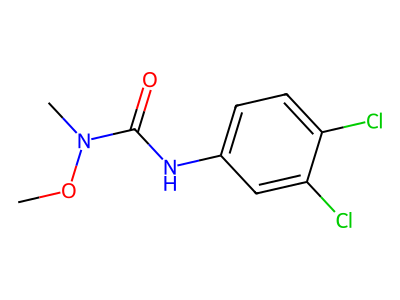
Linuron
Also known as: 1-methoxy-1-methyl-3-(3,4-dichlorophenyl)urea, 3-(3,4-Dichlorophenyl)-1-methoxy-1-methylurea, AFALON, AFALON(R), AGRO-KIMOLIN, LINEX, LINNET, LINUREX, LOROX, Liron, Norunil, N'-(3,4-dichlorophenyl)-N-methoxy-N-methylurea, Urea, N'-(3,4-dichlorophenyl)-N-methoxy-N-methyl-
Linuron (CAS 330-55-2) is a compound in the Organic Compounds category listed in the Jingsj chemical database. It has the molecular formula C9H10Cl2N2O2 and a molecular weight of 249.094 g/mol. Key properties include a melting point of 93-94°C, a boiling point of 361.7±52.0 °C at 760 mmHg, a density of 1.3±0.1 g/cm3 and a flash point of 172.6±30.7 °C. It is classified under GHS with signal word Danger and hazard statements H302 — Harmful if swallowed, H351 — Suspected of causing cancer and H373 — May cause damage to organs through prolonged exposure. No supplier offers are currently listed; request a quote. Record last updated Aug 21, 2026.
- CAS No.
- 330-55-2
- Jingsj CID
- J-11399-5
- Molecular Formula
- C9H10Cl2N2O2
- Molecular Weight
- 249.094 g/mol
- Category
- Organic Compounds
- Last updated
- 8/21/2026
No offers for this compound yet.
Request a quotePhysicochemical Properties
| Melting Point | 93-94°C |
|---|---|
| Boiling Point | 361.7±52.0 °C at 760 mmHg |
| Density | 1.3±0.1 g/cm3 |
| Flash Point | 172.6±30.7 °C |
| Exact Mass | 248.011932 |
| PSA | 41.57000 |
| LogP | 3.33 |
| Vapor Pressure | 0.0±0.9 mmHg at 25°C |
| Refractive Index | 1.556 |
| Additional Property | 0.0075 g/100 mL |
GHS Safety & Compliance
- H302 — Harmful if swallowed
- H351 — Suspected of causing cancer
- H373 — May cause damage to organs through prolonged exposure
- H410 — Very toxic to aquatic life with long lasting effects
Activity & Biological Data
| Target | Ki: 100 μM (Androgen receptor)[2] Photosystem II[4] |
|---|---|
| Additional Information | [1]. Benjamin Horemans, et al. Functional Redundancy of Linuron Degradation in Microbial Communities in Agricultural Soil and Biopurification Systems. Appl Environ Microbiol. 2016 Apr 18;82(9):2843-2853. [2]. C Lambright, et al. Cellular and Molecular Mechanisms of Action of Linuron: An Antiandrogenic Herbicide That Produces Reproductive Malformations in Male Rats. Toxicol Sci. 2000 Aug;56(2):389-99. [3]. Hongwei Ding, et al. Reproductive Toxicity of Linuron Following Gestational Exposure in Rats and Underlying Mechanisms. Toxicol Lett. 2017 Jan 15;266:49-55. [4]. Elżbieta G Magnucka, et al. Various Effects of the Photosystem II--inhibiting Herbicides on 5-n-alkylresorcinol Accumulation in Rye Seedlings. Pestic Biochem Physiol. 2014 Nov;116:56-62. |
Customs & Trade Information
| HS Code | 2928000032 |
|---|---|
| Summary | 2928000032 3-(4-bromo-3-chlorophenyl)-1-methoxy-1-methylurea。supervision conditions:s(import or export registration certificate for pesticides)。VAT:17.0%。tax rebate rate:9.0%。MFN tarrif:6.5%。general tariff:20.0% |
Frequently Asked Questions
What is the CAS number of Linuron?
The CAS number of Linuron is 330-55-2.
What are the molecular formula and molecular weight of Linuron?
Linuron has molecular formula C9H10Cl2N2O2 and molecular weight 249.094 g/mol.
Is Linuron hazardous?
Linuron has GHS signal word Danger and hazard statements H302 — Harmful if swallowed; H351 — Suspected of causing cancer; H373 — May cause damage to organs through prolonged exposure.
What are the upstream and downstream products of Linuron?
For Linuron, Upstream Products: 3,4-Dichlorophenyl isocyanate, Dimethyl sulfate.
Data compiled from public chemical databases such as PubChem and supplier catalogs; supplier offers are provided by suppliers.
Last updated:
How to cite: Jingsj. "Linuron (CAS 330-55-2)". Jingsj Chemical Database. https://www.jingsj.com/compound/J-11399-5 (accessed 2026-11-09).
Data for reference only; verify product details with suppliers before purchase.