
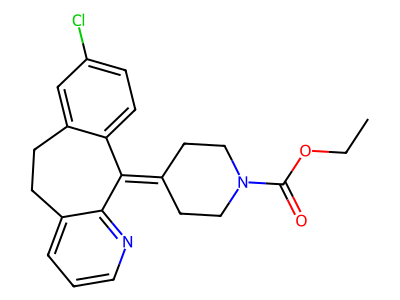
Loratadine
Also known as: Clarityn, Claritin, Claritine, Loranox, Flonidan, Klaritin, Lisino, Civeran, Cronopen, Tadine, Ethyl 4-(8-chloro-5,6-dihydro-11H-benzo[5,6]cyclohepta[1,2-b]pyridin-11-ylidene)-1-piperidinecarboxylate, 4-(8-Chloro-5,6-dihydro-11H-benzo[5,6]cyclohepta[1,2-b]pyridin-11-ylidene)piperidine-1-carboxylic acid ethyl ester, SCH-29851
Loratadine (CAS 79794-75-5) is a compound in the Organohalogen Compounds category listed in the Jingsj chemical database. It has the molecular formula C22H23ClN2O2 and a molecular weight of 382.883 g/mol. Key properties include a melting point of 134-136°C, a boiling point of 531.3±50.0 °C at 760 mmHg, a density of 1.3±0.1 g/cm3 and a flash point of 275.1±30.1 °C. No supplier offers are currently listed; request a quote. Record last updated Aug 21, 2026.
- CAS No.
- 79794-75-5
- Jingsj CID
- J-1014586-5
- Molecular Formula
- C22H23ClN2O2
- Molecular Weight
- 382.883 g/mol
- Category
- Organohalogen Compounds
- Last updated
- 8/21/2026
No offers for this compound yet.
Request a quotePhysicochemical Properties
| Melting Point | 134-136°C |
|---|---|
| Boiling Point | 531.3±50.0 °C at 760 mmHg |
| Density | 1.3±0.1 g/cm3 |
| Flash Point | 275.1±30.1 °C |
| Exact Mass | 382.144806 |
| PSA | 42.43000 |
| LogP | 5.94 |
| Vapor Pressure | 0.0±1.4 mmHg at 25°C |
| Refractive Index | 1.614 |
| Storage Conditions | 2-8°C |
| Stability | Stable, but may be heat sensitive - refrigerate. Incompatible with strong oxidizing agents. |
| Additional Property | DMSO: 26 mg/mL, soluble |
Activity & Biological Data
| Additional Information | [1]. Kay GG, Harris AG. Loratadine: a non-sedating antihistamine. Review of its effects on cognition, psychomotor performance, mood and sedation. Clin Exp Allergy. 1999 Jul;29 Suppl 3:147-50. [2]. Menardo JL, Horak F, Danzig MR, Czarlewski W. A review of loratadine in the treatment of patients with allergic bronchial asthma. Clin Ther. 1997 Nov-Dec;19(6):1278-93; discussion 1523-4. [3]. Monroe EW. Loratadine in the treatment of urticaria. Clin Ther. 1997 Mar-Apr;19(2):232-42. [4]. Haria M, Fitton A, Peters DH. Loratadine. A reappraisal of its pharmacological properties and therapeutic use in allergic disorders. Drugs. 1994 Oct;48(4):617-37. [5]. Roman IJ, Danzig MR. Loratadine. A review of recent findings in pharmacology, pharmacokinetics, efficacy, and safety, with a look at its use in combination with pseudoephedrine. Clin Rev Allergy. 1993 Spring;11(1):89-110. |
|---|
Customs & Trade Information
| HS Code | 2933990090 |
|---|---|
| Summary | 2933990090. heterocyclic compounds with nitrogen hetero-atom(s) only. VAT:17.0%. Tax rebate rate:13.0%. . MFN tariff:6.5%. General tariff:20.0% |
Frequently Asked Questions
What is the CAS number of Loratadine?
The CAS number of Loratadine is 79794-75-5.
What are the molecular formula and molecular weight of Loratadine?
Loratadine has molecular formula C22H23ClN2O2 and molecular weight 382.883 g/mol.
What are the upstream and downstream products of Loratadine?
For Loratadine, Upstream Products: 8-Chloro-11-(1-methyl-4-piperidinylidene)-6,11-dihydro-5H-benzo[5,6]cyclohepta[1,2-b]pyridine, N,N-Diisopropylethylamine, N-tert-butyl-3-methylpyridine-2-carboxamide; Downstream Products: Desloratadine.
Data compiled from public chemical databases such as PubChem and supplier catalogs; supplier offers are provided by suppliers.
Last updated:
How to cite: Jingsj. "Loratadine (CAS 79794-75-5)". Jingsj Chemical Database. https://www.jingsj.com/compound/J-1014586-5 (accessed 2026-11-07).
Data for reference only; verify product details with suppliers before purchase.