
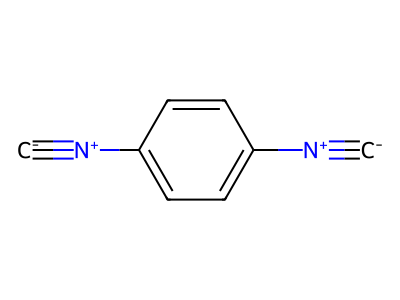
1,4-diisocyanobenzene
1,4-二异腈苯
Also known as: 1,4-Phenylene diisocyanide, p-Phenylenediisocyanide, Benzene, 1,4-diisocyano-, 1,4-diisocyanobenzol, 4-ISOCYANOPHENYLISOCYANIDE, p-Phenylene diisocyanide, 1,4-Phenylene diisocyanide, MFCD00012383
1,4-diisocyanobenzene (CAS 935-16-0) is a compound in the Aromatic Hydrocarbons category listed in the Jingsj chemical database. It has the molecular formula C8H4N2 and a molecular weight of 128.13100 g/mol. It is also known as 1,4-Phenylene diisocyanide, p-Phenylenediisocyanide and Benzene, 1,4-diisocyano-. Key property: a melting point of 160ºC (dec.)(lit.). It is classified under GHS with signal word Warning and hazard statements H302 — Harmful if swallowed, H312 — Harmful in contact with skin and H332 — Harmful if inhaled. No supplier offers are currently listed; request a quote. Record last updated Aug 21, 2026.
- CAS No.
- 935-16-0
- Jingsj CID
- J-26142-5
- Molecular Formula
- C8H4N2
- Chinese Name
- 1,4-二异腈苯
- Molecular Weight
- 128.13100 g/mol
- Category
- Aromatic Hydrocarbons
- Last updated
- 8/21/2026
No offers for this compound yet.
Request a quotePhysicochemical Properties
| Melting Point | 160ºC (dec.)(lit.) |
|---|---|
| Exact Mass | 128.03700 |
| LogP | 1.24960 |
GHS Safety & Compliance
- H302 — Harmful if swallowed
- H312 — Harmful in contact with skin
- H332 — Harmful if inhaled
- H315 — Causes skin irritation
- H319 — Causes serious eye irritation
- H335 — May cause respiratory irritation
Customs & Trade Information
| HS Code | 2926909090 |
|---|---|
| Summary | HS:2926909090 other nitrile-function compounds VAT:17.0% Tax rebate rate:9.0% Supervision conditions:none MFN tariff:6.5% General tariff:30.0% |
Frequently Asked Questions
What is the CAS number of 1,4-diisocyanobenzene?
The CAS number of 1,4-diisocyanobenzene is 935-16-0.
What are the molecular formula and molecular weight of 1,4-diisocyanobenzene?
1,4-diisocyanobenzene has molecular formula C8H4N2 and molecular weight 128.13100 g/mol.
Is 1,4-diisocyanobenzene hazardous?
1,4-diisocyanobenzene has GHS signal word Warning and hazard statements H302 — Harmful if swallowed; H312 — Harmful in contact with skin; H332 — Harmful if inhaled.
Data compiled from public chemical databases and supplier catalogs; supplier offers are provided by suppliers.
Last updated:
How to cite: Jingsj. "1,4-diisocyanobenzene (CAS 935-16-0)". Jingsj Chemical Database. https://www.jingsj.com/compound/J-26142-5 (accessed 2026-10-28).
Data for reference only; verify specifications, grades and regulatory status with suppliers before purchase.