
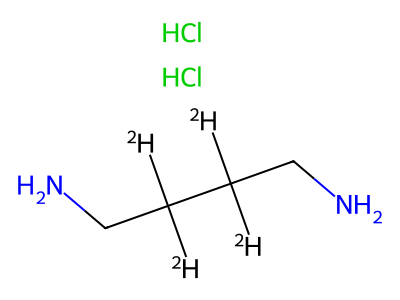
1,4-Butanediamine-2,2,3,3-d4 dihydrochloride
1,4-二氨基丁烷-2,2,3,3-d4 二盐酸盐
Also known as: Putrescine-2,2,3,3-d4 dihydrochloride, 1,4-Diaminobutane-2,2,3,3-d4 dihydrochloride, 1,4-Butanediamine-d4 dihydrochloride, 1,4-Butane-2,2,3,3-d4-diamine dihydrochloride, MFCD01075442
1,4-Butanediamine-2,2,3,3-d4 dihydrochloride (CAS 88972-24-1) is a compound in the Organic Acids category listed in the Jingsj chemical database. It has the molecular formula C4H10Cl2D4N2 and a molecular weight of 165.09800 g/mol. It is also known as Putrescine-2,2,3,3-d4 dihydrochloride, 1,4-Diaminobutane-2,2,3,3-d4 dihydrochloride and 1,4-Butanediamine-d4 dihydrochloride. Key properties include a melting point of 280ºC (dec.)(lit.), a boiling point of 244.5ºC at 760 mmHg and a flash point of 101.7ºC. It is classified under GHS with signal word Warning and hazard statements H315 — Causes skin irritation, H319 — Causes serious eye irritation and H335 — May cause respiratory irritation. No supplier offers are currently listed; request a quote. Record last updated Aug 21, 2026.
- CAS No.
- 88972-24-1
- Jingsj CID
- J-7965-7
- Molecular Formula
- C4H10Cl2D4N2
- Chinese Name
- 1,4-二氨基丁烷-2,2,3,3-d4 二盐酸盐
- Molecular Weight
- 165.09800 g/mol
- Category
- Organic Acids
- Last updated
- 8/21/2026
No offers for this compound yet.
Request a quotePhysicochemical Properties
| Melting Point | 280ºC (dec.)(lit.) |
|---|---|
| Boiling Point | 244.5ºC at 760 mmHg |
| Flash Point | 101.7ºC |
| Exact Mass | 164.07900 |
| PSA | 52.04000 |
| LogP | 2.68860 |
GHS Safety & Compliance
- H315 — Causes skin irritation
- H319 — Causes serious eye irritation
- H335 — May cause respiratory irritation
Activity & Biological Data
| Additional Information | [1]. Russak EM, et al. Impact of Deuterium Substitution on the Pharmacokinetics of Pharmaceuticals. Ann Pharmacother. 2019 Feb;53(2):211-216. [2]. Hauschild MZ. Putrescine (1,4-diaminobutane) as an indicator of pollution-induced stress in higher plants: barley and rape stressed with Cr(III) or Cr(VI). Ecotoxicol Environ Saf. 1993 Oct;26(2):228-47. [3]. E B Sequerra, et al. Putrescine as an important source of GABA in the postnatal rat subventricular zone. Neuroscience. 2007 May 11146(2):489-93. |
|---|
Frequently Asked Questions
What is the CAS number of 1,4-Butanediamine-2,2,3,3-d4 dihydrochloride?
The CAS number of 1,4-Butanediamine-2,2,3,3-d4 dihydrochloride is 88972-24-1.
What are the molecular formula and molecular weight of 1,4-Butanediamine-2,2,3,3-d4 dihydrochloride?
1,4-Butanediamine-2,2,3,3-d4 dihydrochloride has molecular formula C4H10Cl2D4N2 and molecular weight 165.09800 g/mol.
Is 1,4-Butanediamine-2,2,3,3-d4 dihydrochloride hazardous?
1,4-Butanediamine-2,2,3,3-d4 dihydrochloride has GHS signal word Warning and hazard statements H315 — Causes skin irritation; H319 — Causes serious eye irritation; H335 — May cause respiratory irritation.
Data compiled from public chemical databases and supplier catalogs; supplier offers are provided by suppliers.
Last updated:
How to cite: Jingsj. "1,4-Butanediamine-2,2,3,3-d4 dihydrochloride (CAS 88972-24-1)". Jingsj Chemical Database. https://www.jingsj.com/compound/J-7965-7 (accessed 2026-10-28).
Data for reference only; verify specifications, grades and regulatory status with suppliers before purchase.