
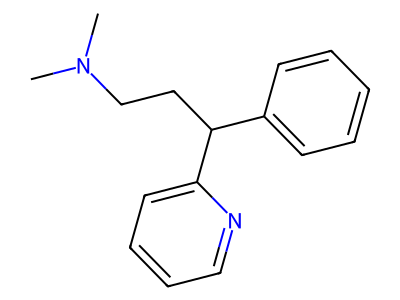
Pheniramine
Also known as: Trimeton, Prophenpyridamine, Avil, Histapyridamine, Propheniramine, Feniramine, Pyriton, Tripoton, Metron, N,N-dimethyl-3-phenyl-3-pyridin-2-ylpropan-1-amine, Dexchlorpheniramine EP Impurity A
Pheniramine (CAS 86-21-5) is a compound in the Organic Compounds category listed in the Jingsj chemical database. It has the molecular formula C16H20N2 and a molecular weight of 240.34300 g/mol. Key properties include a melting point of 30-34 °C(lit.), a boiling point of 84 °C20 mm Hg(lit.), a density of 1.018 g/cm3 and a flash point of 81.7 °C. It is classified under GHS with signal word Danger and hazard statements H225 — Highly flammable liquid and vapour, H301 — Toxic if swallowed and H311 — Toxic in contact with skin. No supplier offers are currently listed; request a quote. Record last updated Nov 2, 2026.
- CAS No.
- 86-21-5
- Jingsj CID
- J-34009-0
- Molecular Formula
- C16H20N2
- Molecular Weight
- 240.34300 g/mol
- Category
- Organic Compounds
- Last updated
- 11/2/2026
No offers for this compound yet.
Request a quotePhysicochemical Properties
| Melting Point | 30-34 °C(lit.) |
|---|---|
| Boiling Point | 84 °C20 mm Hg(lit.) |
| Density | 1.018 g/cm3 |
| Flash Point | 81.7 °C |
| Exact Mass | 240.16300 |
| PSA | 16.13000 |
| LogP | 3.16520 |
| Refractive Index | 1.556 |
| Storage Conditions | ?20°C |
GHS Safety & Compliance
- H225 — Highly flammable liquid and vapour
- H301 — Toxic if swallowed
- H311 — Toxic in contact with skin
- H331 — Toxic if inhaled
- H370 — Causes damage to organs
Activity & Biological Data
| Target | H1 Receptor:1.01 mM (IC50) |
|---|---|
| Additional Information | [1]. Sharma A, et al. Classic histamine H1 receptor antagonists: a critical review of their metabolic and pharmacokinetic fate from a bird's eye view. Curr Drug Metab. 2003 Apr;4(2):105-29. [2]. Brown RD, et al. Alpha 1-adrenergic and H1-histamine receptor control of intracellular Ca2+ in a muscle cell line: the influence of prior agonist exposure on receptor responsiveness. Mol Pharmacol. 1986 Jun;29(6):531-9. [3]. Jangi SM, et al. Apoptosis of human T-cell acute lymphoblastic leukemia cells by diphenhydramine, an H1 histamine receptor antagonist. Oncol Res. 2004;14(7-8):363-72. [4]. Hung CH, et al. Spinal anesthesia with diphenhydramine and pheniramine in rats. Eur J Pharmacol. 2011 Dec 30;673(1-3):20-4. |
Customs & Trade Information
| HS Code | 2933399090 |
|---|---|
| Summary | 2933399090. other compounds containing an unfused pyridine ring (whether or not hydrogenated) in the structure. VAT:17.0%. Tax rebate rate:13.0%. . MFN tariff:6.5%. General tariff:20.0% |
Frequently Asked Questions
What is the CAS number of Pheniramine?
The CAS number of Pheniramine is 86-21-5.
What are the molecular formula and molecular weight of Pheniramine?
Pheniramine has molecular formula C16H20N2 and molecular weight 240.34300 g/mol.
Is Pheniramine hazardous?
Pheniramine has GHS signal word Danger and hazard statements H225 — Highly flammable liquid and vapour; H301 — Toxic if swallowed; H311 — Toxic in contact with skin.
What are the upstream and downstream products of Pheniramine?
For Pheniramine, Upstream Products: Dimethylamine, Acetylene.
Data compiled from public chemical databases such as PubChem and supplier catalogs; supplier offers are provided by suppliers.
Last updated:
How to cite: Jingsj. "Pheniramine (CAS 86-21-5)". Jingsj Chemical Database. https://www.jingsj.com/compound/J-34009-0 (accessed 2026-11-09).
Data for reference only; verify product details with suppliers before purchase.