
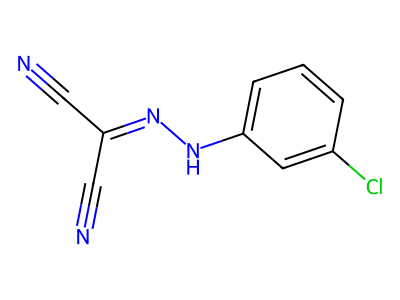
Carbonyl cyanide 3-chlorophenylhydrazone
羰基氰化氯苯腙
Also known as: CCCP, Carbonyl cyanide m-chlorophenylhydrazone, m-Cl-CCP, Mesoxalonitrile 3-chlorophenylhydrazone, 2-[(3-chlorophenyl)hydrazinylidene]propanedinitrile, Propanedinitrile, [(3-chlorophenyl)hydrazono]-, NSC 88124, EINECS 209-103-7, MFCD00001848
Carbonyl cyanide 3-chlorophenylhydrazone (CAS 555-60-2) is a compound in the Aromatic Hydrocarbons category listed in the Jingsj chemical database. It has the molecular formula C9H5ClN4 and a molecular weight of 204.61600 g/mol. It is also known as CCCP, Carbonyl cyanide m-chlorophenylhydrazone and m-Cl-CCP. Key properties include a melting point of 170-175 °C (dec.), a boiling point of 318.3ºC at 760 mmHg, a density of 1.26 g/cm3 and a flash point of 146.3ºC. It is classified under GHS with signal word Danger and hazard statements H301 — Toxic if swallowed, H311 — Toxic in contact with skin and H331 — Toxic if inhaled. No supplier offers are currently listed; request a quote. Record last updated Aug 21, 2026.
- CAS No.
- 555-60-2
- Jingsj CID
- J-27161-7
- Molecular Formula
- C9H5ClN4
- Chinese Name
- 羰基氰化氯苯腙
- Molecular Weight
- 204.61600 g/mol
- Category
- Aromatic Hydrocarbons
- Last updated
- 8/21/2026
No offers for this compound yet.
Request a quotePhysicochemical Properties
| Melting Point | 170-175 °C (dec.) |
|---|---|
| Boiling Point | 318.3ºC at 760 mmHg |
| Density | 1.26 g/cm3 |
| Flash Point | 146.3ºC |
| Exact Mass | 204.02000 |
| PSA | 71.97000 |
| LogP | 2.22806 |
| Refractive Index | 1.611 |
| Storage Conditions | 2-8°C |
| Additional Property | methanol: 10 mg/mL, clear, very deep yellow |
GHS Safety & Compliance
- H301 — Toxic if swallowed
- H311 — Toxic in contact with skin
- H331 — Toxic if inhaled
- H315 — Causes skin irritation
- H319 — Causes serious eye irritation
- H335 — May cause respiratory irritation
Activity & Biological Data
| Target | STING[1] IFN-β[1] |
|---|---|
| Additional Information | [1]. Kwon D, et al. Carbonyl cyanide 3-chlorophenylhydrazone (CCCP) suppresses STING-mediated DNA sensing pathway through inducing mitochondrial fission. Biochem Biophys Res Commun. 2017 Aug 30. pii: S0006-291X(17)31704-7. [2]. Sinha D, et al. Synergistic efficacy of Bisbenzimidazole and Carbonyl Cyanide 3-Chlorophenylhydrazonecombination against MDR bacterial strains. Sci Rep. 2017 Mar 17;7:44419. [3]. Kawamoto A, et al. Measurement of technetium-99m sestamibi signals in rats administered a mitochondrial uncoupler and in a rat model of heart failure. PLoS One. 2015 Jan 16;10(1):e0117091. |
Customs & Trade Information
| HS Code | 2928000090 |
|---|---|
| Summary | 2928000090 other organic derivatives of hydrazine or of hydroxylamine VAT:17.0% Tax rebate rate:9.0% Supervision conditions:none MFN tariff:6.5% General tariff:20.0% |
Frequently Asked Questions
What is the CAS number of Carbonyl cyanide 3-chlorophenylhydrazone?
The CAS number of Carbonyl cyanide 3-chlorophenylhydrazone is 555-60-2.
What are the molecular formula and molecular weight of Carbonyl cyanide 3-chlorophenylhydrazone?
Carbonyl cyanide 3-chlorophenylhydrazone has molecular formula C9H5ClN4 and molecular weight 204.61600 g/mol.
Is Carbonyl cyanide 3-chlorophenylhydrazone hazardous?
Carbonyl cyanide 3-chlorophenylhydrazone has GHS signal word Danger and hazard statements H301 — Toxic if swallowed; H311 — Toxic in contact with skin; H331 — Toxic if inhaled.
Data compiled from public chemical databases and supplier catalogs; supplier offers are provided by suppliers.
Last updated:
How to cite: Jingsj. "Carbonyl cyanide 3-chlorophenylhydrazone (CAS 555-60-2)". Jingsj Chemical Database. https://www.jingsj.com/compound/J-27161-7 (accessed 2026-10-28).
Data for reference only; verify specifications, grades and regulatory status with suppliers before purchase.