
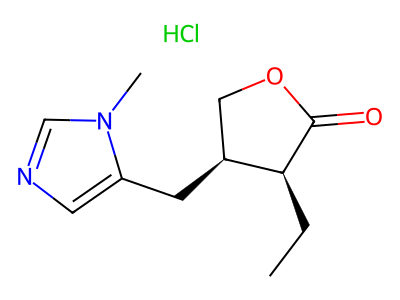
Pilocarpine hydrochloride
盐酸毛果芸香碱
Also known as: (+)-Pilocarpine hydrochloride, (3S,4R)-3-ethyl-4-[(1-methyl-1H-imidazol-5-yl)methyl]dihydrofuran-2(3H)-one hydrochloride, 2(3H)-Furanone, 3-ethyldihydro-4-[(1-methyl-1H-imidazol-5-yl)methyl]-, (3S-cis)-, hydrochloride, Pilocarpine HCl, Pilocarpin Hydrochloride, Akarpine, AlMocarpin, Pilocar, Pilocel, Pilovisc, Salagen, Sanpilo, NSC 5746 HCl, MFCD00012722, EINECS 200-212-5
Pilocarpine hydrochloride (CAS 54-71-7) is a compound in the Organic Acids category listed in the Jingsj chemical database. It has the molecular formula C11H17ClN2O2 and a molecular weight of 208.257 g/mol. It is also known as (+)-Pilocarpine hydrochloride, (3S,4R)-3-ethyl-4-[(1-methyl-1H-imidazol-5-yl)methyl]dihydrofuran-2(3H)-one hydrochloride and 2(3H)-Furanone, 3-ethyldihydro-4-[(1-methyl-1H-imidazol-5-yl)methyl]-, (3S-cis)-, hydrochloride. Key properties include a melting point of 202-205 °C(lit.), a boiling point of 431.8±18.0 °C at 760 mmHg, a density of 1.2±0.1 g/cm3 and a flash point of 215.0±21.2 °C. It is classified under GHS with signal word Danger and hazard statements H300 and H330 — Fatal if inhaled. No supplier offers are currently listed; request a quote. Record last updated Aug 21, 2026.
- CAS No.
- 54-71-7
- Jingsj CID
- J-48468-0
- Molecular Formula
- C11H17ClN2O2
- Chinese Name
- 盐酸毛果芸香碱
- Molecular Weight
- 208.257 g/mol
- Category
- Organic Acids
- Last updated
- 8/21/2026
No offers for this compound yet.
Request a quotePhysicochemical Properties
| Melting Point | 202-205 °C(lit.) |
|---|---|
| Boiling Point | 431.8±18.0 °C at 760 mmHg |
| Density | 1.2±0.1 g/cm3 |
| Flash Point | 215.0±21.2 °C |
| Exact Mass | 208.121185 |
| PSA | 44.12000 |
| LogP | -0.09 |
| Vapor Pressure | 0.0±1.0 mmHg at 25°C |
| Refractive Index | 1.585 |
| Additional Property | soluble |
GHS Safety & Compliance
- H300
- H330 — Fatal if inhaled
Activity & Biological Data
| Target | M3 muscarinic receptor[1] |
|---|---|
| Additional Information | [1]. Matsuzaki K, et al. Daily voluntary exercise enhances pilocarpine-induced saliva secretion and aquaporin 1 expression in rat submandibular glands. FEBS Open Bio. 2017 Dec 7;8(1):85-93. [2]. Yuan XL, et al. Cytotoxicity of pilocarpine to human corneal stromal cells and its underlying cytotoxic mechanisms. Int J Ophthalmol. 2016 Apr 18;9(4):505-11. [3]. Tonta MA, et al. Pilocarpine-induced relaxation of rat tail artery by a non-cholinergic mechanism and in the absence of an intact endothelium. Br J Pharmacol. 1994 Jun;112(2):525-32. [4]. Wang RF, et al. Post-treatment with the GLP-1 analogue liraglutide alleviate chronic inflammation and mitochondrial stress induced by Status epilepticus. Epilepsy Res. 2018 Mar 9;142:45-52. |
Customs & Trade Information
| HS Code | 2934999090 |
|---|---|
| Summary | 2934999090. other heterocyclic compounds. VAT:17.0%. Tax rebate rate:13.0%. . MFN tariff:6.5%. General tariff:20.0% |
Frequently Asked Questions
What is the CAS number of Pilocarpine hydrochloride?
The CAS number of Pilocarpine hydrochloride is 54-71-7.
What are the molecular formula and molecular weight of Pilocarpine hydrochloride?
Pilocarpine hydrochloride has molecular formula C11H17ClN2O2 and molecular weight 208.257 g/mol.
Is Pilocarpine hydrochloride hazardous?
Pilocarpine hydrochloride has GHS signal word Danger and hazard statements H300; H330 — Fatal if inhaled.
Data compiled from public chemical databases and supplier catalogs; supplier offers are provided by suppliers.
Last updated:
How to cite: Jingsj. "Pilocarpine hydrochloride (CAS 54-71-7)". Jingsj Chemical Database. https://www.jingsj.com/compound/J-48468-0 (accessed 2026-10-28).
Data for reference only; verify specifications, grades and regulatory status with suppliers before purchase.