
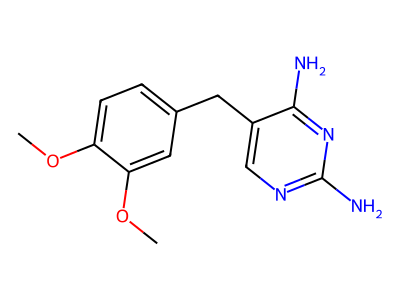
Diaveridine
敌菌净
Also known as: 2,4-Diamino-5-(3,4-dimethoxybenzyl)pyrimidine, 5-(3,4-Dimethoxybenzyl)-2,4-pyrimidinediamine, 2,4-Diamino-5-veratrylpyrimidine, 5-[(3,4-Dimethoxyphenyl)methyl]pyrimidine-2,4-diamine, BW 49-210, Diaveridin, Diaveridina, Diaveridinum, 5-Veratryl-pyrimidin-2,4-diyldiamin, EINECS 226-333-3, MFCD00057349
Diaveridine (CAS 5355-16-8) is a compound in the Organic Compounds category listed in the Jingsj chemical database. It has the molecular formula C13H16N4O2 and a molecular weight of 260.292 g/mol. It is also known as 2,4-Diamino-5-(3,4-dimethoxybenzyl)pyrimidine, 5-(3,4-Dimethoxybenzyl)-2,4-pyrimidinediamine and 2,4-Diamino-5-veratrylpyrimidine. Key properties include a melting point of 232 - 236ºC, a boiling point of 506.1±60.0 °C at 760 mmHg, a density of 1.3±0.1 g/cm3 and a flash point of 259.9±32.9 °C. It is classified under GHS with signal word Warning and hazard statements H315 — Causes skin irritation, H319 — Causes serious eye irritation and H335 — May cause respiratory irritation. No supplier offers are currently listed; request a quote. Record last updated Aug 21, 2026.
- CAS No.
- 5355-16-8
- Jingsj CID
- J-1974742-4
- Molecular Formula
- C13H16N4O2
- Chinese Name
- 敌菌净
- Molecular Weight
- 260.292 g/mol
- Category
- Organic Compounds
- Last updated
- 8/21/2026
No offers for this compound yet.
Request a quotePhysicochemical Properties
| Melting Point | 232 - 236ºC |
|---|---|
| Boiling Point | 506.1±60.0 °C at 760 mmHg |
| Density | 1.3±0.1 g/cm3 |
| Flash Point | 259.9±32.9 °C |
| Exact Mass | 260.127319 |
| PSA | 96.28000 |
| LogP | 1.09 |
| Vapor Pressure | 0.0±1.3 mmHg at 25°C |
| Refractive Index | 1.626 |
GHS Safety & Compliance
- H315 — Causes skin irritation
- H319 — Causes serious eye irritation
- H335 — May cause respiratory irritation
Activity & Biological Data
| Target | Ki: 11.5 nM (DHFR) [1] Bacterial[2] |
|---|---|
| Additional Information | [1]. Sirichaiwat C et al. Target guided synthesis of 5-benzyl-2,4-diamonopyrimidines: their antimalarial activities and binding affinities to wild type and mutant dihydrofolate reductases from Plasmodium falciparum. J Med Chem 47:345-54 (2004). [2]. Ono T, et al. The genotoxicity of diaveridine and trimethoprim. Environ Toxicol Pharmacol. 1997 Sep;3(4):297-306. [3]. Wang J, et al. Acute, mutagenicity, teratogenicity and subchronic oral toxicity studies of diaveridine in rodents. Environ Toxicol Pharmacol. 2015 Sep;40(2):660-70. |
Customs & Trade Information
| HS Code | 2933599090 |
|---|---|
| Summary | 2933599090. other compounds containing a pyrimidine ring (whether or not hydrogenated) or piperazine ring in the structure. VAT:17.0%. Tax rebate rate:13.0%. . MFN tariff:6.5%. General tariff:20.0% |
Frequently Asked Questions
What is the CAS number of Diaveridine?
The CAS number of Diaveridine is 5355-16-8.
What are the molecular formula and molecular weight of Diaveridine?
Diaveridine has molecular formula C13H16N4O2 and molecular weight 260.292 g/mol.
Is Diaveridine hazardous?
Diaveridine has GHS signal word Warning and hazard statements H315 — Causes skin irritation; H319 — Causes serious eye irritation; H335 — May cause respiratory irritation.
What are the upstream and downstream products of Diaveridine?
For Diaveridine, Upstream Products: 1,2-Dimethoxybenzene, Carbon, Guanidine hydrochloride.
Data compiled from public chemical databases and supplier catalogs; supplier offers are provided by suppliers.
Last updated:
How to cite: Jingsj. "Diaveridine (CAS 5355-16-8)". Jingsj Chemical Database. https://www.jingsj.com/compound/J-1974742-4 (accessed 2026-10-28).
Data for reference only; verify specifications, grades and regulatory status with suppliers before purchase.