
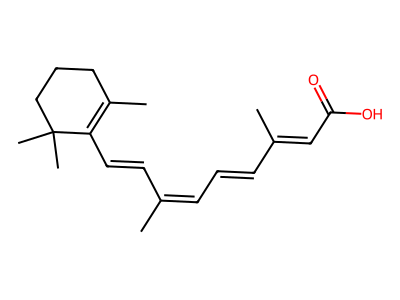
Alitretinoin
9-顺式视黄酸
Also known as: 9-cis-Retinoic acid, 9-cis-Tretinoin, (2E,4E,6Z,8E)-3,7-dimethyl-9-(2,6,6-trimethylcyclohex-1-en-1-yl)nona-2,4,6,8-tetraenoic acid, Panretin Gel, ALRT1057, 9(Z)-Retinoic acid, 9Z-retinoic acid, Isotretinoin EP Impurity D, Tretinoin EP Impurity D, MFCD00270072
Alitretinoin (CAS 5300-03-8) is a compound in the Organic Acids category listed in the Jingsj chemical database. It has the molecular formula C20H28O2 and a molecular weight of 300.435 g/mol. It is also known as 9-cis-Retinoic acid, 9-cis-Tretinoin and (2E,4E,6Z,8E)-3,7-dimethyl-9-(2,6,6-trimethylcyclohex-1-en-1-yl)nona-2,4,6,8-tetraenoic acid. Key properties include a melting point of 189-191ºC, a boiling point of 462.8±14.0 °C at 760 mmHg, a density of 1.0±0.1 g/cm3 and a flash point of 350.6±11.0 °C. It is classified under GHS with signal word Danger and hazard statements H315 — Causes skin irritation, H319 — Causes serious eye irritation and H335 — May cause respiratory irritation. No supplier offers are currently listed; request a quote. Record last updated Aug 21, 2026.
- CAS No.
- 5300-03-8
- Jingsj CID
- J-39897-6
- Molecular Formula
- C20H28O2
- Chinese Name
- 9-顺式视黄酸
- Molecular Weight
- 300.435 g/mol
- Category
- Organic Acids
- Last updated
- 8/21/2026
No offers for this compound yet.
Request a quotePhysicochemical Properties
| Melting Point | 189-191ºC |
|---|---|
| Boiling Point | 462.8±14.0 °C at 760 mmHg |
| Density | 1.0±0.1 g/cm3 |
| Flash Point | 350.6±11.0 °C |
| Exact Mass | 300.208923 |
| PSA | 37.30000 |
| LogP | 6.83 |
| Vapor Pressure | 0.0±2.5 mmHg at 25°C |
| Refractive Index | 1.556 |
GHS Safety & Compliance
- H315 — Causes skin irritation
- H319 — Causes serious eye irritation
- H335 — May cause respiratory irritation
- H360 — May damage fertility or the unborn child
Activity & Biological Data
| Additional Information | [1]. Raul Rosas, et al. Retinoids Augment Thiazolidinedione PPARγ Activation in Oral Cancer Cells. Anticancer Res. 2020 Jun;40(6):3071-3080. [2]. Hua Yang, et al. Effects of 9-cis-retinoic Acid on the Proliferation and Apoptosis of Cutaneous T-cell Lymphoma Cells. Anticancer Drugs. 2019 Jan;30(1):56-64. [3]. Zhiqing Yuan, et al. 9-cis-retinoic Acid Elevates MRP3 Expression by Inhibiting Sumoylation of RXRα to Alleviate Cholestatic Liver Injury. Biochem Biophys Res Commun. 2018 Sep 3;503(1):188-194. [4]. V M Manzano, et al. Human Renal Mesangial Cells Are a Target for the Anti-Inflammatory Action of 9-cis Retinoic Acid. Br J Pharmacol. 2000 Dec;131(8):1673-83. [5]. Gro H Mathisen, et al. Delayed Translocation of NGFI-B/RXR in Glutamate Stimulated Neurons Allows Late Protection by 9-cis Retinoic Acid. Biochem Biophys Res Commun. 2011 Oct 14;414(1):90-5. |
|---|
Customs & Trade Information
| HS Code | 2916209090 |
|---|---|
| Summary | 2916209090 other cyclanic, cyclenic or cyclotherpenic monocarboxylic acids, their anhydrides, halides, peroxides, peroxyacids and their derivatives VAT:17.0% Tax rebate rate:9.0% Supervision conditions:AB(certificate of inspection for goods inward,certificate of inspection for goods outward) MFN tariff:6.5% General tariff:30.0% |
Frequently Asked Questions
What is the CAS number of Alitretinoin?
The CAS number of Alitretinoin is 5300-03-8.
What are the molecular formula and molecular weight of Alitretinoin?
Alitretinoin has molecular formula C20H28O2 and molecular weight 300.435 g/mol.
Is Alitretinoin hazardous?
Alitretinoin has GHS signal word Danger and hazard statements H315 — Causes skin irritation; H319 — Causes serious eye irritation; H335 — May cause respiratory irritation.
Data compiled from public chemical databases and supplier catalogs; supplier offers are provided by suppliers.
Last updated:
How to cite: Jingsj. "Alitretinoin (CAS 5300-03-8)". Jingsj Chemical Database. https://www.jingsj.com/compound/J-39897-6 (accessed 2026-10-28).
Data for reference only; verify specifications, grades and regulatory status with suppliers before purchase.