
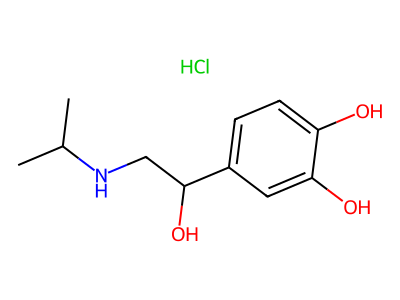
Isoprenaline hydrochloride
盐酸异丙肾上腺素
Also known as: Isoproterenol hydrochloride, DL-Isoprenaline hydrochloride, DL-Isoproterenol hydrochloride, N-Isopropyl-DL-noradrenaline hydrochloride, (±)-Isoproterenol hydrochloride, 4-[1-hydroxy-2-(isopropylamino)ethyl]benzene-1,2-diol hydrochloride, Isuprel, Norisodrine hydrochloride
Isoprenaline hydrochloride (CAS 51-30-9) is a compound in the Organic Acids category listed in the Jingsj chemical database. It has the molecular formula C11H18ClNO3 and a molecular weight of 247.719 g/mol. It is also known as Isoproterenol hydrochloride, DL-Isoprenaline hydrochloride and DL-Isoproterenol hydrochloride. Key properties include a melting point of 165-175 °C (dec.)(lit.), a boiling point of 417.5ºC at 760 mmHg, a density of 1.324 g/cm3 and a flash point of 179.7ºC. It is classified under GHS with signal word Warning and hazard statements H315 — Causes skin irritation, H319 — Causes serious eye irritation and H335 — May cause respiratory irritation. No supplier offers are currently listed; request a quote. Record last updated Aug 21, 2026.
- CAS No.
- 51-30-9
- Jingsj CID
- J-15603-5
- Molecular Formula
- C11H18ClNO3
- Chinese Name
- 盐酸异丙肾上腺素
- Molecular Weight
- 247.719 g/mol
- Category
- Organic Acids
- Last updated
- 8/21/2026
No offers for this compound yet.
Request a quotePhysicochemical Properties
| Melting Point | 165-175 °C (dec.)(lit.) |
|---|---|
| Boiling Point | 417.5ºC at 760 mmHg |
| Density | 1.324 g/cm3 |
| Flash Point | 179.7ºC |
| Exact Mass | 247.097519 |
| PSA | 72.72000 |
| LogP | 2.32210 |
| Stability | Stable, but may be air and light sensitive. Incompatible with strong oxidizing agents. |
| Additional Property | Soluble |
GHS Safety & Compliance
- H315 — Causes skin irritation
- H319 — Causes serious eye irritation
- H335 — May cause respiratory irritation
Activity & Biological Data
| Target | Beta-adrenergic receptor[1] |
|---|---|
| Additional Information | [1]. Degerman E, et al. Evidence that insulin and isoprenaline activate the cGMP-inhibited low-K m cAMP phosphodiesterase in rat fat cells by phosphorylation. Proc Natl Acad Sci U S A. 1990 Jan;87(2):533-7 [2]. Vannucci SJ, et al. Cell surface accessibility of GLUT4 glucose transporters in insulin-stimulated rat adipose cells. Modulation by isoprenaline and adenosine. Biochem J. 1992 Nov 15;288 (Pt 1):325-30. [3]. Delpy E, et al. Effects of cyclic GMP elevation on isoprenaline-induced increase in cyclic AMP and relaxation in rat aortic smooth muscle: role of phosphodiesterase 3. Br J Pharmacol. 1996 Oct;119(3):471-8. [4]. Muller FU, et al. Isoprenaline stimulates gene transcription of the inhibitory G protein alpha-subunit Gi alpha-2 in rat heart. Circ Res. 1993 Mar;72(3):696-700. [5]. Lei M, et al. Modulation of delayed rectifier potassium current, iK, by isoprenaline in rabbit isolated pacemaker cells. Exp Physiol. 2000 Jan;85(1):27-35. |
Frequently Asked Questions
What is the CAS number of Isoprenaline hydrochloride?
The CAS number of Isoprenaline hydrochloride is 51-30-9.
What are the molecular formula and molecular weight of Isoprenaline hydrochloride?
Isoprenaline hydrochloride has molecular formula C11H18ClNO3 and molecular weight 247.719 g/mol.
Is Isoprenaline hydrochloride hazardous?
Isoprenaline hydrochloride has GHS signal word Warning and hazard statements H315 — Causes skin irritation; H319 — Causes serious eye irritation; H335 — May cause respiratory irritation.
What are the upstream and downstream products of Isoprenaline hydrochloride?
For Isoprenaline hydrochloride, Upstream Products: Isoprenaline hydrochloride; Downstream Products: Isoprenaline hydrochloride, (-)-Isoproterenol hydrochloride.
Data compiled from public chemical databases and supplier catalogs; supplier offers are provided by suppliers.
Last updated:
How to cite: Jingsj. "Isoprenaline hydrochloride (CAS 51-30-9)". Jingsj Chemical Database. https://www.jingsj.com/compound/J-15603-5 (accessed 2026-10-28).
Data for reference only; verify specifications, grades and regulatory status with suppliers before purchase.