
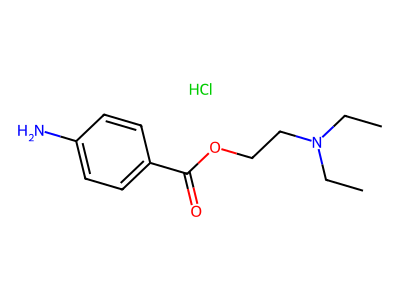
Procaine hydrochloride
盐酸普鲁卡因
Also known as: Novocaine hydrochloride, 2-(Diethylamino)ethyl 4-aminobenzoate hydrochloride, 4-Aminobenzoic acid 2-(diethylamino)ethyl ester hydrochloride, Procaine HCl, Bernacaine, Ethocaine, Syncaine, Anadolor, Anestil, Cetain, Chlorocaine, Diethylaminoethanol 4-aminobenzoate hydrochloride, Eugerase, Irocaine, Naucaine, p-Aminobenzoyldiethylaminoethanol hydrochloride, Paracain, Topokain, TIMTEC-BB SBB001081, Procaine (hydrochloride)
Procaine hydrochloride (CAS 51-05-8) is a compound in the Organic Acids category listed in the Jingsj chemical database. It has the molecular formula C13H21ClN2O2 and a molecular weight of 272.771 g/mol. It is also known as Novocaine hydrochloride, 2-(Diethylamino)ethyl 4-aminobenzoate hydrochloride and 4-Aminobenzoic acid 2-(diethylamino)ethyl ester hydrochloride. Key properties include a melting point of 155-156 °C(lit.), a boiling point of 195-196°C 17mm and a flash point of 195-196°C/17mm. It is classified under GHS with signal word Danger and hazard statements H301 — Toxic if swallowed and H317 — May cause an allergic skin reaction. No supplier offers are currently listed; request a quote. Record last updated Aug 21, 2026.
- CAS No.
- 51-05-8
- Jingsj CID
- J-1129812-4
- Molecular Formula
- C13H21ClN2O2
- Chinese Name
- 盐酸普鲁卡因
- Molecular Weight
- 272.771 g/mol
- Category
- Organic Acids
- Last updated
- 8/21/2026
No offers for this compound yet.
Request a quotePhysicochemical Properties
| Melting Point | 155-156 °C(lit.) |
|---|---|
| Boiling Point | 195-196°C 17mm |
| Flash Point | 195-196°C/17mm |
| Exact Mass | 272.129150 |
| PSA | 55.56000 |
| LogP | 3.15060 |
| Stability | Stable. Incompatible with strong oxidizing agents. |
| Additional Property | soluble |
GHS Safety & Compliance
- H301 — Toxic if swallowed
- H317 — May cause an allergic skin reaction
Activity & Biological Data
| Additional Information | [1]. Fan, P. and F.F. Weight, Procaine impairs the function of 5-HT3 receptor-ion channel complex in rat sensory ganglion neurons. Neuropharmacology, 1994. 33(12): p. 1573-9. [2]. Villar-Garea, A., et al., Procaine is a DNA-demethylating agent with growth-inhibitory effects in human cancer cells. Cancer Res, 2003. 63(16): p. 4984-9. [3]. Adamec, R.E. and C. Stark-Adamec, The effects of procaine HCl on population cellular and evoked response activity within the limbic system of the cat. Evidence for differential excitatory action of procaine in a variety of limbic circuits. Prog Neuropsychopharmacol Biol Psychiatry, 1987. 11(4): p. 345-64. |
|---|
Customs & Trade Information
| HS Code | 2922499990 |
|---|---|
| Summary | HS:2922499990 other amino-acids, other than those containing more than one kind of oxygen function, and their esters; salts thereof VAT:17.0% Tax rebate rate:9.0% Supervision conditions:AB(certificate of inspection for goods inward,certificate of inspection for goods outward) MFN tariff:6.5% General tariff:30.0% |
Frequently Asked Questions
What is the CAS number of Procaine hydrochloride?
The CAS number of Procaine hydrochloride is 51-05-8.
What are the molecular formula and molecular weight of Procaine hydrochloride?
Procaine hydrochloride has molecular formula C13H21ClN2O2 and molecular weight 272.771 g/mol.
Is Procaine hydrochloride hazardous?
Procaine hydrochloride has GHS signal word Danger and hazard statements H301 — Toxic if swallowed; H317 — May cause an allergic skin reaction.
What are the upstream and downstream products of Procaine hydrochloride?
For Procaine hydrochloride, Downstream Products: 2-(Diethylamino)ethanol, 4-aminobenzoic acid.
Data compiled from public chemical databases and supplier catalogs; supplier offers are provided by suppliers.
Last updated:
How to cite: Jingsj. "Procaine hydrochloride (CAS 51-05-8)". Jingsj Chemical Database. https://www.jingsj.com/compound/J-1129812-4 (accessed 2026-10-28).
Data for reference only; verify specifications, grades and regulatory status with suppliers before purchase.