
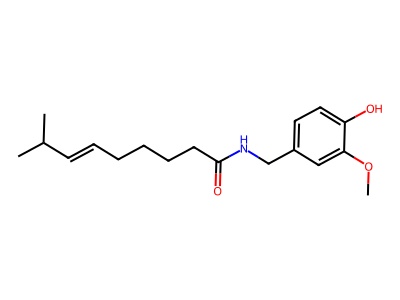
Capsaicin
Also known as: (E)-Capsaicin, 8-Methyl-N-vanillyl-6-nonenamide, trans-Capsaicin, (E)-N-(4-hydroxy-3-methoxybenzyl)-8-methyl-6-nonenamide, Capsaicin (Natural), Capsidol, Zostrix, Qutenza, Styptysat, Transacin, Axsain
Capsaicin (CAS 404-86-4) is a compound in the Organic Bases category listed in the Jingsj chemical database. It has the molecular formula C18H27NO3 and a molecular weight of 305.412 g/mol. Key properties include a melting point of 62-65 °C(lit.), a boiling point of 469.7±55.0 °C at 760 mmHg, a density of 1.0±0.1 g/cm3 and a flash point of 237.9±31.5 °C. It is classified under GHS with signal word Danger and hazard statements H301 — Toxic if swallowed, H315 — Causes skin irritation and H317 — May cause an allergic skin reaction. No supplier offers are currently listed; request a quote. Record last updated Aug 21, 2026.
- CAS No.
- 404-86-4
- Jingsj CID
- J-1984252-1
- Molecular Formula
- C18H27NO3
- Molecular Weight
- 305.412 g/mol
- Category
- Organic Bases
- Last updated
- 8/21/2026
No offers for this compound yet.
Request a quotePhysicochemical Properties
| Melting Point | 62-65 °C(lit.) |
|---|---|
| Boiling Point | 469.7±55.0 °C at 760 mmHg |
| Density | 1.0±0.1 g/cm3 |
| Flash Point | 237.9±31.5 °C |
| Exact Mass | 305.199097 |
| PSA | 58.56000 |
| LogP | 4.27 |
| Vapor Pressure | 0.0±1.2 mmHg at 25°C |
| Refractive Index | 1.508 |
| Additional Property | insoluble |
GHS Safety & Compliance
- H301 — Toxic if swallowed
- H315 — Causes skin irritation
- H317 — May cause an allergic skin reaction
- H319 — Causes serious eye irritation
- H334 — May cause allergy or asthma symptoms if inhaled
- H335 — May cause respiratory irritation
Activity & Biological Data
| Target | EC50: 290 nM (hTRPV1, in HEK293 cell)[1] |
|---|---|
| Additional Information | [1]. McNamara FN, et al. Effects of piperine, the pungent component of black pepper, at the human vanilloid receptor (TRPV1). Br J Pharmacol. 2005 Mar;144(6):781-90. [2]. Shin YH, et al. The Effect of Capsaicin on Salivary Gland Dysfunction. Molecules. 2016 Jun 25;21(7). [3]. Le TD, et al. Capsaicin-induced apoptosis of FaDu human pharyngeal squamous carcinoma cells. Yonsei Med J. 2012 Jul 1;53(4):834-41. [4]. Anandakumar P, et al. Capsaicin provokes apoptosis and restricts benzo(a)pyrene induced lung tumorigenesis in Swiss albino mice. Int Immunopharmacol. 2013 Jun 6;17(2):254-259. [5]. Kagawa Y, et al. Investigation of capsaicin-induced superficial punctate keratopathy model due to reduced tear secretion in rats. Curr Eye Res. 2013 Jul;38(7):729-35. [6]. Wang J, et al. Anti-inflammatory and retinal protective effects of capsaicin on ischaemia-induced injuries through the release of endogenous somatostatin. Clin Exp Pharmacol Physiol. 2017 Jul;44(7):803-814. |
Customs & Trade Information
| HS Code | 2924299090 |
|---|---|
| Summary | 2924299090. other cyclic amides (including cyclic carbamates) and their derivatives; salts thereof. VAT:17.0%. Tax rebate rate:13.0%. . MFN tariff:6.5%. General tariff:30.0% |
Frequently Asked Questions
What is the CAS number of Capsaicin?
The CAS number of Capsaicin is 404-86-4.
What are the molecular formula and molecular weight of Capsaicin?
Capsaicin has molecular formula C18H27NO3 and molecular weight 305.412 g/mol.
Is Capsaicin hazardous?
Capsaicin has GHS signal word Danger and hazard statements H301 — Toxic if swallowed; H315 — Causes skin irritation; H317 — May cause an allergic skin reaction.
What are the upstream and downstream products of Capsaicin?
For Capsaicin, Upstream Products: trans-8-Methyl-6-nonenoyl chloride, (6E)-8-methylnon-6-enoic acid, (5-Carboxypentyl)triphenylphosphonium bromide; Downstream Products: Dihydrocapsaicin, methyl 8-methylnonanoate, Methyl 7-methyloctanoate.
Data compiled from public chemical databases such as PubChem and supplier catalogs; supplier offers are provided by suppliers.
Last updated:
How to cite: Jingsj. "Capsaicin (CAS 404-86-4)". Jingsj Chemical Database. https://www.jingsj.com/compound/J-1984252-1 (accessed 2026-11-06).
Data for reference only; verify product details with suppliers before purchase.