
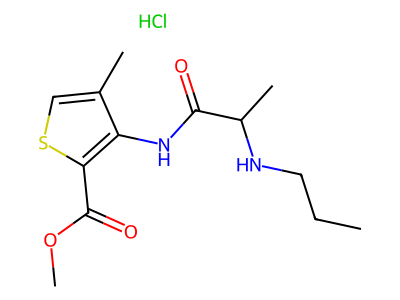
Articaine hydrochloride
盐酸阿替卡因
Also known as: Carticaine hydrochloride, Ultracaine, Septocaine, Methyl 4-methyl-3-(2-propylaminopropanoylamino)thiophene-2-carboxylate hydrochloride, 2-Thiophenecarboxylic acid, 4-methyl-3-[[1-oxo-2-(propylamino)propyl]amino]-, methyl ester, hydrochloride (1:1), Carticaine HCl, Ultracain, Septanest
Articaine hydrochloride (CAS 23964-57-0) is a compound in the Organic Acids category listed in the Jingsj chemical database. It has the molecular formula C13H21ClN2O3S and a molecular weight of 320.835 g/mol. It is also known as Carticaine hydrochloride, Ultracaine and Septocaine. Key properties include a melting point of 177-178°, a boiling point of 440.6ºC at 760 mmHg, a density of 1.178 g/cm3 and a flash point of 220.3ºC. It is classified under GHS with signal word Warning and hazard statements H315 — Causes skin irritation, H319 — Causes serious eye irritation and H335 — May cause respiratory irritation. No supplier offers are currently listed; request a quote. Record last updated Aug 21, 2026.
- CAS No.
- 23964-57-0
- Jingsj CID
- J-1984098-9
- Molecular Formula
- C13H21ClN2O3S
- Chinese Name
- 盐酸阿替卡因
- Molecular Weight
- 320.835 g/mol
- Category
- Organic Acids
- Last updated
- 8/21/2026
No offers for this compound yet.
Request a quotePhysicochemical Properties
| Melting Point | 177-178° |
|---|---|
| Boiling Point | 440.6ºC at 760 mmHg |
| Density | 1.178 g/cm3 |
| Flash Point | 220.3ºC |
| Exact Mass | 320.096130 |
| PSA | 95.67000 |
| LogP | 3.43560 |
| Vapor Pressure | 5.79E-08mmHg at 25°C |
| Storage Conditions | 2-8°C |
| Additional Property | H2O: soluble20mg/mL, clear |
GHS Safety & Compliance
- H315 — Causes skin irritation
- H319 — Causes serious eye irritation
- H335 — May cause respiratory irritation
Activity & Biological Data
| Additional Information | [1]. Malamed, S.F., S. Gagnon, and D. Leblanc, A comparison between articaine HCl and lidocaine HCl in pediatric dental patients. Pediatr Dent, 2000. 22(4): p. 307-11. [2]. Kanaa, M.D., et al., Articaine and lidocaine mandibular buccal infiltration anesthesia: a prospective randomized double-blind cross-over study. J Endod, 2006. 32(4): p. 296-8. [3]. Robertson, D., et al., The anesthetic efficacy of articaine in buccal infiltration of mandibular posterior teeth. J Am Dent Assoc, 2007. 138(8): p. 1104-12. |
|---|
Customs & Trade Information
| HS Code | 2934999090 |
|---|---|
| Summary | 2934999090. other heterocyclic compounds. VAT:17.0%. Tax rebate rate:13.0%. . MFN tariff:6.5%. General tariff:20.0% |
Frequently Asked Questions
What is the CAS number of Articaine hydrochloride?
The CAS number of Articaine hydrochloride is 23964-57-0.
What are the molecular formula and molecular weight of Articaine hydrochloride?
Articaine hydrochloride has molecular formula C13H21ClN2O3S and molecular weight 320.835 g/mol.
Is Articaine hydrochloride hazardous?
Articaine hydrochloride has GHS signal word Warning and hazard statements H315 — Causes skin irritation; H319 — Causes serious eye irritation; H335 — May cause respiratory irritation.
Data compiled from public chemical databases and supplier catalogs; supplier offers are provided by suppliers.
Last updated:
How to cite: Jingsj. "Articaine hydrochloride (CAS 23964-57-0)". Jingsj Chemical Database. https://www.jingsj.com/compound/J-1984098-9 (accessed 2026-10-28).
Data for reference only; verify specifications, grades and regulatory status with suppliers before purchase.