
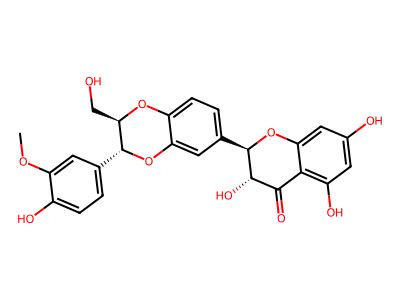
Silibinin
水飞蓟宾A
Also known as: Silybin, Silybin A, Silibinin A, Silybin b1, Silymarin I, 7C3MT, Silliver, Silybine, Silybum substance E6, (2R,3R)-3,5,7-Trihydroxy-2-[(2R,3R)-3-(4-hydroxy-3-methoxyphenyl)-2-(hydroxymethyl)-2,3-dihydro-1,4-benzodioxin-6-yl]-2,3-dihydro-4H-chromen-4-one
Silibinin (CAS 22888-70-6) is a compound in the Organic Compounds category listed in the Jingsj chemical database. It has the molecular formula C25H22O10 and a molecular weight of 482.436 g/mol. It is also known as Silybin, Silybin A and Silibinin A. Key properties include a melting point of 164-174°C, a boiling point of 793.0±60.0 °C at 760 mmHg, a density of 1.5±0.1 g/cm3 and a flash point of 274.5±26.4 °C. It is classified under GHS with signal word Warning and hazard statements H315 — Causes skin irritation, H319 — Causes serious eye irritation and H335 — May cause respiratory irritation. No supplier offers are currently listed; request a quote. Record last updated Aug 21, 2026.
- CAS No.
- 22888-70-6
- Jingsj CID
- J-14327-7
- Molecular Formula
- C25H22O10
- Chinese Name
- 水飞蓟宾A
- Molecular Weight
- 482.436 g/mol
- Category
- Organic Compounds
- Last updated
- 8/21/2026
No offers for this compound yet.
Request a quotePhysicochemical Properties
| Melting Point | 164-174°C |
|---|---|
| Boiling Point | 793.0±60.0 °C at 760 mmHg |
| Density | 1.5±0.1 g/cm3 |
| Flash Point | 274.5±26.4 °C |
| Exact Mass | 482.121307 |
| PSA | 155.14000 |
| LogP | 2.59 |
| Vapor Pressure | 0.0±2.9 mmHg at 25°C |
| Refractive Index | 1.684 |
| Storage Conditions | −20°C |
| Stability | Stable. Incompatible with strong oxidizing agents, strong bases. |
GHS Safety & Compliance
- H315 — Causes skin irritation
- H319 — Causes serious eye irritation
- H335 — May cause respiratory irritation
Activity & Biological Data
| Additional Information | [1]. Woo SM, et al. Silibinin induces apoptosis of HT29 colon carcinoma cells through early growth response-1 (EGR-1)-mediated non-steroidal anti-inflammatory drug-activated gene-1 (NAG-1) up-regulation. Chem Biol Interact. 2014 Jan 16;211C:36-43. [2]. Kim TH, et al. Silibinin induces cell death through ROS-dependent down-regulation of Notch-1/ERK/Akt signaling in human breast cancer cells. J Pharmacol Exp Ther. 2014 Jan 28. [3]. Zhang S, et al. Silybin-mediated inhibition of Notch signaling exerts antitumor activity in human hepatocellular carcinoma cells. PLoS One. 2013 Dec 27;8(12):e83699. [4]. Khan AQ, et al. Silibinin Inhibits Tumor Promotional Triggers and Tumorigenesis Against Chemically Induced Two-Stage Skin Carcinogenesis in Swiss Albino Mice: Possible Role of Oxidative Stress and Inflammation. Nutr Cancer. 2013 Dec 23. [5]. Khazim K, et al. The antioxidant silybin prevents high glucose-induced oxidative stress and podocyte injury in vitro and in vivo. Am J Physiol Renal Physiol. 2013 Sep 1;305(5):F691-700. |
|---|
Customs & Trade Information
| HS Code | 2932999099 |
|---|---|
| Summary | 2932999099. other heterocyclic compounds with oxygen hetero-atom(s) only. VAT:17.0%. Tax rebate rate:13.0%. . MFN tariff:6.5%. General tariff:20.0% |
Frequently Asked Questions
What is the CAS number of Silibinin?
The CAS number of Silibinin is 22888-70-6.
What are the molecular formula and molecular weight of Silibinin?
Silibinin has molecular formula C25H22O10 and molecular weight 482.436 g/mol.
Is Silibinin hazardous?
Silibinin has GHS signal word Warning and hazard statements H315 — Causes skin irritation; H319 — Causes serious eye irritation; H335 — May cause respiratory irritation.
Data compiled from public chemical databases and supplier catalogs; supplier offers are provided by suppliers.
Last updated:
How to cite: Jingsj. "Silibinin (CAS 22888-70-6)". Jingsj Chemical Database. https://www.jingsj.com/compound/J-14327-7 (accessed 2026-10-28).
Data for reference only; verify specifications, grades and regulatory status with suppliers before purchase.