
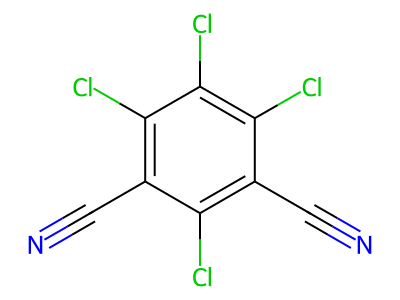
Chlorothalonil
百菌清
Also known as: 1,3-Benzenedicarbonitrile, 2,4,5,6-tetrachloro-, 2,4,5,6-Tetrachloro-1,3-benzenedicarbonitrile, 2,4,5,6-Tetrachloroisophthalonitrile, 1,3-Dicyano-2,4,5,6-tetrachlorobenzene, Tetrachloroisophthalodinitrile, TPN, Bravo, Daconil, Nopcocide, BOMBARDIER, 2,4-Dicyanotetrachlorobenzene
Chlorothalonil (CAS 1897-45-6) is a compound in the Organic Compounds category listed in the Jingsj chemical database. It has the molecular formula C8Cl4N2 and a molecular weight of 265.911 g/mol. It is also known as 1,3-Benzenedicarbonitrile, 2,4,5,6-tetrachloro-, 2,4,5,6-Tetrachloro-1,3-benzenedicarbonitrile and 2,4,5,6-Tetrachloroisophthalonitrile. Key properties include a melting point of 250-251ºC, a boiling point of 350.5±37.0 °C at 760 mmHg, a density of 1.7±0.1 g/cm3 and a flash point of 153.8±20.7 °C. It is classified under GHS with signal word Danger and hazard statements H317 — May cause an allergic skin reaction, H318 — Causes serious eye damage and H330 — Fatal if inhaled. No supplier offers are currently listed; request a quote. Record last updated Aug 21, 2026.
- CAS No.
- 1897-45-6
- Jingsj CID
- J-1104216-5
- Molecular Formula
- C8Cl4N2
- Chinese Name
- 百菌清
- Molecular Weight
- 265.911 g/mol
- Category
- Organic Compounds
- Last updated
- 8/21/2026
No offers for this compound yet.
Request a quotePhysicochemical Properties
| Melting Point | 250-251ºC |
|---|---|
| Boiling Point | 350.5±37.0 °C at 760 mmHg |
| Density | 1.7±0.1 g/cm3 |
| Flash Point | 153.8±20.7 °C |
| Exact Mass | 263.881561 |
| PSA | 47.58000 |
| LogP | 2.88 |
| Vapor Pressure | 0.0±0.8 mmHg at 25°C |
| Refractive Index | 1.633 |
GHS Safety & Compliance
- H317 — May cause an allergic skin reaction
- H318 — Causes serious eye damage
- H330 — Fatal if inhaled
- H335 — May cause respiratory irritation
- H351 — Suspected of causing cancer
- H410 — Very toxic to aquatic life with long lasting effects
Activity & Biological Data
| Additional Information | [1]. Pengfei Zhang, et al. Low Dose Chlorothalonil Impairs Mouse Spermatogenesis Through the Intertwining of Estrogen Receptor Pathways With Histone and DNA Methylation.Chemosphere. 2019 Sep;230:384-395. [2]. Małgorzata Baćmaga, et al. The Influence of Chlorothalonil on the Activity of Soil Microorganisms and Enzymes. Ecotoxicology. 2018 Nov;27(9):1188-1202. |
|---|
Customs & Trade Information
| HS Code | 2926909038 |
|---|---|
| Summary | HS: 2926909038 fenoxanil Educational tariff:17.0% Tax rebate rate:9.0% Regulatory conditions:S(Registration certificate of import and export) Lowest tariff:6.5% General tariff:30.0% |
Frequently Asked Questions
What is the CAS number of Chlorothalonil?
The CAS number of Chlorothalonil is 1897-45-6.
What are the molecular formula and molecular weight of Chlorothalonil?
Chlorothalonil has molecular formula C8Cl4N2 and molecular weight 265.911 g/mol.
Is Chlorothalonil hazardous?
Chlorothalonil has GHS signal word Danger and hazard statements H317 — May cause an allergic skin reaction; H318 — Causes serious eye damage; H330 — Fatal if inhaled.
What are the upstream and downstream products of Chlorothalonil?
For Chlorothalonil, Downstream Products: 1,2,3,4,6,7,8-heptachlorodibenzo-p-dioxin, 1,2,3,4,6,7,8,9-Octachlorodibenzo-p-dioxin, 4-Hydroxy-2,5,6-trichloroisophthalonitrile.
Data compiled from public chemical databases and supplier catalogs; supplier offers are provided by suppliers.
Last updated:
How to cite: Jingsj. "Chlorothalonil (CAS 1897-45-6)". Jingsj Chemical Database. https://www.jingsj.com/compound/J-1104216-5 (accessed 2026-10-28).
Data for reference only; verify specifications, grades and regulatory status with suppliers before purchase.