
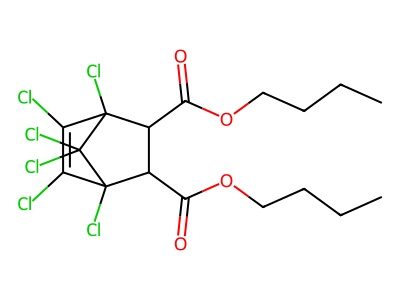
Dibutyl chlorendate
氯菌酸二丁酯
Also known as: Chlorendic acid dibutyl ester, 1,4,5,6,7,7-Hexachlorobicyclo[2.2.1]hept-5-ene-2,3-dicarboxylic acid dibutyl ester, Bicyclo[2.2.1]hept-5-ene-2,3-dicarboxylic acid, 1,4,5,6,7,7-hexachloro-, dibutyl ester, dibutyl 1,4,5,6,7,7-hexachlorobicyclo[2.2.1]hept-5-ene-2,3-dicarboxylate, NSC 5261
Dibutyl chlorendate (CAS 1770-80-5) is a compound in the Organic Acids category listed in the Jingsj chemical database. It has the molecular formula C17H20Cl6O4 and a molecular weight of 501.05600 g/mol. It is also known as Chlorendic acid dibutyl ester, 1,4,5,6,7,7-Hexachlorobicyclo[2.2.1]hept-5-ene-2,3-dicarboxylic acid dibutyl ester and Bicyclo[2.2.1]hept-5-ene-2,3-dicarboxylic acid, 1,4,5,6,7,7-hexachloro-, dibutyl ester. Key properties include a boiling point of 500.5ºC at 760 mmHg, a density of 1.46 g/cm3 and a flash point of 163.7ºC. It is classified under GHS with signal word Danger and hazard statements H225 — Highly flammable liquid and vapour, H302 — Harmful if swallowed and H312 — Harmful in contact with skin. No supplier offers are currently listed; request a quote. Record last updated Aug 21, 2026.
- CAS No.
- 1770-80-5
- Jingsj CID
- J-1365871-1
- Molecular Formula
- C17H20Cl6O4
- Chinese Name
- 氯菌酸二丁酯
- Molecular Weight
- 501.05600 g/mol
- Category
- Organic Acids
- Last updated
- 8/21/2026
No offers for this compound yet.
Request a quotePhysicochemical Properties
| Boiling Point | 500.5ºC at 760 mmHg |
|---|---|
| Density | 1.46 g/cm3 |
| Flash Point | 163.7ºC |
| Exact Mass | 497.94900 |
| PSA | 52.60000 |
| LogP | 5.75090 |
| Vapor Pressure | 3.78E-10mmHg at 25°C |
| Refractive Index | 1.551 |
GHS Safety & Compliance
- H225 — Highly flammable liquid and vapour
- H302 — Harmful if swallowed
- H312 — Harmful in contact with skin
- H332 — Harmful if inhaled
- H319 — Causes serious eye irritation
Frequently Asked Questions
What is the CAS number of Dibutyl chlorendate?
The CAS number of Dibutyl chlorendate is 1770-80-5.
What are the molecular formula and molecular weight of Dibutyl chlorendate?
Dibutyl chlorendate has molecular formula C17H20Cl6O4 and molecular weight 501.05600 g/mol.
Is Dibutyl chlorendate hazardous?
Dibutyl chlorendate has GHS signal word Danger and hazard statements H225 — Highly flammable liquid and vapour; H302 — Harmful if swallowed; H312 — Harmful in contact with skin.
Data compiled from public chemical databases and supplier catalogs; supplier offers are provided by suppliers.
Last updated:
How to cite: Jingsj. "Dibutyl chlorendate (CAS 1770-80-5)". Jingsj Chemical Database. https://www.jingsj.com/compound/J-1365871-1 (accessed 2026-10-28).
Data for reference only; verify specifications, grades and regulatory status with suppliers before purchase.