
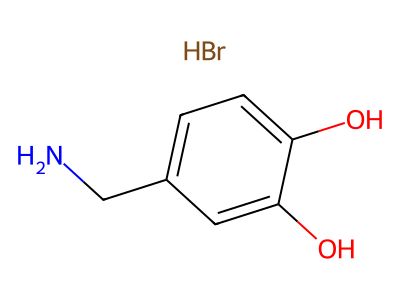
3,4-Dihydroxybenzylamine hydrobromide
3,4-二羟基苄胺氢溴酸盐
Also known as: 4-(Aminomethyl)catechol hydrobromide, DHBA hydrobromide, 4-(aminomethyl)benzene-1,2-diol hydrobromide, 4-(aminomethyl)pyrocatechol hydrobromide, DHBA, 1,2-Benzenediol,4-(aminomethyl)-, hydrobromide (1:1), EINECS 240-382-8, MFCD00012859
3,4-Dihydroxybenzylamine hydrobromide (CAS 16290-26-9) is a compound in the Organic Acids category listed in the Jingsj chemical database. It has the molecular formula C7H10BrNO2 and a molecular weight of 220.06400 g/mol. It is also known as 4-(Aminomethyl)catechol hydrobromide, DHBA hydrobromide and 4-(aminomethyl)benzene-1,2-diol hydrobromide. Key properties include a melting point of 184-186 °C(lit.), a boiling point of 333.4ºC at 760mmHg, a density of 1.309g/cm3 and a flash point of 155.5ºC. It is classified under GHS with signal word Warning and hazard statements H315 — Causes skin irritation, H319 — Causes serious eye irritation and H335 — May cause respiratory irritation. No supplier offers are currently listed; request a quote. Record last updated Aug 21, 2026.
- CAS No.
- 16290-26-9
- Jingsj CID
- J-25406-7
- Molecular Formula
- C7H10BrNO2
- Chinese Name
- 3,4-二羟基苄胺氢溴酸盐
- Molecular Weight
- 220.06400 g/mol
- Category
- Organic Acids
- Last updated
- 8/21/2026
No offers for this compound yet.
Request a quotePhysicochemical Properties
| Melting Point | 184-186 °C(lit.) |
|---|---|
| Boiling Point | 333.4ºC at 760mmHg |
| Density | 1.309g/cm3 |
| Flash Point | 155.5ºC |
| Exact Mass | 218.98900 |
| PSA | 66.48000 |
| LogP | 2.21490 |
| Vapor Pressure | 1.32E-05mmHg at 25°C |
GHS Safety & Compliance
- H315 — Causes skin irritation
- H319 — Causes serious eye irritation
- H335 — May cause respiratory irritation
Activity & Biological Data
| Additional Information | [1]. FitzGerald GB, et al. 3,4-Dihydroxybenzylamine: an improved dopamine analog cytotoxic for melanoma cells in part through oxidation products inhibitory to dna polymerase.J Invest Dermatol. 1983 Feb;80(2):119-23. [2]. Prezioso JA1,et al.Effects of tyrosinase activity on the cytotoxicity of 3,4-dihydroxybenzylamine and buthionine sulfoximine in human melanoma cells.Pigment Cell Res. 1990 Mar-Apr;3(2):49-54. [3]. Mlchael M. Wick,et al. 3,4-Dihydroxybenzylamine: Antitumor Activity Against A Dopamine Analog B16 Melanoma. |
|---|
Customs & Trade Information
| HS Code | 2922299090 |
|---|---|
| Summary | 2922299090. other amino-naphthols and other amino-phenols, other than those containing more than one kind of oxygen function, their ethers and esters; salts thereof. VAT:17.0%. Tax rebate rate:13.0%. . MFN tariff:6.5%. General tariff:30.0% |
Frequently Asked Questions
What is the CAS number of 3,4-Dihydroxybenzylamine hydrobromide?
The CAS number of 3,4-Dihydroxybenzylamine hydrobromide is 16290-26-9.
What are the molecular formula and molecular weight of 3,4-Dihydroxybenzylamine hydrobromide?
3,4-Dihydroxybenzylamine hydrobromide has molecular formula C7H10BrNO2 and molecular weight 220.06400 g/mol.
Is 3,4-Dihydroxybenzylamine hydrobromide hazardous?
3,4-Dihydroxybenzylamine hydrobromide has GHS signal word Warning and hazard statements H315 — Causes skin irritation; H319 — Causes serious eye irritation; H335 — May cause respiratory irritation.
Data compiled from public chemical databases and supplier catalogs; supplier offers are provided by suppliers.
Last updated:
How to cite: Jingsj. "3,4-Dihydroxybenzylamine hydrobromide (CAS 16290-26-9)". Jingsj Chemical Database. https://www.jingsj.com/compound/J-25406-7 (accessed 2026-10-29).
Data for reference only; verify specifications, grades and regulatory status with suppliers before purchase.