
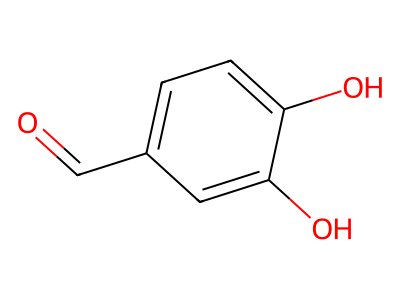
3,4-Dihydroxybenzaldehyde
Also known as: Protocatechualdehyde, Protocatechuic aldehyde, 3,4-Dihydroxybenzaldehyde, 4-Formyl-1,2-benzenediol, 3,4-Dihydroxybenzyl aldehyde, Rancinamycin IV, 1,2-Dihydroxy-4-formylbenzene, 4-Formylcatechol
3,4-Dihydroxybenzaldehyde (CAS 139-85-5) is a compound in the Organic Compounds category listed in the Jingsj chemical database. It has the molecular formula C7H6O3 and a molecular weight of 138.12 g/mol. Key properties include a melting point of 150-157 °C(lit.), a boiling point of 295.4±20.0 °C at 760 mmHg, a density of 1.4±0.1 g/cm3 and a flash point of 146.7±18.3 °C. It is classified under GHS with signal word Warning and hazard statements H315 — Causes skin irritation, H319 — Causes serious eye irritation and H335 — May cause respiratory irritation. No supplier offers are currently listed; request a quote. Record last updated Aug 21, 2026.
- CAS No.
- 139-85-5
- Jingsj CID
- J-48013-6
- Molecular Formula
- C7H6O3
- Molecular Weight
- 138.12 g/mol
- Category
- Organic Compounds
- Last updated
- 8/21/2026
No offers for this compound yet.
Request a quotePhysicochemical Properties
| Melting Point | 150-157 °C(lit.) |
|---|---|
| Boiling Point | 295.4±20.0 °C at 760 mmHg |
| Density | 1.4±0.1 g/cm3 |
| Flash Point | 146.7±18.3 °C |
| Exact Mass | 138.031693 |
| PSA | 57.53000 |
| LogP | 1.14 |
| Vapor Pressure | 0.0±0.6 mmHg at 25°C |
| Refractive Index | 1.674 |
| Additional Property | 50 g/L (20 ºC) |
GHS Safety & Compliance
- H315 — Causes skin irritation
- H319 — Causes serious eye irritation
- H335 — May cause respiratory irritation
Activity & Biological Data
| Additional Information | [1]. Li S, et al. Evaluation of the Antibacterial Effects and Mechanism of Action of Protocatechualdehyde against Ralstonia solanacearum. Molecules. 2016 Jun 9;21(6). [2]. Choi J, et al. Anticancer activity of protocatechualdehyde in human breast cancer cells. J Med Food. 2014 Aug;17(8):842-8. [3]. Jeong JB, et al. Protocatechualdehyde possesses anti-cancer activity through downregulating cyclin D1 and HDAC2 in human colorectal cancer cells. Biochem Biophys Res Commun. 2013 Jan 4;430(1):381-6. |
|---|
Customs & Trade Information
| HS Code | 2912499000 |
|---|---|
| Summary | 2912499000. other aldehyde-ethers, aldehyde-phenols and aldehydes with other oxygen function. VAT:17.0%. Tax rebate rate:9.0%. . MFN tariff:5.5%. General tariff:30.0% |
Frequently Asked Questions
What is the CAS number of 3,4-Dihydroxybenzaldehyde?
The CAS number of 3,4-Dihydroxybenzaldehyde is 139-85-5.
What are the molecular formula and molecular weight of 3,4-Dihydroxybenzaldehyde?
3,4-Dihydroxybenzaldehyde has molecular formula C7H6O3 and molecular weight 138.12 g/mol.
Is 3,4-Dihydroxybenzaldehyde hazardous?
3,4-Dihydroxybenzaldehyde has GHS signal word Warning and hazard statements H315 — Causes skin irritation; H319 — Causes serious eye irritation; H335 — May cause respiratory irritation.
What are the upstream and downstream products of 3,4-Dihydroxybenzaldehyde?
For 3,4-Dihydroxybenzaldehyde, Upstream Products: Isovanillin, Vanillin, 3,4-Dihydroxymandelic acid; Downstream Products: 3-Chloro-4,5-dihydroxybenzaldehyde, 3,4-Dihydroxybenzamide, 4-(Hydroxymethyl)catechol.
Data compiled from public chemical databases such as PubChem and supplier catalogs; supplier offers are provided by suppliers.
Last updated:
How to cite: Jingsj. "3,4-Dihydroxybenzaldehyde (CAS 139-85-5)". Jingsj Chemical Database. https://www.jingsj.com/compound/J-48013-6 (accessed 2026-11-07).
Data for reference only; verify product details with suppliers before purchase.