
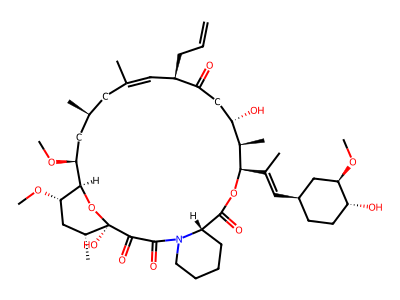
Tacrolimus
他克莫司
Also known as: FK-506, FK 506, FK506, Fujimycin, Prograf, Protopic, Advagraf, FR-900506
Tacrolimus (CAS 104987-11-3) is a compound in the Organic Compounds category listed in the Jingsj chemical database. It has the molecular formula C44H69NO12 and a molecular weight of 804.018 g/mol. It is also known as FK-506, FK 506 and FK506. Key properties include a melting point of 113-115°C, a boiling point of 871.7±75.0 °C at 760 mmHg, a density of 1.2±0.1 g/cm3 and a flash point of 481.0±37.1 °C. It is classified under GHS with signal word Danger and hazard statements H225 — Highly flammable liquid and vapour, H302 — Harmful if swallowed and H312 — Harmful in contact with skin. No supplier offers are currently listed; request a quote. Record last updated Aug 21, 2026.
- CAS No.
- 104987-11-3
- Jingsj CID
- J-18601-6
- Molecular Formula
- C44H69NO12
- Chinese Name
- 他克莫司
- Molecular Weight
- 804.018 g/mol
- Category
- Organic Compounds
- Last updated
- 8/21/2026
No offers for this compound yet.
Request a quotePhysicochemical Properties
| Melting Point | 113-115°C |
|---|---|
| Boiling Point | 871.7±75.0 °C at 760 mmHg |
| Density | 1.2±0.1 g/cm3 |
| Flash Point | 481.0±37.1 °C |
| Exact Mass | 803.481995 |
| PSA | 178.36000 |
| LogP | 3.96 |
| Vapor Pressure | 0.0±0.6 mmHg at 25°C |
| Refractive Index | 1.549 |
| Additional Property | DMSO: >3 mg/mL |
GHS Safety & Compliance
- H225 — Highly flammable liquid and vapour
- H302 — Harmful if swallowed
- H312 — Harmful in contact with skin
- H332 — Harmful if inhaled
- H319 — Causes serious eye irritation
Activity & Biological Data
| Target | PP2B (calcineurin phosphatase)[1] Autophagy inducer[2] |
|---|---|
| Additional Information | [1]. Thomson AW, et al. Mode of action of Tacrolimus (FK506): molecular and cellular mechanisms. Ther Drug Monit. 1995 Dec;17(6):584-91. [2]. Vogel KR, et al. mTOR inhibitors rescue premature lethality and attenuate dysregulation of GABAergic/glutamatergic transcription in murine succinate semialdehyde dehydrogenase deficiency (SSADHD), a disorder of GABA metabolism. J Inherit Metab Dis. 2016 Nov;39(6):877-886. [3]. Zhu H, et al. Tacrolimus promotes hepatocellular carcinoma and enhances CXCR4/SDF 1α expression in vivo. Mol Med Rep. 2014 Aug;10(2):585-92. [4]. Okada Y, et al. Tacrolimus ameliorates dextran sulfate sodium-induced colitis in mice: implication of interferon-γ and interleukin-1β suppression. Biol Pharm Bull. 2011;34(12):1823-7. [5]. Yuwei He, et al. Drug targeting through platelet membrane-coated nanoparticles for the treatment of rheumatoid arthritis. Nano Res. 30 June 2018. |
Frequently Asked Questions
What is the CAS number of Tacrolimus?
The CAS number of Tacrolimus is 104987-11-3.
What are the molecular formula and molecular weight of Tacrolimus?
Tacrolimus has molecular formula C44H69NO12 and molecular weight 804.018 g/mol.
Is Tacrolimus hazardous?
Tacrolimus has GHS signal word Danger and hazard statements H225 — Highly flammable liquid and vapour; H302 — Harmful if swallowed; H312 — Harmful in contact with skin.
What are the upstream and downstream products of Tacrolimus?
For Tacrolimus, Upstream Products: 24,32-Bis-O-(tert-butyldimethylsilyl)-FK-506; Downstream Products: L-Pipecolic acid.
Data compiled from public chemical databases and supplier catalogs; supplier offers are provided by suppliers.
Last updated:
How to cite: Jingsj. "Tacrolimus (CAS 104987-11-3)". Jingsj Chemical Database. https://www.jingsj.com/compound/J-18601-6 (accessed 2026-10-28).
Data for reference only; verify specifications, grades and regulatory status with suppliers before purchase.