
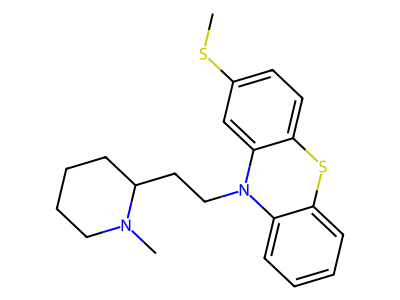
Thioridazine
Also known as: 10-[2-(1-Methyl-2-piperidinyl)ethyl]-2-(methylsulfanyl)-10H-phenothiazine, 10-[2-(1-Methyl-2-piperidinyl)ethyl]-2-(methylthio)-10H-phenothiazine, 10-[2-(1-Methyl-2-piperidyl)]-2-[methylthio]phenothiazine, 10-[2-(1-Methylpiperidin-2-yl)ethyl]-2-(methylsulfanyl)-10H-phenothiazine, 10-[2-(1-methylpiperidin-2-yl)ethyl]-2-(methylthio)-10H-phenothiazine, 10-[2-(1-methylpiperidin-2-yl)ethyl]-2-methylsulfanylphenothiazine, 2-Methylmercapto-10-[2-(N-methyl-2-piperidyl)ethyl]phenothiazine, 3-Methylmercapto-N-[2'-(N'-methyl-2-piperidyl)ethyl]phenothiazine, Thioril, Mellaril, Melleril, UNII:N3D6TG58NI, dl-Thioridazine
Thioridazine (CAS 50-52-2) is a compound in the Organic Compounds category listed in the Jingsj chemical database. It has the molecular formula C21H26N2S2 and a molecular weight of 370.574 g/mol. Key properties include a melting point of 72-74°, a boiling point of 515.7±50.0 °C at 760 mmHg, a density of 1.2±0.1 g/cm3 and a flash point of 265.7±30.1 °C. It is classified under GHS with signal word Danger and hazard statements H225 — Highly flammable liquid and vapour, H301 — Toxic if swallowed and H311 — Toxic in contact with skin. No supplier offers are currently listed; request a quote. Record last updated Aug 21, 2026.
- CAS No.
- 50-52-2
- Jingsj CID
- J-9651-5
- Molecular Formula
- C21H26N2S2
- Molecular Weight
- 370.574 g/mol
- Category
- Organic Compounds
- Last updated
- 8/21/2026
No offers for this compound yet.
Request a quotePhysicochemical Properties
| Melting Point | 72-74° |
|---|---|
| Boiling Point | 515.7±50.0 °C at 760 mmHg |
| Density | 1.2±0.1 g/cm3 |
| Flash Point | 265.7±30.1 °C |
| Exact Mass | 370.153748 |
| PSA | 57.08000 |
| LogP | 6.13 |
| Vapor Pressure | 0.0±1.3 mmHg at 25°C |
| Refractive Index | 1.677 |
| Additional Property | Practically insoluble in water, very soluble in methylene chloride, freely soluble in methanol, soluble in ethanol (96 per cent). |
GHS Safety & Compliance
- H225 — Highly flammable liquid and vapour
- H301 — Toxic if swallowed
- H311 — Toxic in contact with skin
- H331 — Toxic if inhaled
- H370 — Causes damage to organs
- H412 — Harmful to aquatic life with long lasting effects
Activity & Biological Data
| Additional Information | [1]. Tschanz JT, et, al. Atypical antipsychotic drugs block selective components of amphetamine-induced stereotypy. Pharmacol Biochem Behav. 1988 Nov;31(3):519-22. [2]. Mu J, et, al. Thioridazine, an antipsychotic drug, elicits potent antitumor effects in gastric cancer. Oncol Rep. 2014 May;31(5):2107-14. [3]. Kang S, et, al. Thioridazine induces apoptosis by targeting the PI3K/Akt/mTOR pathway in cervical and endometrial cancer cells. Apoptosis. 2012 Sep;17(9):989-97. [4]. Loehr AR, et, al. Targeting Cancer Stem Cells with Differentiation Agents as an Alternative to Genotoxic Chemotherapy for the Treatment of Malignant Testicular Germ Cell Tumors. Cancers (Basel). 2021 Apr 23;13(9):2045. |
|---|
Frequently Asked Questions
What is the CAS number of Thioridazine?
The CAS number of Thioridazine is 50-52-2.
What are the molecular formula and molecular weight of Thioridazine?
Thioridazine has molecular formula C21H26N2S2 and molecular weight 370.574 g/mol.
Is Thioridazine hazardous?
Thioridazine has GHS signal word Danger and hazard statements H225 — Highly flammable liquid and vapour; H301 — Toxic if swallowed; H311 — Toxic in contact with skin.
What are the upstream and downstream products of Thioridazine?
For Thioridazine, Upstream Products: 2-Methylthiophenothiazine, 3-(Methylthio)-N-phenylaniline, 3-(Methylthio)aniline; Downstream Products: Mesoridazine, sulforidazine.
Data compiled from public chemical databases such as PubChem and supplier catalogs; supplier offers are provided by suppliers.
Last updated:
How to cite: Jingsj. "Thioridazine (CAS 50-52-2)". Jingsj Chemical Database. https://www.jingsj.com/compound/J-9651-5 (accessed 2026-11-09).
Data for reference only; verify product details with suppliers before purchase.