
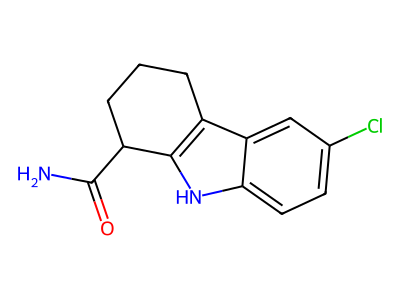
Selisistat (EX 527)
Also known as: (S)-6-chloro-2,3,4,9-tetrahydro-1H-carbazole-1-carboxamide, 1H-Carbazole-1-carboxamide, 6-chloro-2,3,4,9-tetrahydro-, 6-CHLORO-2,3,4,9-TETRAHYDRO-1H-CARBAZOLE-1-CARBOXAMIDE, 6-CHLORO-2,3,4,9-TETRAHYDRO-1H-CARBAZOLE-1-CARBOXAMIDE, >95%, 6-Chlor-1,2,3,4-tetrahydrocarbazol-1-carboxamid, 6-Chloro-2,3,4,9-tetrahydro-1H-carbazole-1-carboxamide, 6-Chloro-2,3,4,9-tetrahydro-1H-carbazole-1-carboxamide EX-527 Selisistat, 6-Chloro-2,3,4,9-tetrahydro-1H-carbazole-1-carboxamide,racemic, 6-chloro-1,2,3,4,9-pentahydro-4aH-carbazolecarboxamide, 6-chloro-2,3,4,9-tetrahydro-1-H-carbazole-1-carboxamide, 6-chloro-2,3,4,9-tetrahydro-1H-carbazole-1-carboxamide, 6-chloro-2,3,4,9-tetrahydro-1H-carbazole-1-carboxylic acid amide, EX 527, EX 527 (SEN0014196), EX 527, >=98%, SEN0014196, SIRT1 Inhibitor III, UNII:L19ECD5014
Selisistat (EX 527) (CAS 49843-98-3) is a compound in the Organic Compounds category listed in the Jingsj chemical database. It has the molecular formula C13H13ClN2O and a molecular weight of 248.708 g/mol. Key properties include a melting point of 179.0 to 183.0 °C, a boiling point of 531.7±38.0 °C at 760 mmHg, a density of 1.4±0.1 g/cm3 and a flash point of 275.4±26.8 °C. It is classified under GHS with signal word Danger and hazard statements H301 — Toxic if swallowed and H319 — Causes serious eye irritation. No supplier offers are currently listed; request a quote. Record last updated Aug 21, 2026.
- CAS No.
- 49843-98-3
- Jingsj CID
- J-89946-7
- Molecular Formula
- C13H13ClN2O
- Molecular Weight
- 248.708 g/mol
- Category
- Organic Compounds
- Last updated
- 8/21/2026
No offers for this compound yet.
Request a quotePhysicochemical Properties
| Melting Point | 179.0 to 183.0 °C |
|---|---|
| Boiling Point | 531.7±38.0 °C at 760 mmHg |
| Density | 1.4±0.1 g/cm3 |
| Flash Point | 275.4±26.8 °C |
| Exact Mass | 248.071640 |
| PSA | 58.88000 |
| LogP | 2.22 |
| Appearance | white to beige |
| Vapor Pressure | 0.0±1.4 mmHg at 25°C |
| Refractive Index | 1.688 |
| Storage Conditions | Store at +4°C |
| Additional Property | Soluble in dimethyl sulfoxide, ethanol and dimethyl formamide. |
GHS Safety & Compliance
- H301 — Toxic if swallowed
- H319 — Causes serious eye irritation
Activity & Biological Data
| Target | SIRT1:98 nM (IC50) SIRT2:19.6 μM (IC50) SIRT3:48.7 μM (IC50) |
|---|---|
| Additional Information | [1]. Solomon JM, et al. Inhibition of SIRT1 catalytic activity increases p53 acetylation but does not alter cell survival following DNA damage. Mol Cell Biol. 2006 Jan;26(1):28-38. [2]. Jia Y, et al. SIRT1 is a regulator in high glucose-induced inflammatory response in RAW264.7 cells. PLoS One. 2015 Mar 20;10(3):e0120849. [3]. Wang X, et al. Resveratrol attenuates microvascular inflammation in sepsis via SIRT-1-Induced modulation of adhesion molecules in ob/ob mice. Obesity (Silver Spring). 2015 Jun;23(6):1209-17. [4]. Napper AD, et al. Discovery of indoles as potent and selective inhibitors of the deacetylase SIRT1. J Med Chem. 2005 Dec 15;48(25):8045-54. |
Frequently Asked Questions
What is the CAS number of Selisistat (EX 527)?
The CAS number of Selisistat (EX 527) is 49843-98-3.
What are the molecular formula and molecular weight of Selisistat (EX 527)?
Selisistat (EX 527) has molecular formula C13H13ClN2O and molecular weight 248.708 g/mol.
Is Selisistat (EX 527) hazardous?
Selisistat (EX 527) has GHS signal word Danger and hazard statements H301 — Toxic if swallowed; H319 — Causes serious eye irritation.
What are the upstream and downstream products of Selisistat (EX 527)?
For Selisistat (EX 527), Upstream Products: ethyl 6-chloro-2,3,4,9-tetrahydro-1H-carbazole-1-carboxylate, Ethyl 2-oxocyclohexanecarboxylate, ethyl 3-bromo-2-oxocyclohexanecarboxylate.
Data compiled from public chemical databases such as PubChem and supplier catalogs; supplier offers are provided by suppliers.
Last updated:
How to cite: Jingsj. "Selisistat (EX 527) (CAS 49843-98-3)". Jingsj Chemical Database. https://www.jingsj.com/compound/J-89946-7 (accessed 2026-11-09).
Data for reference only; verify product details with suppliers before purchase.