
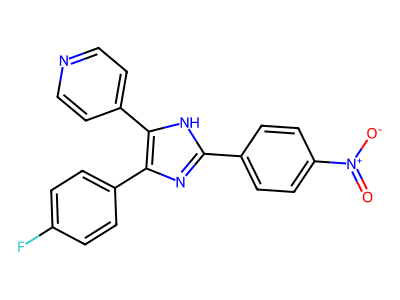
PD 169316
Also known as: 4-(4-Fluorophenyl)-2-(4-nitrophenyl)-5-(4-pyridyl)-1H-imidazole, 4-[4-(4-Fluorophenyl)-2-(4-nitrophenyl)-1H-imidazol-5-yl]pyridine, 4-[4-(4-Fluorophenyl)-2-(4-nitrophenyl)-1H-imidazol-5-yl]pyridine PD 169316, 4-[4-(4-fluorophenyl)-2-(4-nitrophenyl)-1H-imidazol-5-yl]pyridine, 4-[5-(4-fluorophenyl)-2-(4-nitrophenyl)-1H-iMidazol-4-yl]pyridine, CS-497, PD 169316 - CAS 152121-53-4 - Calbiochem, PD 169316, >97%, PD169316, PD169316/PD-169316, Pyridine, 4-[4-(4-fluorophenyl)-2-(4-nitrophenyl)-1H-iMidazol-5-yl]-, Pyridine, 4-[4-(4-fluorophenyl)-2-(4-nitrophenyl)-1H-imidazol-5-yl]-
PD 169316 (CAS 152121-53-4) is a compound in the Organic Compounds category listed in the Jingsj chemical database. It has the molecular formula C20H13FN4O2 and a molecular weight of 360.341 g/mol. Key properties include a boiling point of 583.1±50.0 °C at 760 mmHg, a density of 1.4±0.1 g/cm3 and a flash point of 306.4±30.1 °C. It is classified under GHS with signal word Danger and hazard statements H301 — Toxic if swallowed, H315 — Causes skin irritation and H318 — Causes serious eye damage. No supplier offers are currently listed; request a quote. Record last updated Aug 21, 2026.
- CAS No.
- 152121-53-4
- Jingsj CID
- J-89848-6
- Molecular Formula
- C20H13FN4O2
- Molecular Weight
- 360.341 g/mol
- Category
- Organic Compounds
- Last updated
- 8/21/2026
No offers for this compound yet.
Request a quotePhysicochemical Properties
| Boiling Point | 583.1±50.0 °C at 760 mmHg |
|---|---|
| Density | 1.4±0.1 g/cm3 |
| Flash Point | 306.4±30.1 °C |
| Exact Mass | 360.102264 |
| PSA | 87.39000 |
| LogP | 5.32 |
| Appearance | yellow solid |
| Vapor Pressure | 0.0±1.6 mmHg at 25°C |
| Refractive Index | 1.651 |
| Storage Conditions | -20℃ |
GHS Safety & Compliance
- H301 — Toxic if swallowed
- H315 — Causes skin irritation
- H318 — Causes serious eye damage
- H335 — May cause respiratory irritation
Activity & Biological Data
| Target | IC50: 89 nM (p38 MAPK)[5] |
|---|---|
| Additional Information | [1]. Fu Y, et al. The p38 MAPK inhibitor, PD169316, inhibits transforming growth factor beta-induced Smad signaling in human ovarian cancer cells. Biochem Biophys Res Commun. 2003 Oct 17;310(2):391-7. [2]. Hu W, et al. Suppression of Nestin reveals a critical role for p38-EGFR pathway in neural progenitor cell proliferation. Oncotarget. 2016 Dec 27;7(52):87052-87063. [3]. Kummer JL, et al. Apoptosis induced by withdrawal of trophic factors is mediated by p38 mitogen-activated protein kinase. J Biol Chem. 1997 Aug 15;272(33):20490-4. [4]. PD 169316, et al. ERK and p38 inhibitors attenuate memory deficits and increase CREB phosphorylation and PGC-1α levels in Aβ-injected rats. Behav Brain Res. 2012 Jun 15;232(1):165-73. [5]. Ayumi Iwasaki, et al. Molecular Mechanism Responsible for Fibronectin-controlled Alterations in Matrix Stiffness in Advanced Chronic Liver Fibrogenesis. THE JOURNAL OF BIOLOGICAL CHEMISTRY VOL. 291, NO. 1, pp. 72-88, January 1, 2016 [6]. Zhang Z, et al. PD169316, a specific p38 inhibitor, shows antiviral activity against Enterovirus71. Virology. 2017 Aug;508:150-158. |
Frequently Asked Questions
What is the CAS number of PD 169316?
The CAS number of PD 169316 is 152121-53-4.
What are the molecular formula and molecular weight of PD 169316?
PD 169316 has molecular formula C20H13FN4O2 and molecular weight 360.341 g/mol.
Is PD 169316 hazardous?
PD 169316 has GHS signal word Danger and hazard statements H301 — Toxic if swallowed; H315 — Causes skin irritation; H318 — Causes serious eye damage.
What are the upstream and downstream products of PD 169316?
For PD 169316, Upstream Products: 4-Pyridinemethanol, 4-Fluorobenzoyl chloride, 4-Nitrobenzaldehyde.
Data compiled from public chemical databases such as PubChem and supplier catalogs; supplier offers are provided by suppliers.
Last updated:
How to cite: Jingsj. "PD 169316 (CAS 152121-53-4)". Jingsj Chemical Database. https://www.jingsj.com/compound/J-89848-6 (accessed 2026-11-09).
Data for reference only; verify product details with suppliers before purchase.