
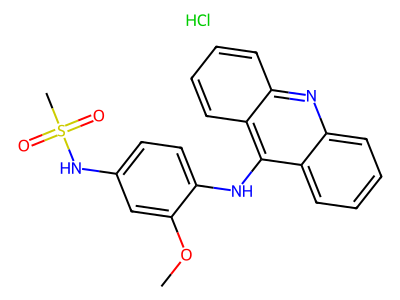
Amsacrine hydrochloride
Also known as: acridinyl anisidide, m-AMSA, 4-(9-Acridinylamino)-N-(methanesulfonyl)-m-anisidine hydrochloride, Methanesulfon-m-anisidide 4'-(9-acridinylamino)-, Methanesulfonamide, N-4-(9-acridinylamino)-3-methoxyphenyl-, monohydrochloride, Methanesulfone-m-anisidine-4'-[(9-acridinyl)amino] hydrochloride, Methansulfon-m-aniside, 4'-(9-acridinylamino)-, monohydrochloride, N-[4-(acridin-9-ylamino)-3-methoxyphenyl]methanesulfonamide hydrochloride, Amsacrine (hydrochloride), M-AMSA HYDROCHLORIDE, M-AMSA, HCL
Amsacrine hydrochloride (CAS 54301-15-4) is a compound in the Organic Acids category listed in the Jingsj chemical database. It has the molecular formula C21H20ClN3O3S and a molecular weight of 429.92000 g/mol. Key properties include a melting point of 197-199ºC, a boiling point of 563ºC at 760 mmHg and a flash point of 294.3ºC. It is classified under GHS with signal word Danger and hazard statements H301 — Toxic if swallowed, H315 — Causes skin irritation and H319 — Causes serious eye irritation. No supplier offers are currently listed; request a quote. Record last updated Aug 21, 2026.
- CAS No.
- 54301-15-4
- Jingsj CID
- J-656-4
- Molecular Formula
- C21H20ClN3O3S
- Molecular Weight
- 429.92000 g/mol
- Category
- Organic Acids
- Last updated
- 8/21/2026
No offers for this compound yet.
Request a quotePhysicochemical Properties
| Melting Point | 197-199ºC |
|---|---|
| Boiling Point | 563ºC at 760 mmHg |
| Flash Point | 294.3ºC |
| Exact Mass | 429.09100 |
| PSA | 88.70000 |
| LogP | 6.54050 |
GHS Safety & Compliance
- H301 — Toxic if swallowed
- H315 — Causes skin irritation
- H319 — Causes serious eye irritation
- H335 — May cause respiratory irritation
Activity & Biological Data
| Target | Topoisomerase II |
|---|---|
| Additional Information | [1]. Thomas D, et al. Inhibition of cardiac HERG currents by the DNA topoisomerase II inhibitor amsacrine: mode of action. Br J Pharmacol. 2004 Jun;142(3):485-94. [2]. Attia SM. Molecular cytogenetic evaluation of the mechanism of genotoxic potential of amsacrine and nocodazole in mouse bone marrow cells. J Appl Toxicol. 2013 Jun;33(6):426-33. [3]. Kao-Shan CS, et al. Cytogenetic effects of amsacrine on human lymphocytes in vivo and in vitro. Cancer Treat Rep. 1984 Jul-Aug;68(7-8):989-97. [4]. Lee YC, et al. Amsacrine-induced apoptosis of human leukemia U937 cells is mediated by the inhibition of AKT- and ERK-induced stabilization of MCL1. Apoptosis. 2017 Mar;22(3):406-420. |
Customs & Trade Information
| HS Code | 2935009090 |
|---|---|
| Summary | 2935009090 other sulphonamides VAT:17.0% Tax rebate rate:9.0% Supervision conditions:none MFN tariff:6.5% General tariff:35.0% |
Frequently Asked Questions
What is the CAS number of Amsacrine hydrochloride?
The CAS number of Amsacrine hydrochloride is 54301-15-4.
What are the molecular formula and molecular weight of Amsacrine hydrochloride?
Amsacrine hydrochloride has molecular formula C21H20ClN3O3S and molecular weight 429.92000 g/mol.
Is Amsacrine hydrochloride hazardous?
Amsacrine hydrochloride has GHS signal word Danger and hazard statements H301 — Toxic if swallowed; H315 — Causes skin irritation; H319 — Causes serious eye irritation.
What are the upstream and downstream products of Amsacrine hydrochloride?
For Amsacrine hydrochloride, Upstream Products: 9-Chloroacridine, N-(4-Amino-3-methoxyphenyl)methanesulfonamide, 3-Methoxy-4-nitroaniline.
Data compiled from public chemical databases such as PubChem and supplier catalogs; supplier offers are provided by suppliers.
Last updated:
How to cite: Jingsj. "Amsacrine hydrochloride (CAS 54301-15-4)". Jingsj Chemical Database. https://www.jingsj.com/compound/J-656-4 (accessed 2026-11-09).
Data for reference only; verify product details with suppliers before purchase.