
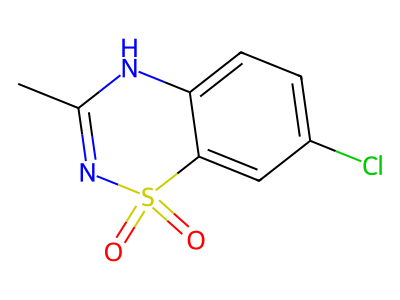
Diazoxide
Also known as: Hyperstat, Proglycem, Eudemine, Mutabase, Sch-6783, NSC-64198, Proglicem, Dizoxide, Diazoxido, Diazossido, 7-Chloro-3-methyl-2H-1,2,4-benzothiadiazine 1,1-dioxide, 3-Methyl-7-chloro-1,2,4-benzothiadiazine 1,1-dioxide
Diazoxide (CAS 364-98-7) is a compound in the Solvents category listed in the Jingsj chemical database. It has the molecular formula C8H7ClN2O2S and a molecular weight of 230.671 g/mol. Key properties include a melting point of >310°C, a boiling point of 414.8±47.0 °C at 760 mmHg, a density of 1.6±0.1 g/cm3 and a flash point of 204.6±29.3 °C. It is classified under GHS with signal word Warning and hazard statements H302 — Harmful if swallowed, H315 — Causes skin irritation and H319 — Causes serious eye irritation. No supplier offers are currently listed; request a quote. Record last updated Nov 3, 2026.
- CAS No.
- 364-98-7
- Jingsj CID
- J-46008-8
- Molecular Formula
- C8H7ClN2O2S
- Molecular Weight
- 230.671 g/mol
- Category
- Solvents
- Last updated
- 11/3/2026
No offers for this compound yet.
Request a quotePhysicochemical Properties
| Melting Point | >310°C |
|---|---|
| Boiling Point | 414.8±47.0 °C at 760 mmHg |
| Density | 1.6±0.1 g/cm3 |
| Flash Point | 204.6±29.3 °C |
| Exact Mass | 229.991669 |
| PSA | 66.91000 |
| LogP | 1.08 |
| Vapor Pressure | 0.0±1.0 mmHg at 25°C |
| Refractive Index | 1.692 |
| Storage Conditions | Store at RT |
| Additional Property | 0.1 M NaOH: soluble |
GHS Safety & Compliance
- H302 — Harmful if swallowed
- H315 — Causes skin irritation
- H319 — Causes serious eye irritation
- H335 — May cause respiratory irritation
Activity & Biological Data
| Additional Information | [1]. Coetzee WA, et al. Multiplicity of effectors of the cardioprotective agent, diazoxide. Pharmacol Ther. 2013 Nov;140(2):167-75. [2]. Virgili N, et al. K(ATP) channel opener diazoxide prevents neurodegeneration: a new mechanism of action viaantioxidative pathway activation. PLoS One. 2013 Sep 11;8(9):e75189. [3]. Wu H, et al. Diazoxide Attenuates Postresuscitation Brain Injury in a Rat Model of Asphyxial Cardiac Arrest by Opening Mitochondrial ATP-Sensitive Potassium Channels. Biomed Res Int. 2016;2016:1253842. [4]. Chowdhury UR, et al. ATP-sensitive potassium (K(ATP)) channel openers diazoxide and nicorandil lower intraocular pressure in vivo. Invest Ophthalmol Vis Sci. 2013 Jul 22;54(7):4892-9. |
|---|
Customs & Trade Information
| HS Code | 2933990090 |
|---|---|
| Summary | 2933990090. heterocyclic compounds with nitrogen hetero-atom(s) only. VAT:17.0%. Tax rebate rate:13.0%. . MFN tariff:6.5%. General tariff:20.0% |
Frequently Asked Questions
What is the CAS number of Diazoxide?
The CAS number of Diazoxide is 364-98-7.
What are the molecular formula and molecular weight of Diazoxide?
Diazoxide has molecular formula C8H7ClN2O2S and molecular weight 230.671 g/mol.
Is Diazoxide hazardous?
Diazoxide has GHS signal word Warning and hazard statements H302 — Harmful if swallowed; H315 — Causes skin irritation; H319 — Causes serious eye irritation.
What are the upstream and downstream products of Diazoxide?
For Diazoxide, Upstream Products: N-(2-sulfamoylphenyl)acetamide, 4-Chloroaniline, 2-Aminobenzenesulfonamide.
Data compiled from public chemical databases such as PubChem and supplier catalogs; supplier offers are provided by suppliers.
Last updated:
How to cite: Jingsj. "Diazoxide (CAS 364-98-7)". Jingsj Chemical Database. https://www.jingsj.com/compound/J-46008-8 (accessed 2026-11-06).
Data for reference only; verify product details with suppliers before purchase.