
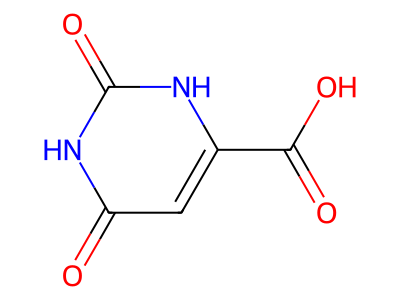
Orotic acid
Also known as: Vitamin B13, 1,2,3,6-Tetrahydro-2,6-dioxo-4-pyrimidinecarboxylic acid, 2,6-Dihydroxy-4-pyrimidinecarboxylic acid, 2,6-Dioxo-1,2,3,6-tetrahydropyrimidine-4-carboxylic acid, 6-Carboxyuracil, Uracil-6-carboxylic acid, Uracil-4-carboxylic acid, 6-Uracilcarboxylic acid, 2,4-Dihydroxypyrimidine-6-carboxylic acid, Orodin, Orotonin, Oroturic, Orotyl, Whey factor, Animal galactose factor
Orotic acid (CAS 65-86-1) is a compound in the Organic Acids category listed in the Jingsj chemical database. It has the molecular formula C5H4N2O4 and a molecular weight of 156.096 g/mol. Key properties include a melting point of >300°C, a boiling point of 656.9±65.0 °C at 760 mmHg, a density of 1.8±0.1 g/cm3 and a flash point of 351.1±34.3 °C. It is classified under GHS with signal word Warning and hazard statements H302 — Harmful if swallowed, H315 — Causes skin irritation and H319 — Causes serious eye irritation. No supplier offers are currently listed; request a quote. Record last updated Nov 3, 2026.
- CAS No.
- 65-86-1
- Jingsj CID
- J-45640-6
- Molecular Formula
- C5H4N2O4
- Molecular Weight
- 156.096 g/mol
- Category
- Organic Acids
- Last updated
- 11/3/2026
No offers for this compound yet.
Request a quotePhysicochemical Properties
| Melting Point | >300°C |
|---|---|
| Boiling Point | 656.9±65.0 °C at 760 mmHg |
| Density | 1.8±0.1 g/cm3 |
| Flash Point | 351.1±34.3 °C |
| Exact Mass | 156.017105 |
| PSA | 103.02000 |
| LogP | -1.40 |
| Vapor Pressure | 0.0±2.1 mmHg at 25°C |
| Refractive Index | 1.705 |
| Stability | Stable. Incompatible with strong oxidizing agents. |
| Additional Property | Slightly soluble |
GHS Safety & Compliance
- H302 — Harmful if swallowed
- H315 — Causes skin irritation
- H319 — Causes serious eye irritation
- H335 — May cause respiratory irritation
Activity & Biological Data
| Target | Human Endogenous Metabolite |
|---|---|
| Additional Information | [1]. Jung, E.J., K.Y. Lee, and B.H. Lee, Proliferating effect of orotic acid through mTORC1 activation mediated by negative regulation of AMPK in SK-Hep1 hepatocellular carcinoma cells. J Toxicol Sci, 2012. 37(4): p. 813-21. [2]. Manjeshwar, S., et al., The regulation of ribonucleoside diphosphate reductase by the tumor promoter orotic acid in normal rat liver in vivo. Mol Carcinog, 1999. 24(3): p. 188-96. [3]. Cha, J.Y., et al., Effect of betaine on the hepatic damage from orotic acid-induced fatty liver development in rats. J Enzyme Inhib Med Chem, 2011. [4]. Jung, E.J., et al., Role of the AMPK/SREBP-1 pathway in the development of orotic acid-induced fatty liver. J Lipid Res, 2011. 52(9): p. 1617-25. |
Frequently Asked Questions
What is the CAS number of Orotic acid?
The CAS number of Orotic acid is 65-86-1.
What are the molecular formula and molecular weight of Orotic acid?
Orotic acid has molecular formula C5H4N2O4 and molecular weight 156.096 g/mol.
Is Orotic acid hazardous?
Orotic acid has GHS signal word Warning and hazard statements H302 — Harmful if swallowed; H315 — Causes skin irritation; H319 — Causes serious eye irritation.
What are the upstream and downstream products of Orotic acid?
For Orotic acid, Upstream Products: L-Dihydroorotic acid, (Cyanomethyl)urea, Glyoxylic acid; Downstream Products: 2,6-Dimethoxypyrimidine-4-carboxylic acid, L-Dihydroorotic acid, 5-Chloro-1,2,3,6-tetrahydro-2,6-dioxo-4-pyrimidinecarboxylic acid.
Data compiled from public chemical databases such as PubChem and supplier catalogs; supplier offers are provided by suppliers.
Last updated:
How to cite: Jingsj. "Orotic acid (CAS 65-86-1)". Jingsj Chemical Database. https://www.jingsj.com/compound/J-45640-6 (accessed 2026-11-09).
Data for reference only; verify product details with suppliers before purchase.