
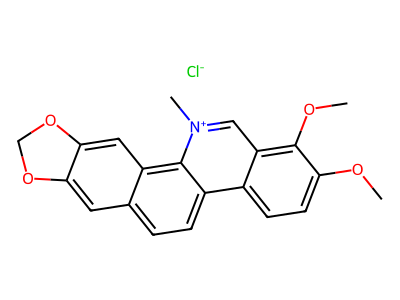
Chelerythrine chloride
Also known as: 1,2-dimethoxy-12-methyl[1,3]benzodioxolo[5,6-c]phenanthridinium chloride, Toddalin chloride, Chelerythrin chloride, CHELERYTHRINE HYDROCHLORIDE, 1,2-Dimethoxy-12-methyl[1,3]dioxolo[4,5]benzo[1,2-c]phenanthridin-12-ium chloride, MFCD00060717
Chelerythrine chloride (CAS 3895-92-9) is a compound in the Organic Bases category listed in the Jingsj chemical database. It has the molecular formula C21H18ClNO4 and a molecular weight of 383.825 g/mol. Key properties include a melting point of 195-205ºC, a boiling point of 711.4ºC at 760 mmHg, a density of 1.36g/cm3 and a flash point of 219.3ºC. It is classified under GHS with signal word Warning and hazard statements H302 — Harmful if swallowed, H312 — Harmful in contact with skin and H315 — Causes skin irritation. No supplier offers are currently listed; request a quote. Record last updated Aug 21, 2026.
- CAS No.
- 3895-92-9
- Jingsj CID
- J-42683-5
- Molecular Formula
- C21H18ClNO4
- Molecular Weight
- 383.825 g/mol
- Category
- Organic Bases
- Last updated
- 8/21/2026
No offers for this compound yet.
Request a quotePhysicochemical Properties
| Melting Point | 195-205ºC |
|---|---|
| Boiling Point | 711.4ºC at 760 mmHg |
| Density | 1.36g/cm3 |
| Flash Point | 219.3ºC |
| Exact Mass | 383.092438 |
| PSA | 40.80000 |
| LogP | 0.72060 |
| Refractive Index | 1.681 |
| Additional Property | DMSO: ≥10 mg/mL |
GHS Safety & Compliance
- H302 — Harmful if swallowed
- H312 — Harmful in contact with skin
- H315 — Causes skin irritation
- H319 — Causes serious eye irritation
- H332 — Harmful if inhaled
- H335 — May cause respiratory irritation
Activity & Biological Data
| Target | PKC:660 nM (IC50) PKA:0.17 mM (IC50) TPK:0.1 mM (IC50) |
|---|---|
| Additional Information | [1]. Chan, et al. Identification of chelerythrine as an inhibitor of BclXL function. J Biol Chem. 2003 Jun 6;278(23):20453-6. [2]. Li W, et al. Effect of Chelerythrine Against Endotoxic Shock in Mice and Its Modulation of Inflammatory Mediators in Peritoneal Macrophages Through the Modulation of Mitogen-Activated Protein Kinase (MAPK) Pathway. Inflammation. 2012 Jul 24. [3]. Pencikova K, et al. Investigation of sanguinarine and chelerythrine effects on LPS-induced inflammatory gene expression in THP-1 cell line. Phytomedicine. 2012 Jul 15;19(10):890-5. Epub 2012 May 14. [4]. Chen XM, et al. Chelerythrine chloride induces apoptosis in renal cancer HEK-293 and SW-839 cell lines. Oncol Lett. 2016 Jun;11(6):3917-3924 [5]. Herbert JM, et al. Chelerythrine is a potent and specific inhibitor of protein kinase C. Biochem Biophys Res Commun. 1990 Nov 15;172(3):993-9. |
Customs & Trade Information
| HS Code | 2933990090 |
|---|---|
| Summary | 2933990090. heterocyclic compounds with nitrogen hetero-atom(s) only. VAT:17.0%. Tax rebate rate:13.0%. . MFN tariff:6.5%. General tariff:20.0% |
Frequently Asked Questions
What is the CAS number of Chelerythrine chloride?
The CAS number of Chelerythrine chloride is 3895-92-9.
What are the molecular formula and molecular weight of Chelerythrine chloride?
Chelerythrine chloride has molecular formula C21H18ClNO4 and molecular weight 383.825 g/mol.
Is Chelerythrine chloride hazardous?
Chelerythrine chloride has GHS signal word Warning and hazard statements H302 — Harmful if swallowed; H312 — Harmful in contact with skin; H315 — Causes skin irritation.
What are the upstream and downstream products of Chelerythrine chloride?
For Chelerythrine chloride, Upstream Products: Dihydrochelerythrine, 6-Oxochelerythrine; Downstream Products: 6-Oxochelerythrine, Dihydrochelerythrine.
Data compiled from public chemical databases such as PubChem and supplier catalogs; supplier offers are provided by suppliers.
Last updated:
How to cite: Jingsj. "Chelerythrine chloride (CAS 3895-92-9)". Jingsj Chemical Database. https://www.jingsj.com/compound/J-42683-5 (accessed 2026-11-09).
Data for reference only; verify product details with suppliers before purchase.