
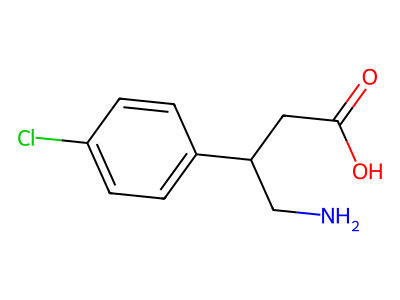
Baclofen
Also known as: 4-Amino-3-(4-chlorophenyl)butanoic acid, 4-Amino-3-(4-chlorophenyl)butyric acid, β-(Aminomethyl)-4-chlorobenzenepropanoic acid, Lioresal, Kemstro, Clofen, Atrofen, baclofen, baclon, β-(4-Chlorophenyl)-γ-aminobutyric acid, β-p-Chlorophenyl-GABA, (R,S)-Baclofen, (±)-Baclofen, DL-Baclofen, Benzenepropanoic acid, β-(aminomethyl)-4-chloro-, MFCD00055143, EINECS 214-486-9, CIBA Ba 34647
Baclofen (CAS 1134-47-0) is a compound in the Organohalogen Compounds category listed in the Jingsj chemical database. It has the molecular formula C10H12ClNO2 and a molecular weight of 213.661 g/mol. Key properties include a melting point of 208-210°C, a boiling point of 364.3±32.0 °C at 760 mmHg, a density of 1.3±0.1 g/cm3 and a flash point of 174.1±25.1 °C. It is classified under GHS with signal word Danger and hazard statements H301 — Toxic if swallowed, H315 — Causes skin irritation and H317 — May cause an allergic skin reaction. No supplier offers are currently listed; request a quote. Record last updated Aug 21, 2026.
- CAS No.
- 1134-47-0
- Jingsj CID
- J-42139-9
- Molecular Formula
- C10H12ClNO2
- Molecular Weight
- 213.661 g/mol
- Category
- Organohalogen Compounds
- Last updated
- 8/21/2026
No offers for this compound yet.
Request a quotePhysicochemical Properties
| Melting Point | 208-210°C |
|---|---|
| Boiling Point | 364.3±32.0 °C at 760 mmHg |
| Density | 1.3±0.1 g/cm3 |
| Flash Point | 174.1±25.1 °C |
| Exact Mass | 213.055649 |
| PSA | 63.32000 |
| LogP | 1.56 |
| Vapor Pressure | 0.0±0.9 mmHg at 25°C |
| Refractive Index | 1.577 |
| Additional Property | 1 M HCl: 50 mg/mL |
GHS Safety & Compliance
- H301 — Toxic if swallowed
- H315 — Causes skin irritation
- H317 — May cause an allergic skin reaction
- H319 — Causes serious eye irritation
- H334 — May cause allergy or asthma symptoms if inhaled
- H335 — May cause respiratory irritation
- H360 — May damage fertility or the unborn child
Activity & Biological Data
| Additional Information | [1]. Bexis, S., et al., Baclofen prevents MDMA-induced rise in core body temperature in rats. Drug Alcohol Depend, 2004. 74(1): p. 89-96. [2]. Perry, H.E., et al., Baclofen overdose: drug experimentation in a group of adolescents. Pediatrics, 1998. 101(6): p. 1045-8. |
|---|
Customs & Trade Information
| HS Code | 2922499990 |
|---|---|
| Summary | HS:2922499990 other amino-acids, other than those containing more than one kind of oxygen function, and their esters; salts thereof VAT:17.0% Tax rebate rate:9.0% Supervision conditions:AB(certificate of inspection for goods inward,certificate of inspection for goods outward) MFN tariff:6.5% General tariff:30.0% |
Frequently Asked Questions
What is the CAS number of Baclofen?
The CAS number of Baclofen is 1134-47-0.
What are the molecular formula and molecular weight of Baclofen?
Baclofen has molecular formula C10H12ClNO2 and molecular weight 213.661 g/mol.
Is Baclofen hazardous?
Baclofen has GHS signal word Danger and hazard statements H301 — Toxic if swallowed; H315 — Causes skin irritation; H317 — May cause an allergic skin reaction.
What are the upstream and downstream products of Baclofen?
For Baclofen, Upstream Products: 4-(4-Chlorophenyl)pyrrolidin-2-one, 1-(4-Chlorophenyl)ethanone, (4-Chlorophenyl)boronic acid; Downstream Products: 4-(4-Chlorophenyl)pyrrolidin-2-one, 3-(4-Chlorophenyl)pyrrolidine, 1-Chlorooctane.
Data compiled from public chemical databases such as PubChem and supplier catalogs; supplier offers are provided by suppliers.
Last updated:
How to cite: Jingsj. "Baclofen (CAS 1134-47-0)". Jingsj Chemical Database. https://www.jingsj.com/compound/J-42139-9 (accessed 2026-11-06).
Data for reference only; verify product details with suppliers before purchase.