
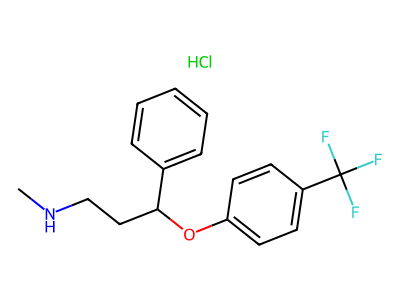
Fluoxetine hydrochloride
Also known as: Fluoxetine HCl, N-Methyl-3-phenyl-3-[4-(trifluoromethyl)phenoxy]propan-1-amine hydrochloride, (±)-N-Methyl-γ-[4-(trifluoromethyl)phenoxy]benzenepropanamine hydrochloride, Prozac, Sarafem, Reneuron
Fluoxetine hydrochloride (CAS 56296-78-7) is a compound in the Organic Acids category listed in the Jingsj chemical database. It has the molecular formula C17H19ClF3NO and a molecular weight of 345.787 g/mol. Key properties include a melting point of 158-159°C, a boiling point of 395.1ºC at 760mmHg and a flash point of 192.8ºC. It is classified under GHS with signal word Danger and hazard statements H302 — Harmful if swallowed, H318 — Causes serious eye damage and H400 — Very toxic to aquatic life. No supplier offers are currently listed; request a quote. Record last updated Aug 21, 2026.
- CAS No.
- 56296-78-7
- Jingsj CID
- J-37895-0
- Molecular Formula
- C17H19ClF3NO
- Molecular Weight
- 345.787 g/mol
- Category
- Organic Acids
- Last updated
- 8/21/2026
No offers for this compound yet.
Request a quotePhysicochemical Properties
| Melting Point | 158-159°C |
|---|---|
| Boiling Point | 395.1ºC at 760mmHg |
| Flash Point | 192.8ºC |
| Exact Mass | 345.110718 |
| PSA | 21.26000 |
| LogP | 5.62790 |
GHS Safety & Compliance
- H302 — Harmful if swallowed
- H318 — Causes serious eye damage
- H400 — Very toxic to aquatic life
Activity & Biological Data
| Additional Information | [1]. Malberg JE, et al. Cell proliferation in adult hippocampus is decreased by inescapable stress: reversal by fluoxetine treatment. Neuropsychopharmacology. 2003 Sep;28(9):1562-71 [2]. Kodama M, et al. Chronic olanzapine or fluoxetine administration increases cell proliferation in hippocampus and prefrontal cortex of adult rat. Biol Psychiatry. 2004 Oct 15;56(8):570-80. [3]. Wang JW, et al. Chronic fluoxetine stimulates maturation and synaptic plasticity of adult-born hippocampal granule cells. J Neurosci. 2008 Feb 6;28(6):1374-84. [4]. Bymaster FP, et al. Fluoxetine, but not other selective serotonin uptake inhibitors, increases norepinephrine and dopamine extracellular levels in prefrontal cortex. Psychopharmacology (Berl). 2002 Apr;160(4):353-61 [5]. Zhang W, et al. Synergistic effects of olanzapine and other antipsychotic agents in combination with fluoxetine on norepinephrine and dopamine release in rat prefrontal cortex. Neuropsychopharmacology. 2000 Sep;23(3):250-62. [6]. Su WJ, et al. Antidiabetic drug glyburide modulates depressive-like behavior comorbid with insulin resistance. J Neuroinflammation. 2017 Oct 30;14(1):210. |
|---|
Customs & Trade Information
| HS Code | 2922299090 |
|---|---|
| Summary | 2922299090. other amino-naphthols and other amino-phenols, other than those containing more than one kind of oxygen function, their ethers and esters; salts thereof. VAT:17.0%. Tax rebate rate:13.0%. . MFN tariff:6.5%. General tariff:30.0% |
Frequently Asked Questions
What is the CAS number of Fluoxetine hydrochloride?
The CAS number of Fluoxetine hydrochloride is 56296-78-7.
What are the molecular formula and molecular weight of Fluoxetine hydrochloride?
Fluoxetine hydrochloride has molecular formula C17H19ClF3NO and molecular weight 345.787 g/mol.
Is Fluoxetine hydrochloride hazardous?
Fluoxetine hydrochloride has GHS signal word Danger and hazard statements H302 — Harmful if swallowed; H318 — Causes serious eye damage; H400 — Very toxic to aquatic life.
What are the upstream and downstream products of Fluoxetine hydrochloride?
For Fluoxetine hydrochloride, Upstream Products: 3-Hydroxy-N-methyl-3-phenyl-propylamine, 4-Iodobenzotrifluoride, Fluoxetine; Downstream Products: Fluoxetine.
Data compiled from public chemical databases such as PubChem and supplier catalogs; supplier offers are provided by suppliers.
Last updated:
How to cite: Jingsj. "Fluoxetine hydrochloride (CAS 56296-78-7)". Jingsj Chemical Database. https://www.jingsj.com/compound/J-37895-0 (accessed 2026-11-09).
Data for reference only; verify product details with suppliers before purchase.