
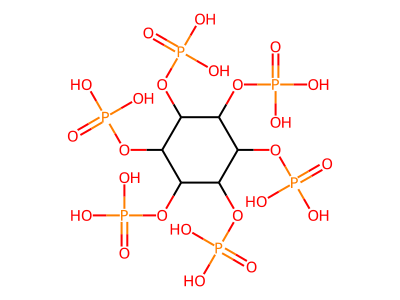
Phytic acid
Also known as: (2,3,4,5,6-Pentaphosphonooxycyclohexyl) dihydrogen phosphate, (2,3,4,5,6-pentaphosphonooxycyclohexyl) dihydrogen phosphate, 1,2,3,4,5,6-Cyclohexanehexol, hexakis(dihydrogen phosphate), sodium salt (1:12), Acidum fyticum, Alkalovert, Alkovert, Dodecasodium 1,2,3,4,5,6-cyclohexanehexayl hexakis(phosphate), EINECS 201-506-6, Fytic acid, Inositol hexaphosphate, Inositol hexaphosphoric acid, 40-50 wt% aqueous solution, Inositol hexaphosphoric acid, 40-50% aqueous solution, MFCD00082309, Phytate, Phytic acid,Inositol hexaphosphoric acid, Phyticacid, Phytine, inocitol hexaphosphate, inositol hexakisphosphate, myo-Inositol hexaphosphate
Phytic acid (CAS 83-86-3) is a compound in the Organic Acids category listed in the Jingsj chemical database. It has the molecular formula C6H18O24P6 and a molecular weight of 660.04 g/mol. Key properties include a boiling point of 1190.7±75.0 °C at 760 mmHg, a density of 2.4±0.1 g/cm3 and a flash point of 673.9±37.1 °C. It is classified under GHS with signal word Danger and hazard statements H290, H314 — Causes severe skin burns and eye damage and H335 — May cause respiratory irritation. No supplier offers are currently listed; request a quote. Record last updated Aug 21, 2026.
- CAS No.
- 83-86-3
- Jingsj CID
- J-37884-0
- Molecular Formula
- C6H18O24P6
- Molecular Weight
- 660.04 g/mol
- Category
- Organic Acids
- Last updated
- 8/21/2026
No offers for this compound yet.
Request a quotePhysicochemical Properties
| Boiling Point | 1190.7±75.0 °C at 760 mmHg |
|---|---|
| Density | 2.4±0.1 g/cm3 |
| Flash Point | 673.9±37.1 °C |
| PSA | 459.42000 |
| LogP | -8.47 |
| Vapor Pressure | 0.0±0.6 mmHg at 25°C |
| Refractive Index | 1.629 |
| Additional Property | MISCIBLE |
GHS Safety & Compliance
- H290
- H314 — Causes severe skin burns and eye damage
- H335 — May cause respiratory irritation
Activity & Biological Data
| Target | Human Endogenous Metabolite |
|---|---|
| Additional Information | [1]. Zhou JR, et al. Phytic acid in health and disease. Crit Rev Food Sci Nutr. 1995 Nov;35(6):495-508. [2]. Muraoka S, et al. Inhibition of xanthine oxidase by phytic acid and its antioxidative action. Life Sci. 2004 Feb 13;74(13):1691-700. [3]. Nawrocka-Musial D, et al. Phytic acid--anticancer nutriceutic. Pol Merkur Lekarski. 2012 Jul;33(193):43-7. [4]. Lv Y, et al. Phytic acid attenuates inflammatory responses and the levels of NF-κB and p-ERK in MPTP-induced Parkinson's disease model of mice. Neurosci Lett. 2015 Jun 15;597:132-6. |
Customs & Trade Information
| HS Code | 2919900090 |
|---|---|
| Summary | 2919900090 other phosphoric esters and their salts, including lactophosphates; their halogenated, sulphonated, nitrated or nitrosated derivatives。supervision conditions:AB(certificate of inspection for goods inward,certificate of inspection for goods outward)。VAT:17.0%。tax rebate rate:9.0%。MFN tariff:6.5%。general tariff:30.0% |
Frequently Asked Questions
What is the CAS number of Phytic acid?
The CAS number of Phytic acid is 83-86-3.
What are the molecular formula and molecular weight of Phytic acid?
Phytic acid has molecular formula C6H18O24P6 and molecular weight 660.04 g/mol.
Is Phytic acid hazardous?
Phytic acid has GHS signal word Danger and hazard statements H290; H314 — Causes severe skin burns and eye damage; H335 — May cause respiratory irritation.
What are the upstream and downstream products of Phytic acid?
For Phytic acid, Upstream Products: L-(-)-chiro-inositol, Inositol, Phosphoric acid; Downstream Products: Inositol, Furfural, Phosphoric acid.
Data compiled from public chemical databases such as PubChem and supplier catalogs; supplier offers are provided by suppliers.
Last updated:
How to cite: Jingsj. "Phytic acid (CAS 83-86-3)". Jingsj Chemical Database. https://www.jingsj.com/compound/J-37884-0 (accessed 2026-11-06).
Data for reference only; verify product details with suppliers before purchase.